Thank you for visiting. This article is the third installment (the finale) in a series explaining the original texts of Norse mythology.
So far, through the two Eddas (Articles 1–2), we have looked at the stories of the gods. In this finale, I take up Norse mythology’s other great pillar — the Völsunga saga, which depicts human heroes. It is the story of the dragon-slaying hero Sigurd and the cursed gold that leads a clan to ruin.
For an overview map of Norse mythology’s original texts as a whole, please see this summary article.
What Kind of Original Text Is the Völsunga Saga?
The “Völsunga saga” is a prose story (saga) composed in 13th-century Iceland.
The basis of its content is the many “heroic poems” contained in the Poetic Edda, explained last time (Article 1). This saga is a reworking of the hero stories, told fragmentarily across the various poems, into a single long clan chronicle. As opposed to the myths of the gods (the Eddas), this depicts a story of human heroes — of pride, betrayal, and revenge.
Worth special mention is its enormous influence on later ages. This story shares a common source with the German epic the Nibelungenlied, and in the 19th century became one of the original texts for Wagner’s opera cycle The Ring of the Nibelung. Further, it is said to be one of the inspirations for the “One Ring” in Tolkien’s The Lord of the Rings, making it a distant ancestor of modern fantasy.
The broad flow of the story is as follows.
The Cursed Gold — the Source of It All
All the tragedy of the story begins with a single piece of cursed gold.
The three gods Odin, Hœnir, and Loki, traveling, caught and ate an otter at a river. But it was the son of a certain man who had changed shape. The angry father seized the three gods and demanded, as compensation, enough gold to cover the otter’s skin.
Loki took the immense gold held by the dwarf “Andvari,” who lived in the river, to pay it. At this time the dwarf was robbed even of the one golden ring (Andvaranaut) he had hidden at the last. The dwarf Andvari, having lost everything, laid a terrible curse as he left: “This ring and gold will bring death to every owner.”
This curse took effect at once. The father who received the gold was killed by his son “Fafnir” over that wealth. And as Fafnir hoarded and guarded the gold for himself, out of his greed he changed into a giant dragon.
The Beginning of the Völsung Clan — Sigmund and Signy
Before entering the story of Sigurd the dragon-slayer, the saga first tells the gruesome beginning of the Völsung clan itself.
“Signy,” the daughter of the clan’s ancestor King Völsung, was married to the king of an enemy land, “Siggeir.” During the wedding feast, a one-eyed old man — a disguised Odin — appeared, thrust a sword deep into the great tree “Barnstokkr” standing in the center of the hall, declared, “I give it to whoever draws it out,” and vanished. The one who alone drew out that sword, which none of the assembled heroes could, was Signy’s brother “Sigmund.”
The envious brother-in-law Siggeir murdered King Völsung and captured his sons. The captive brothers were eaten by a wolf one each night, and at the last only Sigmund survived, by his sister Signy’s wit. Signy’s obsession with revenge for the slaughter of her clan was fierce; she switched forms with a witch to lie with her own brother Sigmund and bore the pure-blooded Völsung avenger, “Sinfjötli.” The brother, sister, and young man, having stored up strength over long years, finally wrapped Siggeir’s hall in flames. And having achieved her purpose, Signy, after confessing everything, walked into the flames herself, together with the husband she hated, and perished. The fierce pride and revenge that the Norse hero tales carry is concentrated in this opening.
The Famed Sword Gram and the Hero Sigurd
The hero of this clan’s blood is the protagonist of this story, “Sigurd.”
His father Sigmund too was a great warrior who fought all his life, but in his last battle, because Odin himself stood in his way spear in hand and shattered that chosen sword, his strength gave out and he fell. The god himself breaks the sword the god had given, ordaining the hero’s death — a solemn scene typical of Norse mythology. Sigurd, born after his father’s death, was raised by the master-smith foster-father “Regin.”
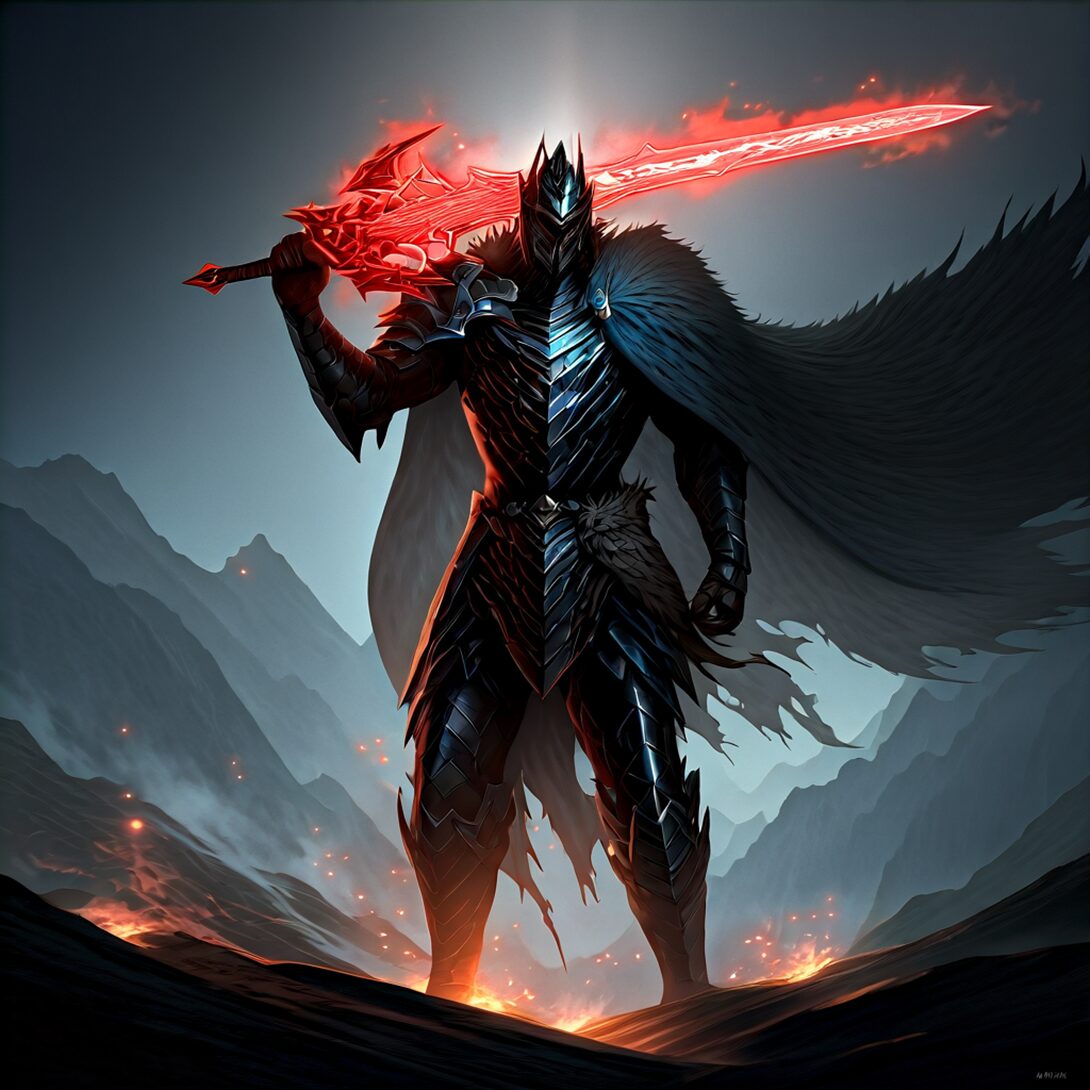
This Regin was in fact the younger brother of the dragon Fafnir. To seize the gold his brother monopolized, he goads Sigurd into slaying Fafnir. Regin reforged the fragments of the broken ancestral sword and forged the famed sword “Gram,” which could cleave even rock and cut in two a tuft of wool floated down a river, and gave it to Sigurd.
Slaying the Dragon Fafnir — Learning the Speech of Birds
With the famed sword Gram in hand, Sigurd heads to the wasteland where the dragon Fafnir guards the gold.
He dug a pit and lay in wait on the path the dragon used to go drink water, and thrust the famed sword Gram up into the belly of the giant dragon passing overhead. Thus Fafnir, the dragon guarding the cursed gold, was slain.
From here comes the most famous scene in Norse mythology. Ordered by his foster-father Regin, Sigurd was roasting the dragon’s heart over fire, and touched it with a finger to check how done it was, and out of the heat put that finger in his mouth. The moment he tasted the dragon’s blood, Sigurd came to understand the speech of birds.
Then he heard the birds perched on a nearby tree speaking thus: “Regin intends to kill Sigurd, to monopolize the gold.” Learning of the betrayal, Sigurd struck down his foster-father Regin first, and obtained the dragon’s gold and that cursed ring Andvaranaut. But by this the curse is passed on to Sigurd himself.
Tragic Love with the Valkyrie Brynhild
Having slain the dragon, on his way back Sigurd finds, atop a mountain ringed by a wall of flame, a single valkyrie, “Brynhild,” sleeping. As punishment for defying the will of the chief god Odin, she had been put to sleep within the flames. Only a hero who can cross the flames can wake her.
Sigurd crosses the flames and wakes her, and the two love each other deeply and swear eternal love. As a token of love, Sigurd gives her that golden ring.
But here the curse bares its fangs. Sigurd, continuing his journey, is received by a certain kingdom (the house of King Gjúki), but its queen gave Sigurd a magic drink that made him lose his memory. Sigurd, having entirely forgotten his love with Brynhild, marries that house’s princess “Gudrun.”
Betrayal, and the Fulfillment of the Curse
The situation grows still more tangled. The house of Gjúki, exploiting Sigurd’s valor, tries to take Brynhild as the wife of the royal brother “Gunnar.” But only Sigurd can cross the wall of flame. So they used magic in a scheme by which Sigurd disguised himself as Gunnar, crossed the flames, and wooed Brynhild in his place.
Thus Brynhild was married to Gunnar, but later learns that the one who truly won her was Sigurd, and that Sigurd was already the husband of another woman. The wrath of Brynhild, betrayed in love and pride, was fierce, and she incited her husband Gunnar and the others to kill Sigurd.
And Brynhild, having had her beloved Sigurd killed through her own grudge, in deep regret and sorrow threw herself into the funeral flames together with Sigurd’s body, following him in death. The cursed gold thus took even the lives of the hero Sigurd and the valkyrie who loved him.
The curse still does not stop. The surviving Gudrun is later married to the mighty king “Atli” (modeled on Attila, king of the Huns). Atli, coveting the gold Sigurd left behind, invited Gudrun’s brothers Gunnar and the others to a feast and tried to make them confess where it was. But the proud brothers would never talk. Gunnar, declaring “the gold shall pass to no one’s hands” and sinking it all in the Rhine, kept playing the harp even when thrown into a snake pit, and is said to have died keeping the secret to the end.
Gudrun’s revenge, her brothers killed, was beyond imagination. She killed her own children, born to Atli, served their flesh to Atli without telling him, then set fire to the hall, killed Atli, and tried to throw herself into the sea. Andvari’s curse did not end with Sigurd’s generation; it never stopped until it had destroyed even the kingdom of the next generation, whole. This very theme — a single ring destroying nations — is what fired the imagination of the later Wagner and Tolkien.
How Strong Are the Characters Here? — The Power Ranking
The gods and heroes appearing in this article are also introduced in strength order in the “Mythology, Religion & Legend Power Ranking.” Enjoy their exploits in the original text alongside their “strength.”
To Learn More
Conclusion
In this article, I explained Norse mythology’s other pillar, the Völsunga saga, in detail, centered on the story of Sigurd the dragon-slayer. How was it?
Beginning with the dwarf’s cursed gold and ring, through the slaying of the dragon Fafnir with the famed sword Gram, the scene of learning the speech of birds from the dragon’s blood, the tragic love with the valkyrie Brynhild, and the tragic end through magic and betrayal — I hope you could feel a tragedy woven from human pride and love and hatred, different again from the myths of the gods. It is no wonder this story still lives on, through Wagner and Tolkien, into modern fantasy.
With this, the three-article series on Norse mythology’s original texts is complete. The world of the gods conveyed by the two Eddas, and the world of heroes conveyed by this Völsunga saga — I hope you have savored both.
For the big picture of Norse mythology’s original texts and the list of other myths and religions, please see the pages below.
I hope you’ll read the next article too.
Also popular with readers
📚 Series: The Original Texts of Norse Mythology (4/4)