Thank you for visiting. This article is the second installment in a series explaining the original texts of Norse mythology.
This time, we look in detail at the original text that conveys Norse mythology most systematically, Snorri’s Edda (the Prose Edda), following its structure.
For an overview map of Norse mythology’s original texts as a whole, please see this summary article.
What Kind of Original Text Is “Snorri’s Edda”?
Snorri’s Edda is a handbook in which the 13th-century Icelandic statesman and historian “Snorri Sturluson” systematically compiled, for young poets, the mythological knowledge that was being lost (around 1220). Against the fragmentary poetry collection the Poetic Edda explained last time, here the myth is organized as story, making it the most reliable original text for understanding Norse mythology.
The author Snorri was Iceland’s foremost magnate and a first-rate man of letters who also wrote the great work Heimskringla (history of the Norwegian kings), but he was caught up in political strife and assassinated in 1241. Worth noting is that, living in an already Christianized Iceland, he sought to write down the pagan myths. So in the preface he takes the position of explaining the myths historically (euhemerism): “Odin and the other Norse gods were in truth excellent humans who came over from near Troy, and were worshipped as gods in later ages.” Here coexist the circumstance that, as a Christian, he could not acknowledge pagan gods as “gods,” and his will to preserve the precious old stories nonetheless.
The book is composed of the following four parts.
| Part | Content |
|---|---|
| Prologue | An introduction explaining the Norse gods by likening them to ancient great men |
| Gylfaginning | The core of the myth, telling from the creation to Ragnarök |
| Skáldskaparmál | Explains poetic metaphors, “kennings,” along with the myths behind them |
| Háttatal | A sample collection of poetic meters |
Of these, the body of the myth is the second part, “Gylfaginning.” It proceeds in dialogue form, in which the Swedish king Gylfi questions three sages disguised as gods about Norse mythology one after another. Below, I explain in the order they tell it.
The Creation of the World — Ice and Fire, and the Giant Ymir
The story is told first from the beginning of the world. There was the icy, misty world to the north, “Niflheim,” the scorching world of fire to the south, “Muspelheim,” and between them the endless rift, “Ginnungagap (the void).”
From a drop where ice and fire met and melted together were born the first life, the primeval giant “Ymir,” and the cow “Auðumbla,” who nourished him with her milk. As the cow kept licking the salty ice, the ancestors of the gods emerged from it, and eventually the chief god “Odin” and his brothers Vili and Vé were born.
The three brothers slew the tyrannical Ymir and made the world from his giant corpse as material.
| Ymir’s body | What it became |
|---|---|
| Flesh | The earth |
| Blood | The seas and lakes |
| Bones | The mountains |
| Skull | The sky |
| Brain | The clouds |
| Eyelashes | The wall surrounding the human world (Midgard) |
And the gods breathed life into two pieces of driftwood on the shore, making the first human man “Ask” and woman “Embla.” They also gave form to what had swarmed like maggots on Ymir’s corpse, producing the master-smith “dwarves.”
The World Tree Yggdrasil and the Nine Worlds
The whole created world is supported by a single giant ash tree, the world tree “Yggdrasil.” Its three roots each stretch to a different world, connecting in all “nine worlds.”
| World | Inhabitants |
|---|---|
| Asgard | The land of the chief gods (the Æsir) |
| Vanaheim | The land of the fertility gods (the Vanir) |
| Álfheim | The land of the light elves |
| Midgard | The land of humans |
| Jötunheim | The land of the giants |
| Svartálfheim | The land of the dwarves |
| Muspelheim | The land of the fire giants |
| Niflheim | The world of ice and mist |
| Hel | The land of the dead |
At the foot of the world tree, the “Well of Urd” is home to the three goddesses of fate, the “Norns,” who govern past, present, and future, fixing even the fate of the gods. Living in the world tree are the eagle at its top, the venom-dragon Níðhöggr gnawing its roots, and the squirrel Ratatoskr who carries insults between them — presenting a distinctive worldview of a world constantly tended and supported.
The Major Gods
The book next introduces the gods. The Norse gods divide into the “Æsir” of battle and wisdom and the “Vanir” of fertility.
| God | Role |
|---|---|
| Odin | Chief god. Governs wisdom, war, death, magic, and poetry. Gave an eye for knowledge |
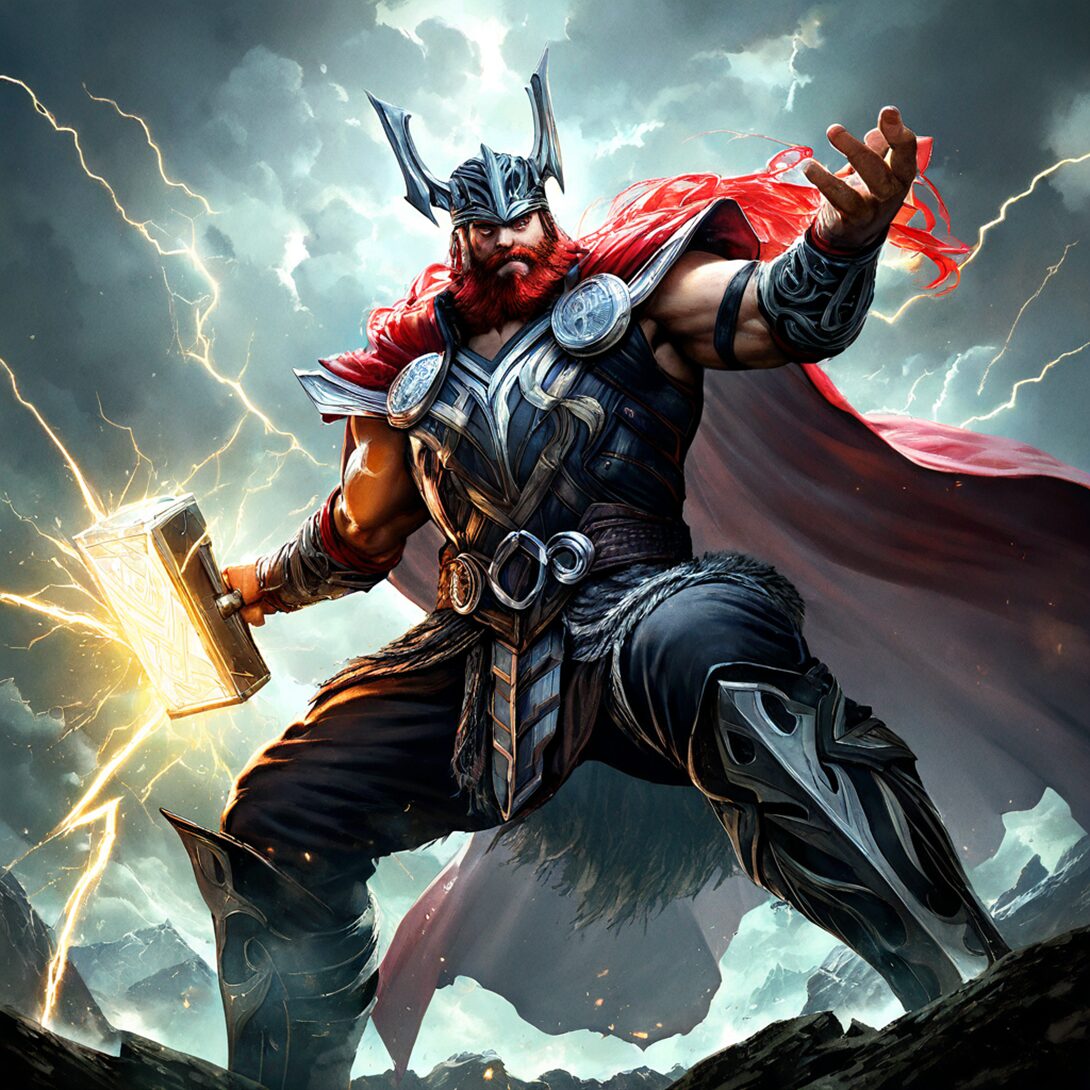
| Thor | Thunder god. The mightiest warrior, wielding the hammer Mjölnir |
| Loki | A trickster of god and giant blood. A seed of calamity |
| Baldr | The most beloved god, symbol of light and good |
| Týr | War god. A one-armed hero who lost a hand binding Fenrir |
| Freyr / Freyja | Vanir. Govern fertility and love |
Odin prizes wisdom above all, a one-eyed god who offered one eye in exchange to drink the water of the well of knowledge. He flies two ravens across the world and gathers the souls of the slain in the hall “Valhalla,” preparing for the coming Ragnarök.
The Gods’ Treasures, and Thor’s Adventures
Snorri’s Edda conveys many anecdotes concerning the gods.
Famous is the “birth of the gods’ treasures.” It begins with the trickster Loki cutting the goddess Sif’s hair as a prank, and as amends he has the dwarves make treasures. Thus were produced Odin’s spear Gungnir, Freyr’s ship Skíðblaðnir, and Thor’s hammer Mjölnir.
Also told are the anecdote in which, when a giant was made to build Asgard’s wall, Loki turned into a mare to obstruct him and gave birth to the eight-legged steed “Sleipnir,” and the adventures of the thunder god Thor. Humorous and powerful stories line up, such as Thor disguising as a bride to retrieve his stolen hammer.
The Giant’s Castle Útgarðr — Thor Bewitched
Especially famous is the story of Thor and Loki visiting the castle of the giant king “Útgarða-Loki.” Challenged to contests of strength at the castle, the party is utterly defeated. Loki loses an eating contest, the swift attendant Þjálfi is outrun, and even Thor could not drain a drinking horn, could not lift a cat on the floor, and went to one knee in a wrestling match with an old woman.
But on leaving the castle, the king reveals the trick. It was all magical illusion: what Loki competed against was “fire” itself; what Þjálfi competed against was “thought”; the horn Thor drank from was connected to the sea, and lowering its level created the ebb and flow of the tide. The cat he lifted was in truth the great serpent Jörmungandr that encircles the world, and the old woman he wrestled was “old age (Elli),” whom no one can defeat. Thor angrily raised his hammer, but the castle and the giant had already vanished. The Norse worldview — that even a god cannot match the vast forces of nature — is set into a skillful story.
Recover the Apples of Youth — Iðunn and Loki
The secret of the gods not aging lay in the “apples of youth” kept by the goddess “Iðunn.” But Loki, deceived by a giant, hands Iðunn and the apples over to the land of the giants. At once the gods turn gray-haired and grow old and decrepit. Loki, the cause, is blamed by the gods, transforms into a hawk, turns Iðunn into a nut and brings her back, and the pursuing giant is burned to death by the gods’ fire. An anecdote showing how precarious even the gods’ “immortality” is.
Thor’s Duel with the Giant Hrungnir
A story showing the thunder god Thor’s valor is his single combat with the mightiest giant, “Hrungnir.” Hrungnir, with a heart and head of stone, challenged him armed with a stone shield and a whetstone. When Thor threw his hammer Mjölnir, it collided in midair with the whetstone Hrungnir threw and shattered it, and a fragment of that shattered whetstone lodged deep in Thor’s forehead. Thor splendidly struck down Hrungnir, but it is said the whetstone stuck in his forehead could never be pulled out — depicting the thunder god’s strength and yet the harshness of a battle from which even he cannot emerge unscathed.
Binding the Wolf Fenrir — Týr’s Sacrifice
Among the anecdotes Snorri’s Edda conveys, one with especially heavy meaning is the story of binding the giant wolf “Fenrir,” a child of Loki. Growing larger by the day and prophesied eventually to bring calamity on the gods, this wolf the gods try to chain. But Fenrir easily snapped any sturdy chain.
So the gods have the dwarves make, from “things that do not exist in this world” — the footfall of a cat, the beard of a woman, the roots of a mountain, the sinews of a bear, the breath of a fish, the spittle of a bird — a magical cord as fine and supple as silk, “Gleipnir.” The wary Fenrir demanded, “I will let you bind me as a test, but as a guarantee put someone’s hand in my mouth.” While all hesitated, only the war god “Týr” placed his right hand in the wolf’s mouth. Realizing the cord would not budge, Fenrir, as agreed, bit off Týr’s hand. A god sacrificing his own hand to seal away calamity — this story, together with the fate of Fenrir being unleashed at Ragnarök, expresses well the tragic grandeur of Norse mythology.
The Death of Baldr — the Omen of Doom
What announces the end of the age of the gods is the “death of the light god Baldr.”
For Baldr, troubled by ominous dreams, his mother Frigg has every thing in the world swear an oath not to harm Baldr. Since nothing thrown at the now-invincible Baldr would hurt him, the gods made a game of it.
But Loki finds the plant “mistletoe,” which Frigg had overlooked. He has the blind god Höðr hold and throw a mistletoe branch, and kills the most beloved god, Baldr. The gods try to win his return from the underworld, but fail due to Loki’s interference. This became the decisive omen of the world heading toward doom.
The Binding of Loki — the God Turned Salmon, and the Torment of the Venom-Snake
For the crime of killing Baldr, Loki at last becomes a fugitive hunted by the gods. The original text tells his flight and capture in detail. Loki hid in a house in the mountains and turned into a salmon and lurked in a waterfall pool. In his hideout, Loki, thinking from the side of the one who catches, tried weaving a “net” (the original text tells this as if it were the origin of the net). When the gods closed in, he threw the net into the fire to destroy it, but from the shape of the leftover ash, the clever gods saw through the device, wove the same net, and cornered Loki. In the end, as the salmon Loki tried to leap over the net, Thor caught him bare-handed. Because he gripped the slipping salmon near the tail, the salmon’s tail became slender, the original text says.
The punishment of the captured Loki was severe. The gods bound Loki to rocks (the bonds, it is told, were made from the entrails of his own son), and the giantess Skaði hung a venom-snake over his head, letting its poison drip. His wife Sigyn holds up a bowl to keep catching the poison, but only while the bowl overflows and she empties it does the poison fall on Loki’s face. Each time, Loki writhes, and that becomes earthquakes, the original text concludes. Loki lies in this state until the day of Ragnarök.
Ragnarök and the Rebirth of the World
And the book tells of the world’s end, “Ragnarök (the twilight of the gods).”
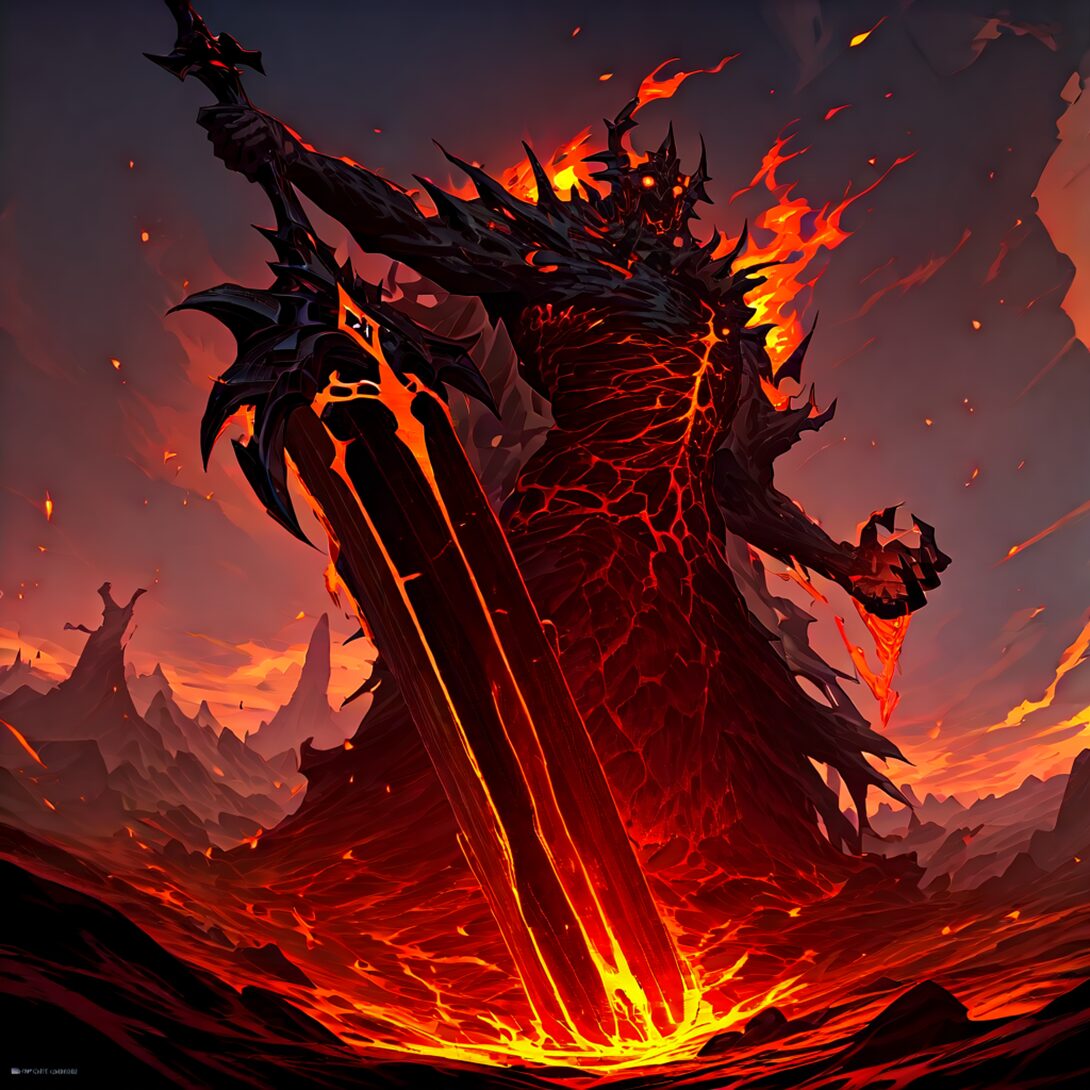
After a three-year winter, “Fimbulwinter,” Loki and the giants freed from their bonds, the wolf Fenrir, and the great serpent Jörmungandr attack the land of the gods. At the signal of the watchman Heimdall’s horn, the final battle between the gods and the monsters begins.
| Confrontation | Outcome |
|---|---|
| Odin × the wolf Fenrir | Swallowed and killed (his son Víðarr avenges him) |
| Thor × the serpent Jörmungandr | Defeats it, but, drenched in poison, his strength gives out |
| Freyr × the fire giant Surt | Freyr, who had let go of his weapon, is slain |
| Loki × the watchman Heimdall | They slay each other and fall together |
Finally the fire giant Surt sets the world ablaze, and the world burns up and sinks into the sea. But the story does not end there. After the doom, a new earth rises again from the sea, and from the surviving gods, such as Baldr returned from the underworld, and the human man and woman who survived hidden in a forest, “Líf and Lífþrasir,” the world begins again.
Skáldskaparmál — the Poetic Metaphor “Kenning”
In the book’s third part, “Skáldskaparmál,” the elaborate metaphors much used in Norse poetry, “kennings,” are explained together with the myths behind them. For example, gold is called “Sif’s hair,” the sea “the whale’s road,” and poetry “Odin’s mead.” Without knowing the myth, you cannot read the poem — and that is exactly why Snorri wrote this handbook.
The Mead of Poetry — Where Does Poetry Come From?
What is told as the origin of that kenning “poetry = Odin’s mead” is the myth of the “mead of poetry.”
Once, from the spittle of the gods was born a sage endowed with all wisdom, “Kvasir.” But he was killed by dwarves, and his blood was mixed with honey to make “a mead that turns whoever drinks it into a poet or sage.” This mead, passing from hand to hand, was hidden deep in a mountain by a certain giant and guarded by his daughter.
Coveting it, Odin turned into a snake to enter through a crevice in the mountain rock, wooed the giant’s daughter, and drank all the mead in three gulps. Then, transforming into an eagle, he flew back to Asgard, spat it out into vessels, and shared it among the gods and the finest poets. The gift of poetry is a divine gift that Odin won at the risk of his life and bestowed on people — behind the special reverence for poets in the North lay such a myth.
How Strong Are the Characters Here? — The Power Ranking
The gods and heroes appearing in this article are also introduced in strength order in the “Mythology, Religion & Legend Power Ranking.” Enjoy their exploits in the original text alongside their “strength.”
To Learn More
Conclusion
In this article, I explained the original text that conveys Norse mythology most systematically, Snorri’s Edda, following its structure. How was it?
I hope you can see that the second part, “Gylfaginning,” tells the whole of Norse mythology in the order the creation of the world → the world tree and the gods → treasures and adventures → the death of Baldr → Ragnarök and rebirth, and that the third part, “Skáldskaparmál,” serves as a guide to putting that knowledge to use in poetry.
In the previous article (Article 1), I explained the Poetic Edda, which collects the old poems behind these stories. Please see that too.
In the next article (Article 3), I will explain the Völsunga saga, which depicts human heroes, different in flavor from the myths of the gods — the story of Sigurd the dragon-slayer and the cursed gold.
I hope you’ll read the next article too.
Also popular with readers
📚 Series: The Original Texts of Norse Mythology (3/4)