
Thank you for visiting this site. This article covers “Jevons Paradox.”
If a machine becomes more fuel-efficient, it ought to burn less fuel. What actually happened in nineteenth-century Britain was the opposite. After steam-engine efficiency improved dramatically, national coal consumption jumped. It is an inversion that goes to the heart of environmental policy: the more efficiency technology spreads, the less resource use falls.
An economist worried about running out of coal
In 1865 the British economist William Stanley Jevons published The Coal Question.
Britain was then the workshop of the world on the strength of burning coal, and reserves are finite. Jevons warned that at this rate the source of national power would be exhausted.
He then took issue with the optimism widely held at the time: “more efficient engines will save coal, so there is nothing to worry about.”
Jevons produced data and argued that although James Watt’s improvements to the steam engine had greatly reduced the coal required, Britain’s coal consumption had continued to rise afterwards.
His conclusion was blunt: it is wholly a confusion of ideas to suppose that efficient use of fuel means diminished consumption.
Why efficiency raises consumption
The reasoning is not difficult.
Higher efficiency means less fuel is needed for the same work. In other words, the cost of using the machine falls.
Once it is cheaper, it becomes usable for applications that never paid for themselves before. With steam, the uses spread from pumping water out of mines to factory power, railways and ships.
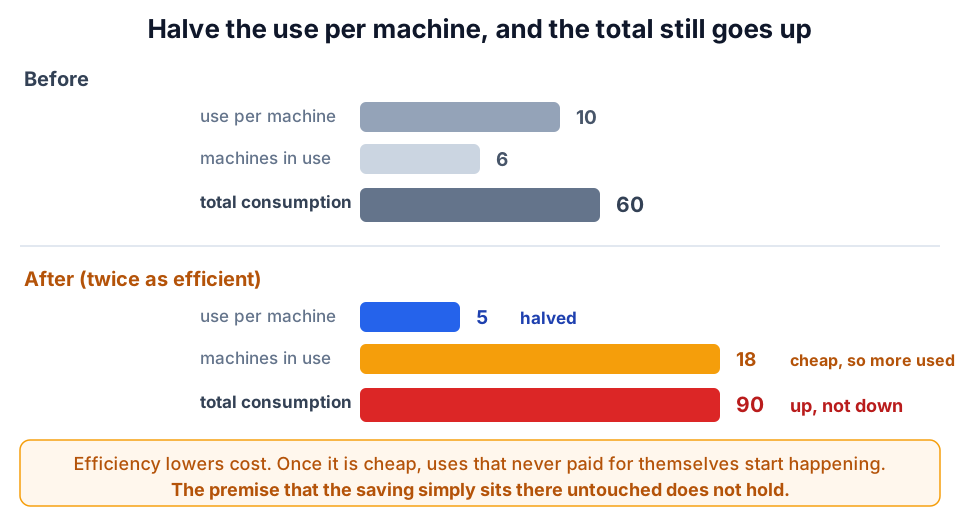
And if it is cheap to run, buying more of them becomes attractive. Halve the fuel per machine and triple the machine count, and total use is up by half.
The saving does not sit there untouched; it converts into “it is cheap now, so use more.” That is the whole mechanism.
The modern name: rebound effect
Modern economics organises this as the rebound effect.
It measures what proportion of the resource that efficiency should have freed up actually gets consumed. If the whole saving remains, 0%; if half is spent, 50%.
Above 100%, where consumption ends up higher than before the improvement, is specifically called backfire, and that is Jevons paradox.
This is worth stating precisely: not every efficiency gain backfires. For uses where people already consume as much as they want — domestic refrigerators, air conditioning — many studies put rebound at only 10 to 30%.
Rebound is large in fields where “a great many uses are lying dormant because they were too expensive.” The steam engine in Jevons’s day was exactly that situation.
Rebound arrives by three routes
The rebound effect is not one phenomenon. Splitting it by route shows where it can be avoided and where it cannot.
Three routes
- Direct rebound: usage rises in the same application. A fuel-efficient car gets driven further
- Indirect rebound: the money saved goes to other consumption. Lower heating bills fund a holiday
- Economy-wide rebound: prices fall and the industrial structure itself changes. Steam engines producing railways and factories
Direct rebound is relatively well measured, with estimates reported by sector like these.
| Sector | Estimated direct rebound | Note |
|---|---|---|
| Domestic heating | 10-30% | There is a ceiling on comfortable room temperature |
| Car travel | 10-30% | Time constraints cap it |
| Lighting | 5-12% | In developed countries; larger in developing ones |
| Appliances | 0-20% | Small where people already use as much as they want |
In developed-country households, rebound generally stays in the 10 to 30% band, and within that range efficiency does deliver savings.
The dangerous route is the economy-wide one
The problem is the third. Direct and indirect together do not exceed 100%; once the industrial structure is being rearranged, that changes.
The steam engine Jevons was watching took exactly that route. When entirely new uses come into existence, the ceiling on rebound disappears.
Computing sits in the same position. It is not that the same workloads are run more often because they are cheaper; it is that uses which never existed are appearing one after another.
The same thing today
The observation from 160 years ago keeps reproducing itself.
Lighting is the clearest case. Replacing incandescent bulbs with LEDs cut the power needed for the same brightness by more than 90%. And then people stopped rationing brightness, and outdoor and decorative lighting proliferated.
Cars are the same. Better fuel economy tends to increase distance driven, so the reduction in fuel use is smaller than the improvement in economy.
Information technology may be the most striking. Semiconductor power efficiency has improved astonishingly, and yet total data-centre power consumption keeps rising, because cheaper computation means running enormous volumes of processing that was never worth doing before.
The spread of generative AI sits squarely on this structure. Efforts to make each request more efficient continue, but if cheapness increases the number of requests, nothing guarantees the total falls.
Was Jevons’s own prediction right?
The obvious question is what became of the warning itself.
In 1865 Jevons predicted that British coal would be exhausted in the near future and national power lost. In short, that prediction was wrong.
British coal production peaked around 1913 at roughly 290 million tons a year and declined thereafter, but not because of exhaustion.
- The switch to oil: ships and factories moved to a liquid fuel that was easier to handle
- Cheap imported coal: domestic extraction conditions worsened and lost on price to foreign supply
- Structural change: manufacturing’s share fell, and coal-intensive processes with it
In the end coal was not dug out to the last seam; it stopped being used. Substitute technologies Jevons had not imagined invalidated his scenario.
That said, this does not mean the mechanism he identified was wrong. The observation that efficiency raises consumption has been confirmed repeatedly in later empirical work. It is the classic shape of “the mechanism was right and the extrapolation was wrong.”
Forecasts usually fail because the technology assumed in the premises changes shape. It is worth holding the discovery of a mechanism and the prediction built on it at different levels of confidence.
Efficiency alone is not enough
The policy implication is uncomfortable.
Promoting efficiency technology is good in itself. The same life achieved with fewer resources is a genuine increase in prosperity.
But “raise efficiency and total consumption falls” is a leap. Efficiency pushes usage both up and down, so holding the total down requires separate machinery.
Concretely, that means combining approaches like carbon pricing, which puts a price on use itself, and emissions trading, which caps the total. Efficiency lowers the unit cost; price or a cap holds the total — without both, you do not get the outcome you aimed for.
Since learning this I am a little suspicious of the feeling of “I have done something for the environment” after buying a more efficient appliance. If I have started using it more freely because I replaced it, there may be almost nothing left on the balance.
Related paradoxes of economics and happiness
Related paradoxes where an improvement measured in money or efficiency fails to deliver the expected result.




Summary
This article covered “Jevons Paradox.”
Efficiency up, consumption down: intuitively almost beyond doubt, and yet inserting the single plain fact that cheap things get used more is enough to invert the conclusion.
A problem you believed technology would solve turns out to be a problem of behaviour and price. It remains a very live observation about that kind of oversight.
To return to the full list of paradoxes, follow the link below.
Thank you for reading. We hope to see you in the next article.

Also popular with readers
📚 Series: The World's Paradoxes (59/81)