Thank you for visiting this site. This article covers the “Paradox of Value.”
Without water a person dies within days, yet tap water costs next to nothing. Diamonds, which nobody would miss, trade at extraordinary prices. This contradiction — usefulness and price running in exactly opposite directions — troubled Adam Smith, the father of economics, and stayed unsolved for roughly a hundred years.
Water or diamonds: which is more useful?
Start with which is more useful to a human being.
You cannot live without drinking water. It is used in cooking, in washing, in agriculture, and more than 60% of your body is made of it. Remove it and civilisation goes with it.
What about diamonds? There are industrial uses, but if jewellery-grade diamonds became unobtainable tomorrow, almost nobody would be inconvenienced.
On usefulness, water wins overwhelmingly. On price, tap water runs to a fraction of a cent per litre while diamond runs to thousands of dollars per gram.
The more useful a thing is, the more it should sell for. That is the natural expectation, and reality points cleanly the other way.
The question Adam Smith posed
The person who put the contradiction into plain words was Adam Smith, in The Wealth of Nations in 1776.
Nothing is more useful than water; but it will purchase scarce any thing. A diamond, on the contrary, has scarce any value in use; but a very great quantity of other goods may frequently be had in exchange for it.
Smith sorted this out by noting that the word value carries two meanings. One is “value in use,” how useful the thing is. The other is “value in exchange,” how much of other goods it commands in a market.
Water has extremely high value in use and extremely low value in exchange; diamonds are the reverse. Splitting the terms tidied the problem up, but the crucial explanation of why the two invert was left unanswered.
Smith’s own answer, and its limits
Smith’s answer located the source of value in the quantity of labour put in.
Getting a diamond takes enormous effort: digging the mine, sorting, cutting and polishing. Water comes up if you dig a well. Different labour, different price.
Plausible at a glance, but things start appearing that it cannot explain.
Items crafted painstakingly over years routinely fail to sell, while a stone somebody happened to pick up can fetch a fortune. If price were fixed by labour, neither should occur.
More fundamentally, the question remains: “why do people pour enormous labour into digging for diamonds in the first place?” They dig because they know it sells high; it does not sell high because they dug. Cause and effect end up the wrong way round.
Marginal utility, a century later
The problem was solved in the 1870s, when Jevons in Britain, Menger in Austria and Walras in Switzerland arrived at the same answer at almost the same time, independently of one another. Economic history calls it the marginal revolution.
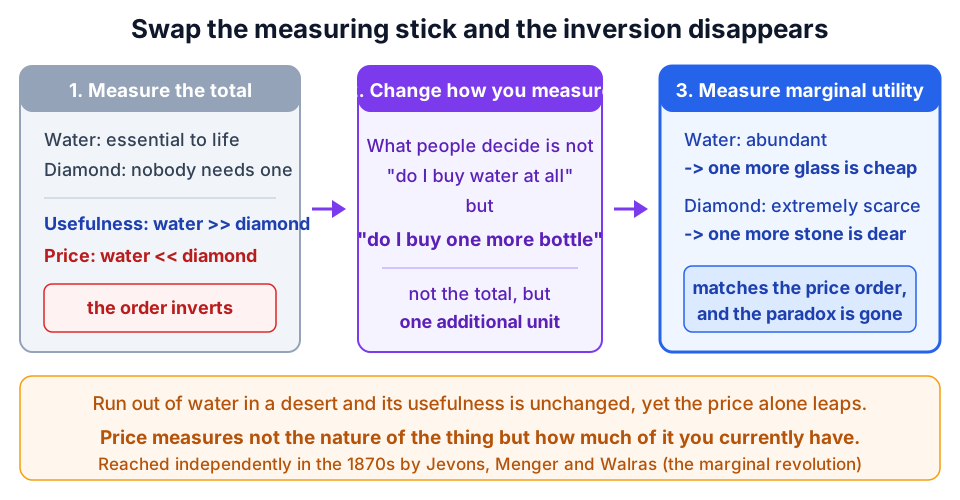
Their answer: what sets the price is not the value delivered by the total quantity, but the value delivered by “one more unit.” This is marginal utility.
Think about it — when we shop we are not deciding whether to buy “water as such.” We are deciding “whether to buy one more bottle.”
And when you already have plenty of water, one more glass adds almost nothing. That is the law of diminishing marginal utility: the more you hold, the less an additional unit is worth.
Water is everywhere, so an additional litre is worth very little. Diamonds are extraordinarily scarce, so an additional stone is worth a great deal. Once price is set by marginal utility, there is nothing contradictory about the usefulness ordering and the price ordering being reversed.
Sell water in a desert and the price changes
You can confirm the explanation immediately by changing the situation.
To someone who has wandered a desert for three days and run out of water, a single cup is worth incomparably more than a diamond. They would hand over every gem they carry without regret.
The usefulness of water has not changed at all. The only thing that changed is “how much of it is to hand.” That alone inverts the price. Which is to say price is set not by the nature of the thing but by its relation to the situation.
Bottled water spiking after a disaster is the same mechanism. Sellers did not suddenly become greedy; scarcity sent marginal utility through the roof. Though price gouging is tangled up in that, so the discussion does not end with economics alone.
What the marginal revolution left behind
The idea three people reached simultaneously did more than solve the paradox of value. It replaced economics’ toolkit.
- Grounds for the demand curve: quantity bought rises as price falls because the value of each additional unit declines
- Consumer surplus: the gap between what you would have paid and what you did pay became measurable as the gain from the transaction
- A new notion of cost: measured not by effort expended but by the value the resource would have produced in its next-best use
- Utility as a common yardstick: goods of any kind became comparable on the same basis, satisfaction from one more unit
The second is the big one. Those of us buying tap water for a fraction of a cent per litre are receiving an enormous surplus from it. A low price meant not low value but large surplus.
The third, opportunity cost, is also an idea the labour theory of value never produces. Choosing something is simultaneously giving something else up. With that perspective in place, economics shifted its footing from “what did it cost to make” to “what was given up.”
Price does not report the size of value
The lesson to draw from this paradox is that you should not treat price and value as the same thing.
Cheap means low value, expensive means high value — we take it that way instinctively, but what price actually measures is the single question of “how much else would I give up to obtain one more.”
Framed that way, it starts to seem obvious that the most commonplace things around us carry the lowest tags. Air is free, and nobody thinks its value is zero. There is an inversion here: the things without a price are the things you can least do without.
Since learning this, I stop for a moment whenever I catch myself judging something’s value by its price. Is it cheap simply because it is everywhere? Just asking that changes how things look.
Following marginal utility through numbers
Words alone make it slippery, so let me order the glasses of water.
The first glass and the tenth are not worth the same
Drink in order from a state of thirst and the gratitude per glass falls away quickly.
| Which glass | What it is for | Subjective value | What you would pay |
|---|---|---|---|
| 1st | Staying alive | Enormous | Everything you own |
| 2nd | Quenching thirst | High | Hundreds of dollars |
| 5th | Cooking | Moderate | A few cents |
| 20th | Laundry | Low | A fraction of a cent |
| 100th | Watering the garden | Almost zero | Effectively nothing |
What a mains water supply delivers is the whole volume, right down to what corresponds to the hundredth glass. The price is set by that last, least valuable glass, so of course it is cheap.
Diamonds are the reverse: for most people, what is available is the first stone. The value of “the first one” becomes the price, and stays high.
Total utility and marginal utility are different things
The distinction now becomes sharp. Water’s total utility is the whole right-hand column added up, which is an astronomical figure. Its marginal utility is the last row alone, which is nearly zero.
Adam Smith was looking at total utility while the market was looking at marginal utility. That mismatch is what kept the problem unsolved for a century.
Water spikes in a desert because supply is throttled and “the last glass” moves up the table. Total utility has not changed at all; only marginal utility leaps.
Related paradoxes of economics and happiness
Related paradoxes where money, as a yardstick, fails to measure real prosperity or real value.


Summary
This article covered the “Paradox of Value.”
The water-and-diamonds contradiction dissolves purely on the difference between measuring usefulness by the total and by one additional unit. Simple once you know the answer, and yet even the father of economics could not reach it, and it took a hundred years.
When a problem will not yield, what is missing is often not information or computing power but the yardstick. I think this is the textbook case.
To return to the full list of paradoxes, follow the link below.
Thank you for reading. We hope to see you in the next article.
Also popular with readers
📚 Series: The World's Paradoxes (58/81)