Thank you for visiting this site. This article covers “Buridan’s Ass.”
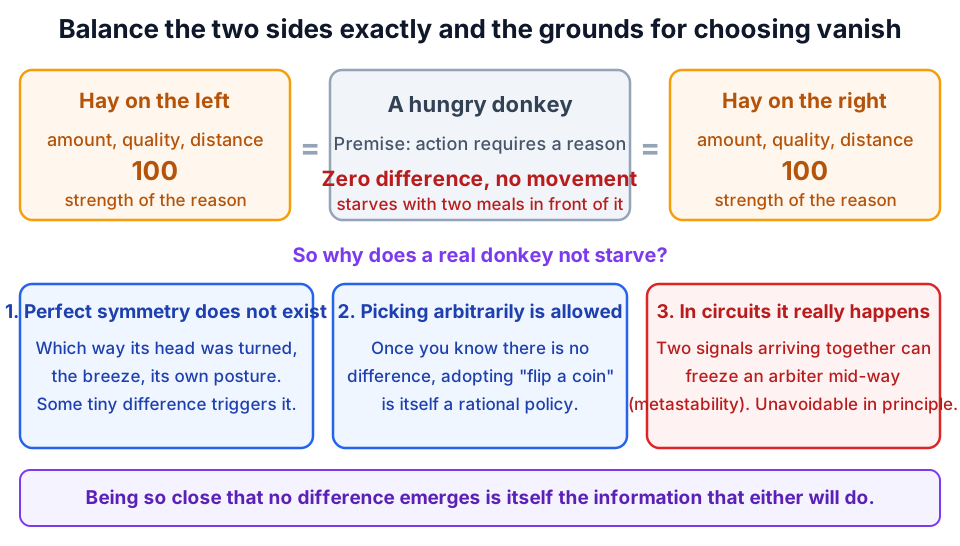
A hungry donkey stands between two identical piles of hay. Same distance, same quantity, same quality. The donkey tries to choose, but since no reason to prefer either can be found anywhere, it cannot move, and starves. It is a classic problem that presses the question of whether the act of choosing always requires a reason.
Frozen between two piles of hay
The setup is extreme in its simplicity.
There is a hungry donkey. Two completely identical piles of hay sit at completely identical distances on either side. Appearance, quantity, smell — no difference the donkey could detect.
Now add the premise that “action requires a reason.” A rational being moves because it chooses the better option.
But in this situation, the reason to go left and the reason to go right are equally zero. No ground for preferring either exists in principle.
If so, the donkey cannot move. Not moving, it does not eat, and eventually starves. Starving to death with two meals in front of it is the absurd conclusion.
The original is in Aristotle
The story is in fact far older than Buridan.
In the fourth century BCE, Aristotle raised in On the Heavens the case of a person equally hungry and equally thirsty, positioned exactly equidistant from food and drink. Such a person, he notes, cannot move from the spot.
Aristotle himself brought it up as an example demonstrating an absurd consequence. It appears as an analogy, in the context of explaining why the earth rests at the centre of the universe.
The same structure appears in the arguments of the twelfth-century Islamic philosopher al-Ghazali, which shows it has been rediscovered repeatedly across eras and regions. The idea that perfect symmetry halts judgement evidently provokes human intuition that reliably.
Buridan never said it
So why is it named after the fourteenth-century French philosopher Jean Buridan?
Buridan was an eminent scholastic who served as rector of the University of Paris, and his view of the will was this: the will always chooses whichever option is judged better. In other words, “you cannot choose without a reason.”
He did, however, provide an escape for cases where two options appear equal. In that case, the will may suspend judgement and gather further information.
The trouble is that suspension gave his critics a splendid target. “And if you gather information and still find no difference? Do you suspend until you die?”
That is where the donkey was brought in. It is an illustration invented to mock Buridan, and the donkey appears nowhere in his surviving works. Being left with only the name attached seems a little hard on him.
Can a perfectly balanced situation exist?
The first practical objection is that such perfect symmetry is impossible.
Indeed, two haystacks are never identical down to the atom, and a donkey’s own body is slightly asymmetric. Which way its head happened to be turned, which direction the wind came from — minute differences always exist.
Some tiny fluctuation acts as a trigger, and the actual donkey promptly eats one of them. Reasons may look balanced, but a decisive difference is hiding somewhere.
The other response reconsiders how choosing works at all. If there is no difference, toss a coin. Adopting the policy “when there is no difference, decide arbitrarily” is itself a perfectly rational judgement.
Spinoza touched on the problem in the Ethics and conceded that a human placed in perfect equilibrium really would starve — adding tartly that such a person should be regarded as a donkey rather than a human being.
Who has answered, and how
The problem has a long accumulation of argument, and the donkey’s fate changes depending on the position taken.
The main answers compared
| Thinker | Position | What happens to the donkey |
|---|---|---|
| Aristotle | Raised as an example of absurdity | Cannot move |
| Buridan | The will may suspend judgement | Waits until information arrives |
| Leibniz | No two things are perfectly identical | Always a tiny difference, so it moves |
| Spinoza | In perfect equilibrium it really does die | Starves |
| Modern engineering | Undecidable states genuinely exist | It resolves, but you cannot guarantee when |
Leibniz’s position follows from his identity of indiscernibles: “two things so alike as to be indistinguishable are, in fact, one and the same thing.” On that view the two haystacks must differ somewhere.
Spinoza gives no quarter. In the Ethics he grants that a human in perfect equilibrium would starve, and writes that such a person should be counted a donkey and not a human being.
The weakness of suspension
Buridan’s own position, “suspend until information arrives,” sounds reasonable at first.
But it says nothing about what happens if gathering more never reveals a difference. That is exactly where his critics struck, pointing out that you starve while continuing to suspend.
From a modern vantage the criticism lands. Suspension costs time, so “not deciding” is not a harmless option. That the donkey story is more than sophistry is down to this point.
A real Buridan’s ass, in electronics
It is usually taken as a philosopher’s thought experiment, yet the problem occurs for real in engineering.
Digital circuits contain a component called an arbiter, which decides which of two signals arriving at nearly the same moment gets handled first. Here, if the two signals are close enough in time, the circuit can fall into an unstable state where it cannot settle on either.
This is called metastability: the output hovers at an intermediate value that is neither 0 nor 1, and there is no guarantee of how long that lasts.
Worse, it has been shown theoretically that “an arbiter guaranteed to reach a verdict within a fixed time” cannot be built even in principle. The probability can be driven arbitrarily low, but never to zero.
Not a metaphor, not a fable: a real circuit genuinely locks up unable to decide. When I learned this, there was something wonderful about finding a medieval philosophical dispute surviving as a design constraint in semiconductors.
More options make it worse
This is not only a problem when there are two options.
With ten equally good candidates, there are 45 pairwise comparisons. If all of them are close, the more you compare the less difference you can see, and the decision recedes.
The phenomenon that more options make people less able to choose, and less satisfied afterwards is known as the paradox of choice. You can read it as Buridan’s ass stretched to real-world scale.
The difference is that with two piles of hay you can tell “there is no difference,” whereas with ten the suspicion that “something better might be out there” never goes away. The grounds for stopping the comparison become harder, not easier, to find.
Dealing with being unable to decide
The same structure appears in ordinary life in various forms.
Two job offers you cannot separate; two paths that look equally attractive. People stall for a long time in situations like these.
What the donkey teaches, though, is that if continued comparison produces no difference, the comparison has no more information in it. That the options are close enough to produce no difference is itself the conclusion that it barely matters which you take.
If so, the cost of continuing to agonise exceeds the cost of choosing wrongly. When I hit a decision I cannot settle, I try to remember this. Time spent worrying is time spent not eating the hay, and framing it that way tends to get me moving.
Related paradoxes of rational choice
Related paradoxes where a judgement made rationally still ends up inconsistent, or with no settled right answer.
Summary
This article covered “Buridan’s Ass.”
Push the mild-sounding premise that choice requires a reason to its conclusion, and the moment the reasons balance exactly, action itself stops. And it is not confined to fable: it exists as the arbiter circuit.
Not “no reason means I cannot choose,” but “no reason means I am free to choose arbitrarily.” Flipping the framing that way is, I think, where the practical answer to this problem lies.
To return to the full list of paradoxes, follow the link below.
Thank you for reading. We hope to see you in the next article.
Also popular with readers
📚 Series: The World's Paradoxes (67/81)