Thank you for visiting this site. This article covers the “Ellsberg Paradox.”
Part of the colour breakdown inside an urn is unknown. On that condition alone, most people’s choices become a combination that contradicts itself. It is an experiment that extracts, very cleanly, how much people dislike the state of not knowing the odds.
An urn with ninety balls
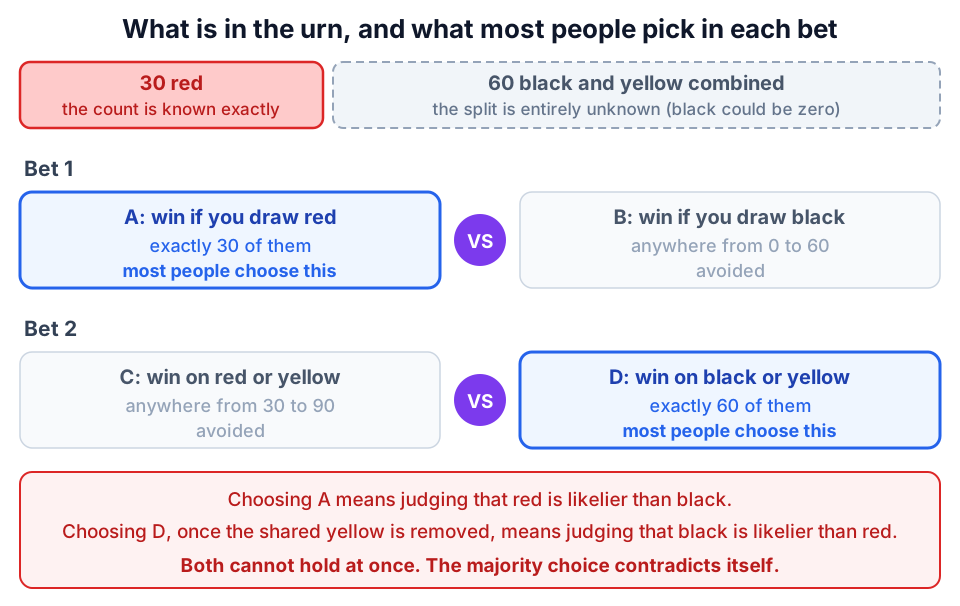
There is an urn in front of you. It holds ninety balls in total, in three colours: red, black and yellow.
All you are told is this.
- Exactly 30 of them are red
- The remaining 60 are black or yellow, in a breakdown you are told nothing about
There might be 60 black and no yellow, or the reverse, or an even split. All you know is that black and yellow together come to 60.
You will draw one ball from this urn. Two bets follow about which colour pays out.
Bet 1 and bet 2
Bet 1 first. Choose one of these.
Bet A: $1,000 if the ball is red Bet B: $1,000 if the ball is black
Then bet 2, using the same urn. Again, choose one.
Bet C: $1,000 if the ball is red or yellow Bet D: $1,000 if the ball is black or yellow
Run the experiment and A wins bet 1 overwhelmingly, while D wins bet 2.
Ask why, and the answers are much the same. In bet 1, red is a solid 30. Black could be zero, which is frightening. So, A.
In bet 2, black and yellow together are a solid 60. Red and yellow, on the other hand, might be only 30 if there is no yellow at all. So, D.
Both look like the same consistent attitude — “bet on whichever count you actually know” — and yet it is not consistent at all.
The two choices cannot both hold
Choosing A in bet 1 means judging that “red is more likely to come up than black.”
Choosing D in bet 2 means judging that “black or yellow is more likely than red or yellow.”
Now notice that yellow appears on both sides of bet 2. Strip the shared yellow out of that comparison and what remains is black against red. So choosing D is the same as saying “black is more likely than red.”
Red is likelier, and simultaneously black is likelier. Both cannot be true. Whatever probabilities the person had in mind, the majority combination cannot be explained by any of them.
This violates Savage’s sure-thing principle, a foundation of decision theory. The same axiom the Allais paradox broke is broken here through a different door — not amounts of money, but “not knowing the odds.”
Risk and ambiguity turn out to be different
Why does this happen? Because people distinguish two kinds of not-knowing.
One is called risk: “the probability is known, the outcome is not.” Coin flips and dice fall here.
The other is ambiguity: “the probability itself is unknown.” The black and yellow in this urn are exactly that.
Conventional expected utility theory did not distinguish the two. If the probability is unknown, estimate something reasonable and calculate. But actual humans, this experiment showed, treat ambiguity as a separate category and dislike it strongly. This is called ambiguity aversion.
Worth noting: nobody choosing A, and nobody choosing D, is losing money. Neither bet is especially bad on expected value; it is putting the two side by side that destroys the consistency. The irrationality has the shape of “decisions that are individually fine and collectively incoherent.”
The proposer, of Pentagon Papers fame
The paradox was presented in a 1961 paper by Daniel Ellsberg.
At the time he was an analyst studying nuclear strategy at the RAND Corporation. Decision-making where the probabilities are not clear was, quite literally, his day job.
And ten years later this same Ellsberg entered world history. In 1971 he was the man who handed the Department of Defense’s classified study of the Vietnam War — the “Pentagon Papers” — to the press.
A person researching how people judge when the odds are unknown went on to force the opacity of national decision-making into public view. When I learned that, it struck me how the research topic and the life ran continuously into one another.
Telling risk and ambiguity apart
When separating the two in practice, these are useful markers.
- Is the population fixed? If there is a basis for estimating probability, as with dice or actuarial tables, it is risk
- Are there enough past cases? A situation with only a handful of precedents should be treated as ambiguity, not probability
- Can you put a range on the estimate? If all you can say is “about 30%” with no range, the grounds are thin
- Is the other party selecting what to show you? Being shown only the convenient numbers is ambiguity wearing the face of probability
The most dangerous case by far is ambiguity arriving dressed as probability. A weakly grounded estimate gets treated as risk the moment it is presented as a figure.
What is excellent about Ellsberg’s urn is that it presents the “unknown” without hiding it. In real decisions, the unknown part is more often replaced by a plausible-looking number and thereby made invisible.
Ambiguity aversion in the wild
You can observe it in all sorts of everyday settings.
In investing, equities in unfamiliar countries and novel financial products tend to be shunned. Even at equal expected return, what is not understood gets avoided. The home-bias toward domestic equities seen worldwide is sometimes explained as an extension of this.
The same happens in medicine. Between a treatment with clearly published efficacy figures and a newer one that merely has less data, the latter is avoided out of proportion.
Part of the reason established suppliers keep winning corporate procurement is here too. A new counterparty might be better or worse; it is the width of that “might” that is disliked.
That said, avoiding ambiguity is not always wrong. Caution when information is scarce is arguably a good survival strategy. The problem is being unaware that you are avoiding it, and losing a whole class of opportunity as a result.
Rebuilding the theory to handle ambiguity
What Ellsberg’s experiment showed is that the framework of expressing probability as a single number does not fit human judgement. From there, work began on rebuilding the theory.
Holding probability as a range
The most widely adopted approach holds probability not as one value but as “the range it could be in.”
In the urn, all you can say about black is that its probability lies somewhere between 0 and two-thirds. Frameworks were proposed for carrying that width through the decision intact.
| Approach | Treatment of probability | Valuation of black in the urn | Character |
|---|---|---|---|
| Expected utility | Fixed at one value | Pinned at one-third | Does not distinguish ambiguity |
| Maxmin expected utility | A range, take the worst case | Valued as 0 | Can be excessively cautious |
| Alpha-maxmin | Weight worst and best case | Between 0 and two-thirds | Degree of caution is tunable |
| Choquet expected utility | Uses weights that are not probabilities | Varies by situation | Mathematically heavy |
Maxmin expected utility, formalised in 1989 by Itzhak Gilboa and David Schmeidler, chooses on the basis of the worst probability the range permits. Black in the urn is then valued at 0, and the majority choice comes out as straightforwardly rational.
In practice it becomes a question of how cautious to be
Looking only at the worst case is criticised as excessively cautious, so weighted averages with the best case are also used. The weighting coefficient becomes a number expressing how much that actor dislikes ambiguity.
Whether to avoid ambiguity stopped being a question of right and wrong, and became a question of how much to avoid it. This is used in real decisions where probabilities do not settle: stress tests in financial regulation, cost-benefit analysis for climate policy.
Related paradoxes of rational choice
Related paradoxes where a judgement made rationally still ends up inconsistent, or with no settled right answer.
Summary
This article covered the “Ellsberg Paradox.”
Hide a little of what is in the urn and consistency drains out of people’s choices — while they remain entirely unaware of contradicting themselves. What it shows is that people treat “unknown” not as a kind of probability but as something to be avoided.
When I decline something, was it really because the expected value was against me, or simply because I had little information? I try to stop and check now and then.
To return to the full list of paradoxes, follow the link below.
Thank you for reading. We hope to see you in the next article.
Also popular with readers
📚 Series: The World's Paradoxes (68/81)