Thank you for visiting this site. This article covers the “Allais Paradox.”
You are shown two very similar gambles and simply asked which option you prefer in each. Yet the pair most people choose contradicts, head-on, the axioms of rationality economics assumed for decades. And the awkward part is that once the contradiction is pointed out, most people still do not want to change their answer.
Two experiments, one choice each
Experiment 1 first. Pick one of these.
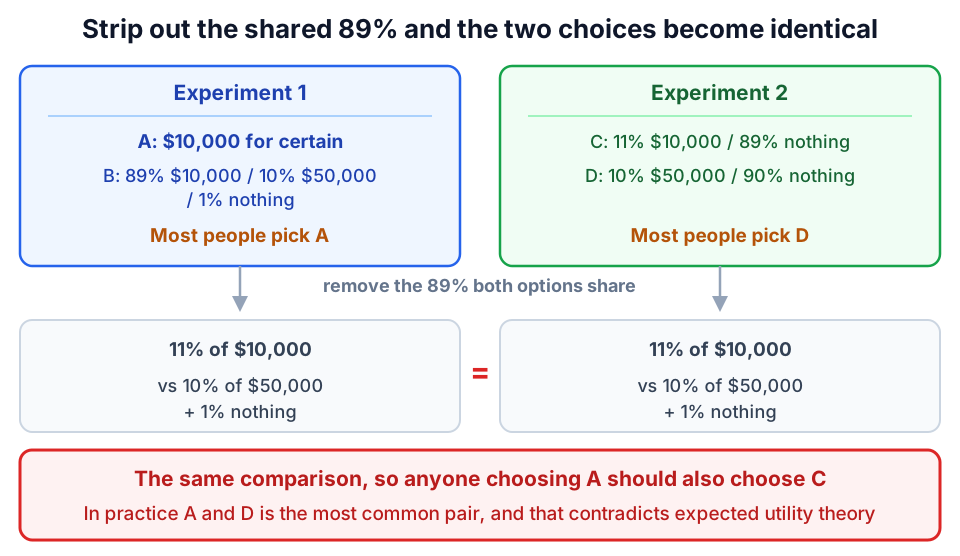
Option A: $10,000, guaranteed Option B: 89% chance of $10,000, 10% chance of $50,000, 1% chance of nothing
Now experiment 2. Again, pick one.
Option C: 11% chance of $10,000, 89% chance of nothing Option D: 10% chance of $50,000, 90% chance of nothing
Decide both before reading on and the rest of this will land more concretely.
Most people choose A and D
Run the experiment and option A wins experiment 1, while option D wins experiment 2.
Why A wins is easy to see. Choosing B introduces a chance — only 1%, but a real one — of “walking away with nothing.” The feeling is that you cannot bring yourself to gamble away a certain $10,000.
Experiment 2 goes the other way. C and D both leave you with nothing most of the time, so if you are probably losing anyway, you may as well go for the bigger number. The difference between 11% and 10% barely registers.
Taken on its own, each judgement is perfectly reasonable. The trouble starts when you put them side by side.
The 89% part never needed comparing
Here is the trick. Look at A against B, and C against D, within each experiment.
In experiment 1, the “89% part” of both A and B is $10,000. In experiment 2, the 89% part of both C and D is “nothing.”
The shared part gives the same result whichever you pick, so it cannot inform the decision. Expected utility theory says you can strike it out and compare only what is left without changing the conclusion. This is known as the independence axiom, or the sure-thing principle.
Strike out the 89% and both experiments turn into exactly the same comparison.
11% chance of $10,000 versus 10% chance of $50,000 plus 1% chance of nothing
Since it is the same comparison, anyone who picked A in experiment 1 has to pick C in experiment 2 to be consistent. In practice, A and D is the most common pair. At that point the majority choice contradicts the theory.
What the expected values say
For completeness, the plain expected values.
| Option | Expected value |
|---|---|
| A: $10,000 guaranteed | $10,000 |
| B: 89% $10,000, 10% $50,000, 1% nothing | $13,900 |
| C: 11% of $10,000 | $1,100 |
| D: 10% of $50,000 | $5,000 |
By expected value alone the right answers are B in experiment 1 and D in experiment 2. Yet the majority pick A, which is $3,900 worse.
Meanwhile in experiment 2 the higher expected value, D, is duly chosen. So “people who ignore expected value” does not explain it. The same person follows expected value in one setting and abandons it in another.
The distortion certainty creates
The key to explaining this is what is called the certainty effect.
People do not feel a given change in probability equally at every point on the scale. One point from 99% to 100% feels far larger than one point from 10% to 11%. The first is the boundary where “might” becomes “will”; the second is a number going up.
A wins experiment 1 precisely because that boundary is within reach. Experiment 2 has no such boundary, so the certainty effect does not fire and the larger sum simply wins.
The paradox was put forward in 1953 by the French economist Maurice Allais. At the time, expected utility theory was taken to be what rational decision-making looked like, and Allais put an experimental hole straight through it. He went on to win the Nobel Prize in economics in 1988.
Then in 1979, Daniel Kahneman and Amos Tversky built prospect theory with this certainty effect as one of its foundations. It is fair to say that the field of behavioural economics itself sits on the far end of this paradox.
Why the experiment kept being repeated
More than seventy years on, the experiment is still run in varied forms, because the objections had to be answered.
The main criticisms, and what testing found:
- The sums are unrealistically large: the same pattern appears when real cash is actually paid out
- Subjects simply miscalculated: laying out probabilities and amounts in a table, with ample time, does not change the choices
- Point out the contradiction and they will correct it: most people keep their choice after it is explained, and say the theory is what is wrong
- It is culturally specific: the same results are reported across Europe, the Americas, Asia and Africa
The third is decisive. Refusing to correct an error after it has been explained cannot be a calculation slip. You are forced to accept that people genuinely value it that way.
Some studies do report lower violation rates under carefully arranged conditions, and the argument about the size of the effect continues. But that judgement bends near certainty is treated as repeatedly confirmed fact.
Insurance and lottery tickets share the habit
The same habit surfaces all over ordinary life.
Insurance is the clearest case. On expected value you always lose by paying a premium, and yet most people buy it. They are paying above expected value for “the certainty of no loss.”
Extended warranties and free-cancellation options sell for the same reason. Reducing your worry to zero feels far more valuable than reducing it by 90%. Businesses know this and reach for phrasings like “completely” and “no charge whatsoever.”
I do this myself, regularly paying a bit more for a free-cancellation rate when booking travel. Worked out coldly it does not add up, but it makes sense once you see that what I am buying is the state of being certain I can get the money back. Not rational, but that is the kind of creature we are.
We do not take probabilities at face value
To explain the Allais paradox, Kahneman and Tversky brought in the premise that “people do not use probabilities as given.”
Overweighted at the ends, underweighted in the middle
What they proposed is the probability weighting function: the idea that the actual probability and the subjective weight used in judgement come apart, roughly like this.
| Actual probability | Approximate weight used | Direction |
|---|---|---|
| 0% | 0 | as given |
| 1% | around 5% | overweighted |
| 10% | around 19% | overweighted |
| 50% | around 42% | slightly under |
| 90% | around 71% | heavily discounted |
| 99% | around 90% | heavily discounted |
| 100% | 1 | as given |
The treatment of the two ends is what to notice. Only 0% and 100% are taken at face value, and the weight jumps sharply just inside them.
99% only feels like about 90%, and then the moment it becomes 100% it counts in full. That step is exactly what the certainty effect is. A wins experiment 1 because an option was offered that crosses the step.
The side effect: small probabilities are overweighted
The same function explains why lottery tickets sell. If a sub-1% chance of winning is evaluated at a weight of around 5%, people will gladly take a bet that loses on expected value.
The same person buying both insurance and lottery tickets — behaviour expected utility theory struggles with — falls out of this single distortion. Bending the theory toward people rather than the other way round buys you that kind of clarity.
Related paradoxes of rational choice
Related paradoxes where a judgement made rationally still ends up inconsistent, or with no settled right answer.

Summary
This article covered the “Allais Paradox.”
What I find interesting is that most people do not want to change their answer even after the contradiction is explained to them. Normally, having a logical error pointed out makes you want to fix it; here, the feeling of “I would still rather take the certain $10,000” simply persists.
That stubbornness is what forced economics to rewrite its own premises. Rather than fitting people to the theory, fit the theory to people. I think of it as the problem that marked that turn.
To return to the full list of paradoxes, follow the link below.
Thank you for reading. We hope to see you in the next article.
Also popular with readers
📚 Series: The World's Paradoxes (66/81)