Thank you for visiting this site. This article covers “Newcomb’s Paradox.”
A predictor who is almost never wrong about the future sets two boxes in front of you. Take one box and you get a million dollars; take both and you get a thousand — and yet, at the same time, there is a proof that taking both leaves you $1,000 better off no matter what. Philosophers have been split down the middle on it for over sixty years, with no resolution.
Two boxes, set out by a predictor
There are two boxes in front of you.
Box A is transparent, and you can see the $1,000 inside it. Box B is opaque. Your options are exactly two: “take box B only” or “take both A and B.”
What is in box B was decided in advance by the predictor, on this rule.
If the predictor forecast “this person will take box B only,” box B contains $1,000,000. If the predictor forecast “this person will take both,” box B is empty.
Two conditions matter. First, this predictor has been right hundreds of times before. Second, the prediction is already made, and the contents of the boxes are fixed at this moment.
The contents are settled before you choose, and the predictor almost never misses. With those two together, things start going wrong.
The case for taking one box
Take the expected value straightforwardly first.
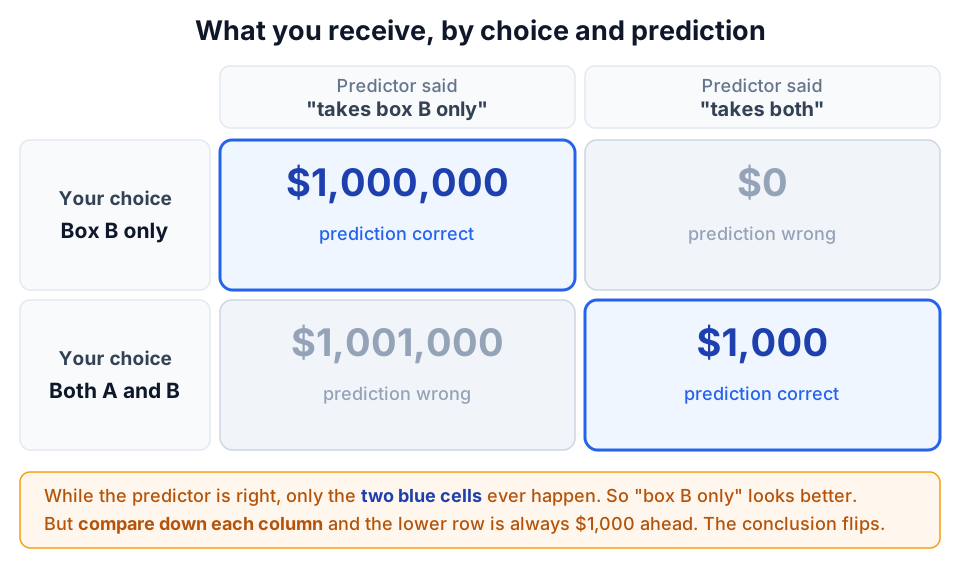
Someone who takes box B only will have been forecast as “takes box B only.” The predictor is nearly always right, so box B holds $1,000,000.
Someone who takes both will have been forecast as “takes both,” so box B is empty. All they get is the $1,000 in box A.
Put the historical accuracy at 99% and the expected value of taking box B only is about $990,000, against about $11,000 for taking both. The gap is obvious.
In short, if you want the million dollars, take box B only. Most people do pick this intuitively.
The case for taking both
And yet a completely separate line of reasoning looks equally watertight.
Remember the condition: the contents are already fixed. Nothing you choose now makes box B fuller or emptier.
So split into the two possible situations.
If box B holds $1,000,000, then box B alone gives you $1,000,000 and taking both gives you $1,001,000. Taking both is $1,000 better.
If box B is empty, then box B alone gives you $0 and taking both gives you $1,000. Again, taking both is $1,000 better.
In either situation, taking both is guaranteed to leave you $1,000 ahead. In decision theory this is called a dominant strategy, and normally it is a principle you follow without argument.
What possible reason is there to walk away from $1,000 you can see through the glass? Put that way, it is hard to argue with either.
Its inventor, and a split that never closed
The problem was devised by the American physicist William Newcomb, around 1960, though he never wrote it up himself.
It became widely known through the philosopher Robert Nozick’s 1969 paper “Newcomb’s Problem and Two Principles of Choice,” in which Nozick left a memorable observation.
To almost everyone, it is perfectly clear and obvious what should be done. The difficulty is that these people seem to divide almost evenly on the problem, with large numbers thinking that the opposing half is just being silly.
Indeed, the large 2009 PhilPapers Survey of professional philosophers found roughly 31% for two-boxing, roughly 21% for one-boxing, and the rest undecided or other. Nearly half a century of argument has not converged even among specialists.
The real dispute is correlation versus causation
Why so divided? Because the two positions measure the “goodness” of a decision by fundamentally different standards.
Behind one-boxing is evidential decision theory. Your choice is evidence about the contents of the box. The fact that “I am the sort of person who takes box B only” is strong evidence that box B holds a million, so that is what you should choose.
Two-boxers stand on causal decision theory, which evaluates only the causal influence your choice has on the outcome. The contents are already fixed, so nothing you choose now changes them. Therefore take the option that is reliably $1,000 more.
Put plainly, there is correlation between choice and outcome but no causation. Bet on the correlation, or bet on the causation? No general answer to that question exists, which is why Newcomb’s paradox stays unsettled.
One more thing: if the predictor really is 100% accurate, the world where “you take both and still get the million” does not exist at all. The objection that the calculation includes a non-existent option is fairly persistent.
The same shape without any predictor
Framed as a psychic it sounds like fantasy, but the structure turns up in reality often.
Job interviews, for instance. An honest person behaves honestly, and the interviewer sees it. Is the choice to “behave honestly” what raises the assessment, or is it merely evidence of already being an honest person? The fact that merely imitating the behaviour tends to get spotted makes the structure quite close to Newcomb’s.
The standard textbook case is smoking and genetics. Suppose there is a “gene that makes you want to smoke,” and that gene is the true cause of lung cancer. Quitting now does not change your genes, so causally your health does not improve. And yet “being a person who does not smoke” is still evidence of being healthy.
Since meeting that example I have stopped seeing Newcomb’s problem as merely an intellectual puzzle. The question of whether your action “creates” the outcome or merely “reveals” what sort of person you are shows up in everyday judgement more often than you would expect.
How far can the predictor’s accuracy fall?
So far we have assumed near-certain accuracy. As it drops, where does the conclusion flip?
Solving for the accuracy that balances the expected values
Let p be the accuracy and take each expected value.
Taking box B only pays $1,000,000 if the prediction was right and $0 if it was wrong. Expected value: 1,000,000 × p.
Taking both is the reverse: $1,000 if right, $1,001,000 if wrong. Expected value: 1,000 × p + 1,001,000 × (1 − p).
Solve for the p where these balance and the answer is about 50.05%.
| Predictor accuracy | EV of box B only | EV of taking both | Better option |
|---|---|---|---|
| 100% | $1,000,000 | $1,000 | Box B only |
| 90% | $900,000 | $101,000 | Box B only |
| 60% | $600,000 | $401,000 | Box B only |
| 50.05% | $500,500 | $500,500 | Level |
| 50% | $500,000 | $501,000 | Take both |
The dispute was never about the predictor’s powers
What this shows is that even against someone barely better than a coin flip, the expected-value calculation keeps saying take one box.
The dominance principle, meanwhile, says take both at any accuracy whatever. With the contents fixed, the probability is simply irrelevant.
So “does the predictor really have supernatural powers” was never the issue. If your opponent reads you even slightly better than chance, the two principles disagree from the outset. The psychic framing only makes the disagreement easy to see; it holds at entirely mundane levels of predictive accuracy.
Related paradoxes of rational choice
Related paradoxes where a judgement made rationally still ends up inconsistent, or with no settled right answer.
Summary
This article covered “Newcomb’s Paradox.”
Expected value says take one box; the dominance principle says take both. Both are legitimate foundations of decision theory, and in this situation they produce opposite answers. The value of the problem lies in having exposed that the word “rational” was never settled on a single meaning.
For what it is worth, I am a two-boxer — though writing that down makes me feel I am losing to the people walking off with a million dollars, which is not a comfortable place to sit.
To return to the full list of paradoxes, follow the link below.
Thank you for reading. We hope to see you in the next article.
Also popular with readers
📚 Series: The World's Paradoxes (69/81)