Thank you for visiting this site. This article covers the “Paradox of Hedonism.”
Wanting to be happy is natural enough, but aim directly at happiness itself as a goal and it becomes harder to obtain. The inversion nineteenth-century philosophers noticed has since been confirmed repeatedly in psychology experiments. It has a slightly mean-spirited structure: the people who are not aiming at it are the ones who end up with it.
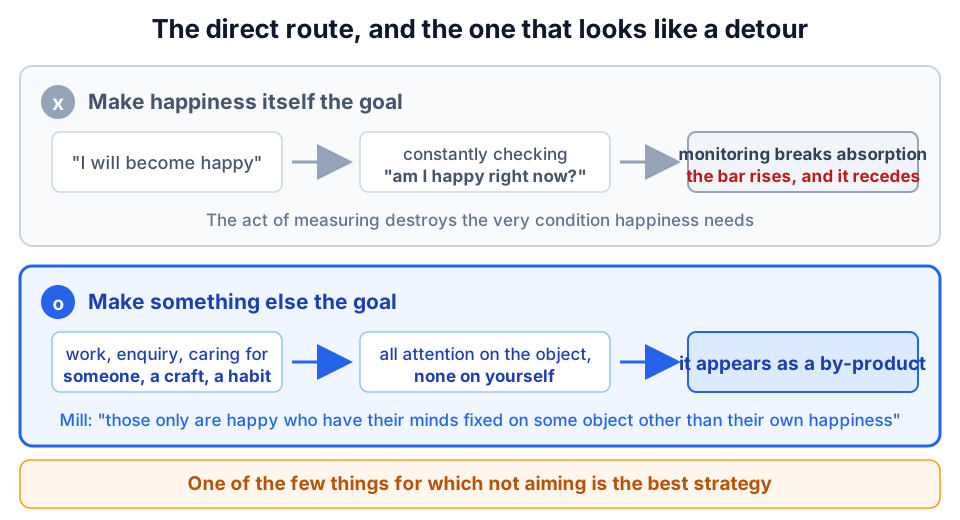
Make happiness the goal and you will not get it
The claim itself is simple.
Set “becoming happy” as your life’s goal, choose your actions for it, and keep checking whether it is working. People who take that approach tend to end up less happy than people who do not.
Meanwhile, people absorbed in something else entirely — their work, their research, caring for someone, a hobby — are frequently fulfilled without aiming at happiness at all.
Set a goal, work at it, get closer. That commonplace rule holds for most things, and inverts for this one.
Mill wrote it down as his own experience
One of the people who put the phenomenon clearly into words was the British philosopher John Stuart Mill.
Raised as a utilitarian and taught that maximising happiness was the correct goal, he fell into a serious mental crisis at twenty. He asked himself “if every one of my life’s aims were achieved, would I be happy?” and the answer was no.
Having come through it, he wrote this in his Autobiography.
Those only are happy who have their minds fixed on some object other than their own happiness; on the happiness of others, on the improvement of mankind, even on some art or pursuit, followed not as a means, but as itself an ideal end. Aiming thus at something else, they find happiness by the way.
Happiness is not caught by aiming at it; it appears as a by-product while you are doing something else. That was Mill’s conclusion.
The name paradox of hedonism was given by another British ethicist, Henry Sidgwick, who wrote in The Methods of Ethics (1874) that the impulse toward pleasure, if too strong, defeats its own aim.
You cannot be absorbed while observing yourself
Why does it happen? One clear explanation is about where attention goes.
When you are genuinely enjoying something, you are not thinking about whether you are enjoying it. All your attention is spent on what is in front of you.
Start checking “am I happy right now?” and part of that attention is reassigned to monitoring your own interior. The moment there is a self doing the monitoring, absorption has already broken.
The flow state studied by the psychologist Mihaly Csikszentmihalyi shares this feature. In flow, people report that self-consciousness thins out and even the sense of time becomes vague — you are too far inside the object to have any spare capacity for looking at yourself.
Put plainly, the act of trying to measure happiness destroys the condition under which happiness exists. It has the awkward property of “being there only while you are not looking.”
Modern research confirms it
This is not confined to a Victorian philosopher’s introspection; psychology experiments find similar results.
A 2011 study by Iris Mauss and colleagues reported that the more strongly people valued happiness, the lower their actual happiness and the stronger their loneliness. They measured how much participants valued happiness by questionnaire and examined the relation with life satisfaction and depressive tendencies.
In a further experiment using a film designed to induce a happy mood, the group primed to value happiness reported lower satisfaction.
The reason offered is the level of expectation. The harder you want happiness, the higher your bar for “is this enough?” becomes, and the good things in front of you start feeling insufficient. The more you aim, the less the same experience is worth.
Research in this area also reports cultural differences, with some cultural contexts where pursuing happiness is not counterproductive. Best held as a tendency rather than a law that holds everywhere.
The hedonic treadmill underneath
Beyond where attention goes, there is a second powerful mechanism behind why aiming directly fails: hedonic adaptation.
Happiness returns to baseline after events
Something good happens and happiness rises, then after a while it drifts back to its previous level. Brickman and Campbell named this the hedonic treadmill in 1971.
| Event | Immediate change | What happens long term |
|---|---|---|
| Large lottery win | Large rise | Returns close to baseline |
| Promotion or a raise | Rise | Back within about a year |
| Marriage | Rise | Back within about two years |
| Moving house | Rise | Returns relatively quickly |
| Job loss | Large fall | Does not fully recover even after re-employment |
| Death of a spouse | Large fall | Recovers over years, but not fully |
A 1978 study by Brickman and colleagues compared the happiness of major lottery winners with people disabled by accidents. Winners were not much happier than the general population, and were if anything less able to enjoy small everyday pleasures.
Not everything returns, though. Later research found that some events, such as job loss and bereavement, leave adaptation incomplete.
What aiming gets you, and what it drives away
Given the treadmill, different targets need different handling.
- Status and income: obtainable by aiming, but you adapt and return to baseline
- Absorbing activities: aiming starts the monitoring and breaks them, yet they persist as a by-product if you keep at them
- Relationships: trying to build them works, but framing it as “for happiness” tends to spin its wheels
- Removing suffering: relieving chronic pain or poverty adapts poorly, so the effect lasts
The readable tendency here is that subtracting what is dragging you down is more reliable than adding upward. Rather than adding happiness, remove the obstacles — that is the route less exposed to the treadmill.
Moving the goal aside
So what should you do?
What philosophers and psychologists both recommend is removing happiness from the goal position and putting something else there.
Work you can throw yourself into, a habit worth keeping, a person who matters. Set concrete targets like those, and treat happiness as something that follows along the way. Mill’s “find happiness by the way.”
The psychiatrist Viktor Frankl made much the same point, writing that happiness is not to be pursued but must ensue.
Speaking personally, I have felt more fulfilled in periods when I was absorbed in what was in front of me than in periods when I was deliberately trying to raise my happiness. “Do not try to be happy” sounds like a throwaway piece of advice, but treated as a concrete question about where to point your attention, it becomes much easier to act on.
Other things that break when measured
Happiness is not unique. The structure “the act of measuring changes the thing measured” is known in a number of fields.
- Goodhart’s law: when a measure becomes a target, it ceases to be a good measure
- Campbell’s law: the more a social indicator is used for decisions, the more it invites distortion and corruption
- Teaching to the test: an exam meant to measure ability becomes the target, and only exam technique improves
- Creativity and quotas: manage good ideas by count and you get safe, easily approved ones
All share the feature that something that should arise as a result was installed as a direct target.
Happiness is worse still, because the measurer and the thing measured are the same person. An external metric can be delegated to somebody else while you get on with the work; your own happiness you have to go and look at yourself. There is no escaping the constraint that you cannot measure and be absorbed at the same time.
Framed that way, Mill’s advice stops being a homily and becomes a design question. Pick a target that does not require you to monitor it. That is the only route out of this structure.
Related paradoxes of economics and happiness
Related paradoxes where an improvement measured in money or happiness fails to deliver the expected result.


Summary
This article covered the “Paradox of Hedonism.”
Set a goal, work at it, get closer — the obvious rule points the other way for happiness alone. The cause is that happiness arises alongside a state of absorption in something, and absorption ends the instant you start monitoring.
Not aiming turns out to be the best strategy. Simply knowing that such targets exist helps you work out where to stop pushing.
To return to the full list of paradoxes, follow the link below.
Thank you for reading. We hope to see you in the next article.

Also popular with readers
📚 Series: The World's Paradoxes (70/81)