
Thank you for visiting this site. This article covers the “Paradox of Plenty.”
A country blessed with oil or minerals ought to be able to build on that foundation. Run the statistics, however, and a clear tendency appears: the more resource-rich a country, the slower its growth and the more corruption and conflict it suffers. Also called the resource curse, it throws cold water on the question of what actually makes a country prosperous.
The statistics: more resources, slower growth
What brought the phenomenon to wide attention was a 1995 study by Jeffrey Sachs and Andrew Warner.
They examined, across many countries, the relation between natural-resource exports as a share of GDP and subsequent economic growth. A negative correlation emerged: the more dependent on resources, the lower the growth rate.
The phrase resource curse itself was coined in 1993 by the economist Richard Auty.
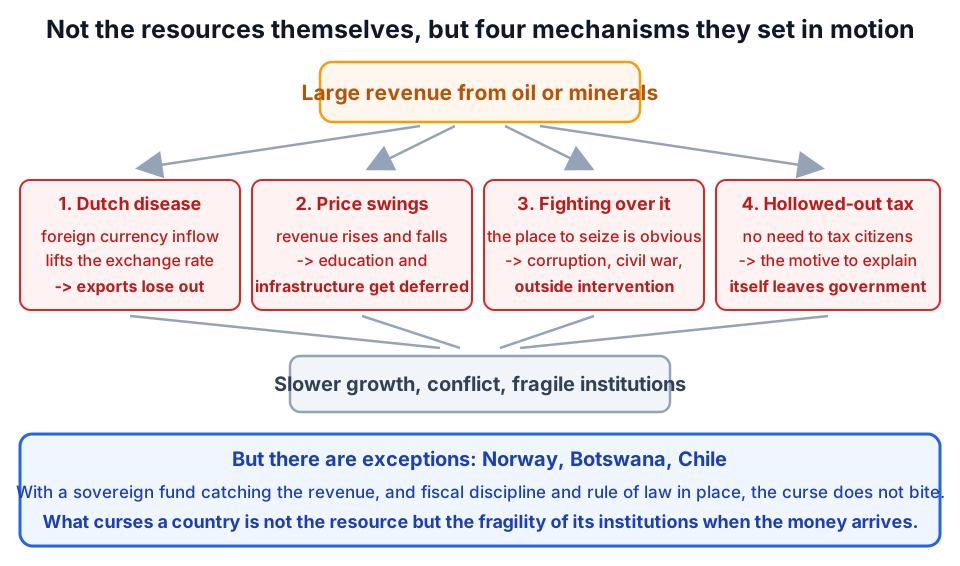
Resources do not bring disaster by themselves, of course. What actually happens is that resources set several awkward mechanisms in motion.
A rising currency kills the other industries
The first mechanism is known as Dutch disease.
The name comes from what followed the discovery of an enormous natural gas field in the Netherlands in 1959. Gas exports brought in foreign currency in volume, and the currency appreciated.
A stronger currency makes exports more expensive as seen from abroad. Manufacturing and agriculture that had been competitive can no longer compete in export markets. Dutch industry was damaged, and The Economist named the phenomenon Dutch disease in 1977.
The nasty part is that industries once lost do not come back easily. Technology and skilled workers take a long time to rebuild. When the resource runs out, what remains is a country that only knows how to dig.
Violent price swings wreck planning
The second is price volatility.
Oil and mineral prices move sharply with supply, demand and international events. When national income is concentrated in resources, that income swings the same way.
In the good years, spending expands generously; in the bad years it cannot be cut quickly and debt piles up. Long-term planning becomes impossible, so slow investments like education and infrastructure keep getting deferred.
Fighting over it wrecks institutions
The third is probably the most serious.
Resource revenue comes out of “a specific place”: an oil field, a mine. Whoever holds that place gets the whole thing.
Unlike wealth spread thinly across agriculture or manufacturing, the thing to seize is unambiguous, which makes it worth fighting over. Corruption follows, civil wars find funding, and outside powers are drawn in.
And fourth, there is the question of tax. When government revenue is covered by resources, there is little need to tax citizens.
A government that does not tax has no motive to explain itself either. The famous phrase is “no taxation without representation”; here it runs the other way, as “no taxation, therefore no representation.” The healthy tension between the governing and the governed never develops.
The type of resource changes the outcome
The strength of the curse is not uniform. It varies greatly with how easily the resource can be seized.
Point resources versus diffuse resources
| Type | Examples | How it is produced | Strength of the curse |
|---|---|---|---|
| Point resources | Oil, diamonds, rare metals | Concentrated in specific places | Strong |
| Diffuse resources | Grain, timber, fisheries | Spread over a wide area | Weak |
Hold one point on the map and an oil field or a mine hands you the entire revenue. Easy for armed groups to capture, easy for a regime to monopolise, and easy for outsiders to intervene over.
Agricultural produce, by contrast, is carried by many producers scattered across the country. Seizing it requires controlling the whole society, and the income distributes itself widely.
Denmark and New Zealand grew wealthy on farming and livestock not because they lacked resources but because their endowment was diffuse.
What Norway decided first
Let me look concretely at what the leading exception actually did.
- All revenue goes to the fund: oil income does not enter the treasury directly; it accumulates in the Government Pension Fund
- Only the returns are spendable: what may go to the budget is capped at the fund’s expected real return. Initially 4%, lowered to 3% in 2017
- Everything is invested abroad: money is blocked from flowing into the domestic economy, preventing currency appreciation and pressure on domestic industry
- The portfolio is public: holdings are disclosed down to individual securities, so political diversion can be watched for
What matters is that these were decided before oil revenue arrived in earnest. The fund was established in 1990; the first deposit came in 1996. Debate the uses after the money is in and vested interests form first.
The third point does a lot of work. Dutch disease is caused by inflows appreciating the currency; put the entire sum offshore and that route is sealed. A good example of “understand the mechanism and you can cut it at exactly one point.”
What the exceptions show
This is not, then, an inescapable fate. There are clear exceptions.
Norway acquired North Sea oil in the 1960s and channelled most of the revenue into a sovereign fund rather than letting it flood the domestic economy at once. Those assets have grown into one of the largest such funds in the world, held for future generations.
Botswana produces diamonds and has maintained fiscal discipline and the rule of law consistently since independence, achieving some of Africa’s strongest growth. Chile manages copper revenue through a stabilisation fund.
What these countries have in common is that they built the machinery for handling the revenue before it arrived, or immediately after.
What lays the curse is not the resource but the fragility of institutions when the resource arrives. Recent research also points out that the strength of the correlation depends on how resource dependence is measured in the first place, and there is growing caution about the simple picture of resources as the cause.
What countries without resources did
The mirror image is repeatedly cited too: resource-poor countries achieving high growth.
Japan, South Korea, Taiwan, Singapore, Switzerland. None has meaningful natural resources. They share these features.
- Investment in human capital: resources concentrated on education, competing on the quality of the workforce
- Exposure to export competition: with no protected income at home, they had to be good enough for international markets
- Taxation was necessary: taking tax from citizens meant government carried continuing accountability
- Value added through processing: importing raw materials, transforming them, selling them on
The third is exactly the element missing in the resource states. A government whose revenue depends on its citizens cannot ignore them.
That said, lacking resources does not automatically produce growth. Plenty of countries are resource-poor and still poor. What matters is not whether resources exist but that where the revenue comes from shapes how institutions get built.
A resource state that builds institutions first, like Norway, escapes the curse; a resource-poor state whose institutions never develop stays poor. The argument returns to the same single point.
The same shape for people and organisations
I feel this structure appears at smaller scales too.
A company with one large revenue source can come to rely on it and stop attempting anything new. When that source thins, it notices there is nothing else.
The same for individuals: settling comfortably into a well-paid job for a long time can cost you the chance to build skills that work elsewhere. Being fortunate strips away the effort needed to stay fortunate.
Then again, what the exceptional countries show is that “you can build the frame that catches the wealth in advance.” Decide how the incoming resource will be handled. The result turns on that one point, which makes it a fairly practical lesson.
Related paradoxes of economics and happiness
Related paradoxes where prosperity measured in money or resources fails to deliver the expected result.


Summary
This article covered the “Paradox of Plenty.”
Being blessed with resources holds growth back. The cause is not the resources themselves but four mechanisms: currency appreciation, price volatility, fighting over the prize, and the hollowing out of taxation. And as Norway and Botswana show, prepare the machinery first and the curse can be avoided.
The frame that handles what you have decides the outcome more than what you have. That it reads equally well as a story about countries and as a story about your own circumstances is, I think, what makes this paradox interesting.
To return to the full list of paradoxes, follow the link below.
Thank you for reading. We hope to see you in the next article.

Also popular with readers
📚 Series: The World's Paradoxes (60/81)