
Thank you for visiting this site. This article covers the “Productivity Paradox.”
Through the 1980s American firms poured money into computers. Offices filled with terminals and process after process was computerised, and yet the national productivity statistics were not rising — they were slowing down. The Nobel laureate Robert Solow summed the situation up in a single line, and the argument has run for nearly forty years since.
The line Solow wrote
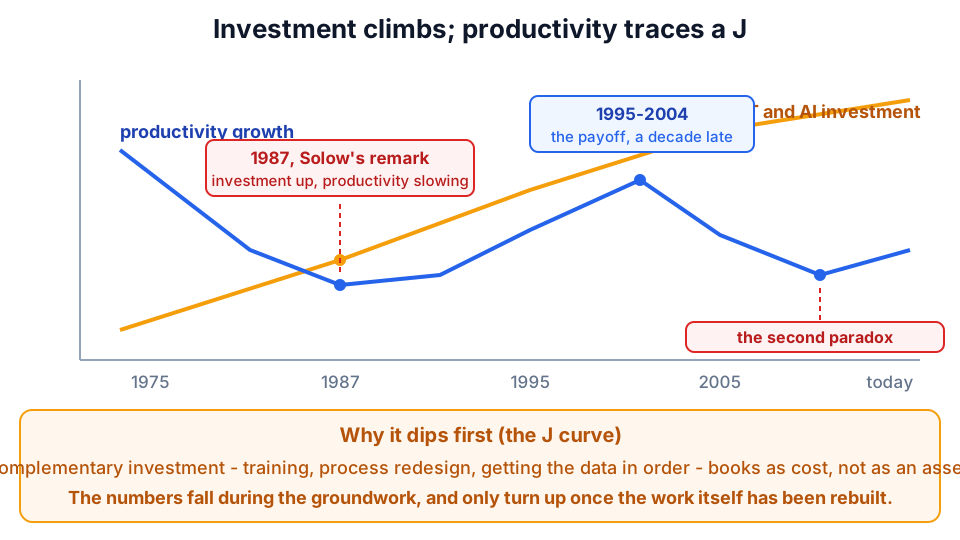
In 1987, in a New York Times book review, the economist Robert Solow wrote this.
You can see the computer age everywhere but in the productivity statistics.
That barbed line became the name of the problem. It is also called the Solow paradox.
The numbers of the period show how serious it was. US labour productivity growth had run at around 3% a year from the post-war period to the early 1970s, then fell into the 1% range. Precisely while firms were buying computers by the truckload, productivity growth had more than halved.
Technological progress raises productivity. The relationship economics had taken as given was failing in plain sight.
Four explanations on offer
Four main explanations were put forward at the time.
The first was measurement. Productivity is output divided by input, and the way output was measured had not moved on. When software gets better, or medical care improves in quality, the statistics struggle to turn that into numbers. The problem is acute in services, so the claim was that growth was real but unmeasured.
The second was lag. New technology does nothing on installation alone. It only begins to work once the way work is done and the shape of the organisation have been rebuilt around it. Research by Erik Brynjolfsson and colleagues showed that rebuilding takes more than a decade.
The third was redistribution. One firm may take customers using IT, but the firm that lost them simply shrinks, so society as a whole may not gain.
The fourth was plain misuse: deploying with vague objectives, or simply moving paper procedures onto a screen unchanged.
The numbers moved in the late 1990s
As the argument dragged on, the situation changed in the second half of the 1990s.
US productivity growth accelerated clearly from around 1995 to around 2004, returning to the high 2% range. Many studies analysed this as information technology investment finally bearing fruit.
Solow himself later said the paradox had been resolved. The answer, then, was not “it had no effect” but “it took a long time to start working.”
Between deployment and payoff, only the cost of the investment is booked. Training and reorganisation absorb people too, so apparent productivity temporarily falls. That dip before the rise came to be called the J curve.
The same thing happened with electrification
There is a powerful precedent, pointed out by the economic historian Paul David in 1990: the history of electrification.
Electric motors did almost nothing for forty years
Practical generators and electric motors appeared in the 1880s. American factory productivity did not begin to rise clearly until the 1920s.
The cause lay in how factories were built.
A steam-era factory was organised around one enormous engine, distributing power to each machine through long overhead line shafts and belts. Machines had to be packed within reach of the power, so buildings were multi-storey and layout was not free.
Replace only the steam engine in that factory with a large electric motor and the structure is unchanged, so efficiency barely moves.
The payoff came only after the switch to fitting a small motor to each individual machine. With the line shafts gone, machines could be laid out along the flow of work across a wide single-storey floor. That is when productivity jumped.
Every general-purpose technology has the same lag
The same shape repeats each time a large technology appears.
| Technology | Practical from | When it showed in the figures | Lag | What had to be rebuilt |
|---|---|---|---|---|
| Steam engine | 1770s | 1830s onward | ~60 years | The factory system, rail networks |
| Electric power | 1880s | 1920s onward | ~40 years | Factory layout |
| Computers | 1970s | 1995 onward | ~25 years | Business processes |
| Generative AI | 2020s | Undetermined | Undetermined | How work is divided up |
The lag is shortening, but it has not reached zero. And what was required each time is the same: not the tool, but a rebuild on the work side.
David wrote his paper in 1990, precisely while the Solow paradox was unresolved. On the precedent of electrification he predicted “wait a few more years and the numbers will move” — and from 1995 productivity duly accelerated.
And then a second paradox
The story does not end there.
From around 2005, US productivity growth slowed again. Smartphones spread, cloud computing expanded, machine learning became practical, and the statistics stagnated.
This is called the second productivity paradox, and it is still being argued about. In 2017 Brynjolfsson and colleagues pointed out that general-purpose technologies require large volumes of “invisible complementary investment.”
Retraining people, redesigning processes, getting data in order. Such investment is hard to book as an asset and appears in the accounts as cost. The numbers fall during the groundwork and rise once the results arrive — the same structure, repeating.
The current situation around generative AI is increasingly discussed in this frame. Handing out tools changes nothing; only the places that rebuild how work is assembled see a payoff. Almost exactly the story of the 1980s, forty years on.
Will the lag be shorter this time?
Assuming generative AI follows the same order, will the wait be shorter than for electricity or computers? There are factors on both sides.
Working toward a shorter lag:
- Low up-front cost: no factory to rebuild; it runs on the machines people already have
- Fast diffusion: it reached hundreds of millions of people within months
- Cheap iteration: trying something small and throwing it away can be repeated at low cost
And working toward a longer one:
- What must be rebuilt is human work: unlike machine layout, it means changing roles and where responsibility sits
- Verification is laborious: a new step is needed to check whether the output is correct
- Institutions have not caught up: scope of liability and methods of audit remain unsettled in many areas
The speed of handing out tools is historically unprecedented; the speed of rearranging work is much as it always was. That gap will decide how long this lag runs.
My own view is that the time to reach the statistics will shorten somewhat but not vanish. Knowing that a period of complaints that it is not working is guaranteed to be part of it should help avoid misjudging that period.
It matches how deployment actually feels
The structure fits experience on the ground.
Right after a new tool arrives, efficiency usually drops. You learn it, reconcile it with existing procedures, work around the parts that fail. Productivity in that period is naturally lower than before.
On top of that, many organisations treat “having deployed it” as the achievement and never go as far as rebuilding the work. In which case it stays down.
I think the main lesson of this paradox is that technology is a tool, and what produces results is the rebuilding of the work. It is not absent from the statistics because of the technology; it is absent because the rebuild has not happened.
If that was true of computers forty years ago, it is safest to assume today’s AI follows the same order.
Related paradoxes of economics and happiness
Related paradoxes where improvement through technology or money fails to produce the expected result.




Summary
This article covered the “Productivity Paradox.”
Computers everywhere but the statistics. What that line exposed was that between deploying a technology and getting results sit a long lag and a great deal of invisible investment.
And a problem apparently solved once comes back with each new technology. Realising we are standing in the same place right now makes it difficult to treat as somebody else’s story.
To return to the full list of paradoxes, follow the link below.
Thank you for reading. We hope to see you in the next article.

Also popular with readers
📚 Series: The World's Paradoxes (61/81)