
Thank you for visiting this site. This article covers “d’Alembert’s Paradox.”
A body moving through water meets resistance. Anyone who has swum knows this. And yet solving the eighteenth-century equations of fluid mechanics rigorously produces the answer that the resistance is exactly zero. There is no error in the calculation. For 150 years the contradiction split the field of fluid mechanics in two.
A calculation that gives zero drag
In 1752 the French mathematician Jean le Rond d’Alembert published a paper on fluid resistance.
He treated an ideal fluid under several conditions: no viscosity, incompressible, irrotational, and with a flow that does not change over time. Under those conditions he computed the flow around a body exactly.
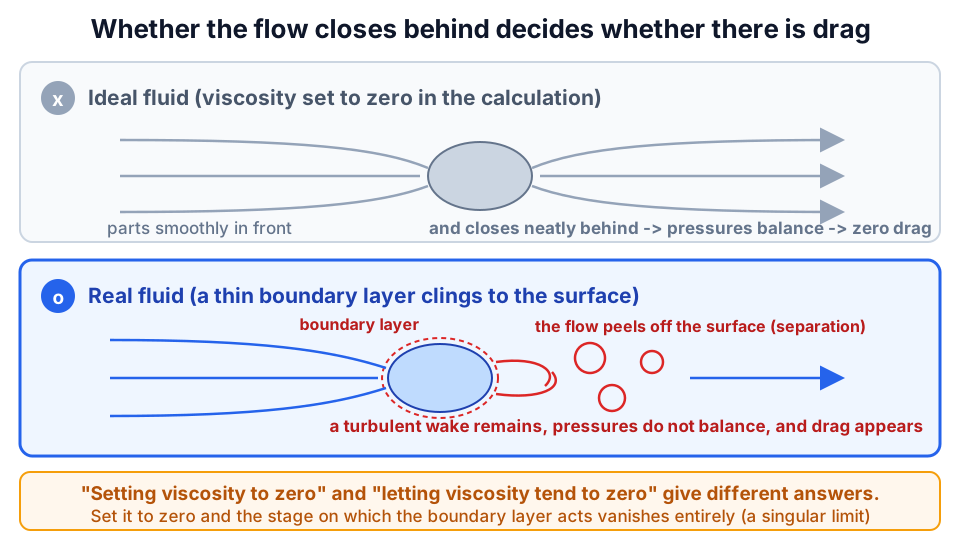
The result was clear. The pressure on the front of the body and the pressure on the back balance perfectly. The pushing and the pushing-back cancel, and net drag is zero.
Physically, the fluid parts smoothly in front of the body and closes neatly again behind it. Whatever slows in front is fully recovered behind, so no energy is lost anywhere.
D’Alembert knew this conflicted with reality. In the paper he wrote:
It seems to me that the theory, developed in all possible rigour, gives, at least in several cases, a strictly vanishing resistance, a singular paradox which I leave to future geometers to elucidate.
Fluid mechanics split in two
The contradiction cast a long shadow over the field.
On one side was theoretical hydrodynamics, chasing mathematically beautiful theory. In the hands of Euler, Lagrange and others the equations were refined superbly, and could explain neither the drag on a ship nor the lift on a wing.
On the other were the hydraulics engineers who actually built channels and pipework. They accumulated empirical rules from experiment and handled real design, without being able to say why any of it worked.
The situation is captured by a famous barb: “hydraulicians observed what could not be explained, and hydrodynamicists explained what could not be observed.” Two communities working on the same subject and unable to talk to each other.
Prandtl found a thin layer
Resolution came in 1904, 152 years after d’Alembert’s paper.
At a conference in Heidelberg, the German physicist Ludwig Prandtl gave a talk of about ten minutes. Its content was to focus on an extremely thin region at the surface of the body.
The ideal-fluid calculation had set viscosity to zero. The viscosity of real water and air is indeed very small and looks safely negligible.
Prandtl pointed out that immediately next to the surface, viscosity cannot be neglected however small it is. Fluid velocity at the surface is zero, so between there and a short distance away the velocity changes abruptly. That thin region is the boundary layer.
Inside the boundary layer the velocity gradient is steep, so viscosity does bite — and the flow can peel away from the surface over the rear of the body. That is separation.
Once separation occurs, a turbulent region containing vortices forms behind the body. The front and rear pressures no longer balance, and drag appears. The ideal-fluid premise that the flow “closes neatly behind” simply did not hold.
Setting to zero is not the same as tending to zero
The lesson of this paradox in one line:
calculating with viscosity set to zero and calculating with viscosity tending to zero give different answers.
Ordinary intuition says small quantities can be ignored. Here, the instant viscosity is set to zero the stage on which the boundary layer performs disappears, and you are computing in a different world entirely.
Mathematics calls this a singular limit. The judgement that something is negligible because it is small does not always hold.
Since learning this, whenever I hear “the effect was small so we ignored it,” I want to know whether the smallness is the kind that stops mattering continuously. There may be a boundary where the character of the effect changes.
There is more than one kind of drag
What d’Alembert’s calculation zeroed out was only part of the drag. Here is the modern breakdown.
Four kinds of drag
| Kind | Cause | In an ideal fluid | How to reduce it |
|---|---|---|---|
| Pressure (form) drag | Pressure difference from separation behind | Vanishes | Taper the rear into a streamlined shape |
| Skin friction drag | Viscous drag at the surface | Vanishes | Less surface area, smoother finish |
| Wave drag | Energy lost making waves at the surface | Not treated | Hull shape, such as a bulbous bow |
| Induced drag | Loss from vortices at the wingtip | Not treated | Long thin wings, winglets |
The first two are what vanished in d’Alembert’s calculation. Setting viscosity to zero makes skin friction undefinable, and with no separation, pressure drag disappears too.
The interesting part is that these two pull against each other. A smoother surface reduces friction drag but can make separation more likely and raise pressure drag. The dimples on a golf ball are a design that goes after pressure drag in exactly that tug of war.
Singular limits appear in other fields
The phenomenon where “set to zero” and “tend to zero” give different answers is not exclusive to fluid mechanics.
- Geometrical optics: set the wavelength to zero and light only travels in straight lines; diffraction and interference vanish
- Classical mechanics: set Planck’s constant to zero and tunnelling vanishes; particles cannot cross barriers
- Newtonian mechanics: set the speed of light to infinity and the relativity of simultaneity vanishes
- Statistical mechanics: only in the limit of infinite particle number do phase transitions appear
All have the same shape: set a small quantity to zero and the phenomenon that quantity was supporting disappears wholesale.
Whether an approximation is usable is not decided by the size of the quantity alone. You have to check what is lost when the quantity becomes zero. D’Alembert’s paradox is the oldest instance of that lesson.
It leads to today’s aircraft and ships
Prandtl’s boundary layer theory became the foundation of aeronautical and naval engineering.
In designing a wing section, where separation is made to occur — or prevented — is decisive. An aircraft wing stalls because the angle of attack grows too large and separation sets in.
The dimples on a golf ball follow the same logic. Deliberately disturbing the surface flow changes the character of the boundary layer and moves the separation point rearward. The turbulent region behind shrinks and the ball flies further.
You would expect smoother to mean less drag, and the truth runs the other way. The answer to a question thrown out 150 years ago now lives in the design of familiar objects.
Lift was explained in the same period
Drag was not the only thing d’Alembert’s calculation could not explain. Why a wing lifts also has no explanation in an ideal fluid.
A symmetric flow produces no pressure difference between top and bottom, so lift comes out zero as well. The same reason as zero drag.
The problem was solved by circulation theory, reached independently between 1902 and 1906 by Martin Kutta in Germany and Nikolai Zhukovsky in Russia.
The idea is this. When a vortex-like component called “circulation” is added to the flow around a wing, the flow over the upper surface speeds up and the lower slows, producing a pressure difference. The magnitude of the lift is proportional to the strength of that circulation.
Where does the circulation come from? The boundary layer again. When the flow is arranged to leave the trailing edge smoothly, circulation is left around the wing as the reaction.
Which is to say the reason drag exists and the reason lift exists both live in the thin layer where viscosity acts. The two phenomena that vanished in the ideal fluid came back together, from the same place.
That the period when aircraft became able to fly overlaps with the period when this theory came together is, I think, no coincidence.
Related paradoxes of classical physics
Related paradoxes about familiar phenomena that stop yielding to straightforward reasoning.




Summary
This article covered “d’Alembert’s Paradox.”
Solve correct equations rigorously and the answer comes out the opposite of reality. The cause was not the calculation but the innocuous-looking assumption of zero viscosity made at the start.
Something small enough to ignore turns out to be decisive in one particular place. The structure it took 150 years to find is a way of looking at things that transfers widely.
To return to the full list of paradoxes, follow the link below.
Thank you for reading. We hope to see you in the next article.

Also popular with readers
📚 Series: The World's Paradoxes (41/81)