
Thank you for visiting this site. This article covers the “Ehrenfest Paradox.”
Spin a disc at close to the speed of light and its rim contracts along the direction of travel, while the radius, being perpendicular to the rotation, does not. Circumference divided by diameter then comes out different from pi. The problem of a supposedly rigid disc that cannot keep its shape became an important stepping stone pushing Einstein toward general relativity.
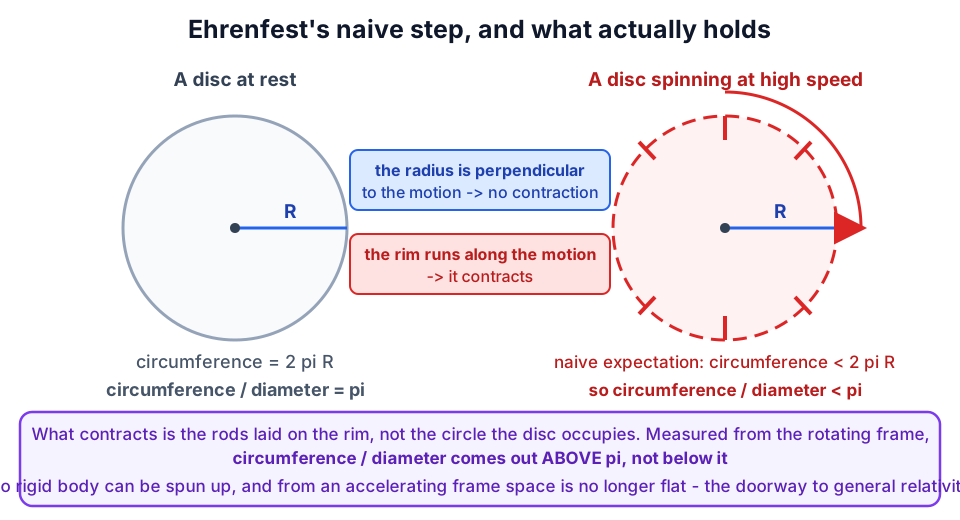
What happens on a spinning disc
Start with a stationary disc of radius R and circumference 2 pi R. An entirely ordinary circle.
Now spin it fast enough that the rim approaches the speed of light. Consider two parts separately.
A small segment on the rim is moving at tremendous speed along the tangent. Moving objects contract along their direction of travel, so this segment gets shorter. Add the segments up around the rim and the circumference measures less than 2 pi R.
What about along the radius? The direction of rotation is always tangential, so the radius is perpendicular to the motion. No contraction occurs perpendicular to motion. The radius stays R.
To summarise: the radius stays R and only the circumference shortens. Divide the circumference by the diameter 2R and you get a value below pi.
That is the chain of reasoning Ehrenfest assembled in order to produce a contradiction. It has one trap built into it. What contracts is the material laid along the rim, not the circle the disc occupies in the stationary frame. That distinction does the work later, when the answer arrives.
Can the disc keep its shape?
Here is the contradiction.
If the disc is a rigid object, spinning it should not change its shape. But if only the circumference contracts while the radius does not, it is no longer a flat circle.
Think about a real material and the rim ends up stretched beyond its natural length. Spin the disc while holding the radius at R and the material of the rim is too short for the job and has to keep turning under tension. Exactly the shape of Bell’s spaceship, where the thread is pulled taut and snaps.
The problem was posed in 1909 by the Austrian physicist Paul Ehrenfest, only four years after special relativity was published.
Half the answer: rigid bodies do not exist
In the modern understanding, half the answer is “there is no such thing as a rigid disc in the first place.”
Relativity cannot accommodate a perfectly rigid object. Force propagates no faster than light, so an object whose whole body moves the instant you push it is impossible. The same root as the thread snapping in Bell’s spaceship paradox.
There is a more precise result too. By a theorem shown by Herglotz and Noether around 1910, it is impossible in principle to spin a disc up from rest while preserving its shape.
Try to spin a stationary disc and stress necessarily appears somewhere. Hold the radius and the rim is stretched; let the material keep its natural length and the radius shrinks instead. Either way the shape changes. What was contradictory was not relativity but the premise of “spinning a rigid disc.”
The geometry of a rotating world is not flat
The other half of the answer is deeper.
Suppose an observer rotating with the disc measures the space beneath their feet. Laying measuring rods around the circumference, they need more rods than a stationary observer counts.
So in the space as seen from the rotating frame, circumference divided by radius comes out greater than 2 pi. Divide by the diameter instead and the value is not below pi but above it. That cannot happen in flat space.
And here the trap from earlier is collected. Seen from the stationary frame, the disc still occupies a circle of radius R, and that circle still has circumference 2 pi R. What contracted was the rods laid along the rim, which is precisely why the rotating observer needs more of them. The circumference does not shrink; the thing measuring it does. Confuse the two and you arrive at the opposite conclusion, that the ratio falls below pi.
The Euclidean geometry taught at school assumes flat space. Merely rotating breaks that assumption. What appears here is the fact that “from an accelerating frame, space itself looks curved.”
What clocks do on a spinning disc
We have talked about length; something equally interesting happens with time.
Clocks run slower toward the rim
Each point on the disc moves faster the further it is from the centre. Fast-moving clocks run slow, so a clock at the centre and a clock on the rim keep different time.
And the amount of slowing varies with position, changing continuously with radius. Trying to define a single shared time across the whole disc does not work.
In a rotating frame, even “what counts as simultaneous” cannot be settled uniquely. That is part of why Ehrenfest’s problem remains a hard spot still under discussion.
The Sagnac effect, and the instruments it produced
Rotation’s effect on time is actually measurable.
Send light both clockwise and anticlockwise around a circular path. If the apparatus is stationary they complete the loop together; if it is rotating, they arrive at different times, because the beam travelling with the rotation has further to chase.
Confirmed by Georges Sagnac in 1913, the phenomenon is now a product.
| Device | Use | Principle |
|---|---|---|
| Ring laser gyroscope | Attitude control in aircraft and ships | Detects the path difference as a frequency shift |
| Fibre-optic gyroscope | Rockets, cars, drones | Detects a phase difference in a coil of fibre |
| GPS timing correction | Position calculation | Corrects for the path difference from Earth’s rotation |
Having no rotating parts, they do not wear and respond quickly. The subject of a thought experiment about a spinning disc now flies as the device keeping airliners level.
GPS needs the Sagnac correction for the same reason: ignore Earth’s rotation and positions drift by tens of metres. An argument from more than a century ago underpins the accuracy of everyday location data.
It led Einstein to general relativity
The person who reacted most strongly to this was Albert Einstein.
He had already arrived at the equivalence principle: acceleration and gravity cannot be distinguished. Rotation is a kind of acceleration, and on a rotating disc the geometry of space is no longer flat.
From there comes the idea that where there is gravity, space itself may be curved. Stop treating gravity as a force and describe it as the geometry of spacetime.
Einstein himself, looking back on the road to general relativity, said the consideration of the rotating disc played a decisive role. He went on to relearn Riemannian geometry and completed general relativity in 1915.
What looked like a contradiction turned out to be the entrance to a new theory. I think this is the example that best expresses what paradoxes are worth.
Parts still under discussion
That said, the problem is not entirely settled.
How to define length on a rotating disc, and what simultaneity means for an observer rotating with it, are points still argued over in detail. The Norwegian physicist Øyvind Grøn among others has produced many papers on this subject alone.
The core of it touches the hard question of “how to describe spacetime as seen from an accelerating frame.” Special relativity handles relations between inertial frames, so situations involving acceleration, like rotation, demand care.
A thought experiment more than a century old still being the subject of papers is quite unusual.
Nature really does have fast-spinning bodies
It looks like a thought experiment, and yet the universe contains objects spinning at extreme rates.
Pulsars, a kind of neutron star, are only around 20 kilometres across and some have been found rotating hundreds of times a second. In the fastest cases, surface speed near the equator is estimated above 10% of light speed.
At that scale the rigid-body approximation is useless. Research accounts for points like these.
- Deformation of shape: centrifugal force bulges the equator, so it is not a perfect sphere
- Internal stress: there is a rotation rate beyond which the material would tear apart
- Differences in the rate of time: clocks at the surface and at the centre run differently
- Frame dragging: rotation drags the surrounding spacetime itself
The situation Ehrenfest identified in saying “a rigid disc cannot be spun” is happening for real at astronomical scale.
Handling rotating objects correctly requires a theory with deformation built in from the start. A conclusion reached by thought experiment a century ago is used directly in describing what we observe.
Related paradoxes of relativity
Related paradoxes where everyday intuitions about length and simultaneity stop working near the speed of light.




Summary
This article covered the “Ehrenfest Paradox.”
The circumference contracts and the radius does not. From that simple observation follow two things: that the concept of a rigid body is unusable, and that space is not flat from an accelerating frame. Measure it properly from the rotating frame and the ratio standing in for pi comes out above pi, not below it — and it was the naive contradiction that opened the road there.
And the second leads on to reconceiving gravity as geometry. As a case of an awkward contradiction becoming the entrance to a theory, it holds one of the more distinguished positions in the history of physics.
To return to the full list of paradoxes, follow the link below.
Thank you for reading. We hope to see you in the next article.

Also popular with readers
📚 Series: The World's Paradoxes (40/81)