
Thank you for visiting this site. This article covers “Bell’s Spaceship Paradox.”
Connect two spaceships with a fine thread and give them exactly the same acceleration. The gap between them never changes, so the thread should be fine — and yet the correct answer is that the thread snaps. The problem is famous for an accompanying anecdote: a majority of the researchers in CERN’s theory division got it wrong.
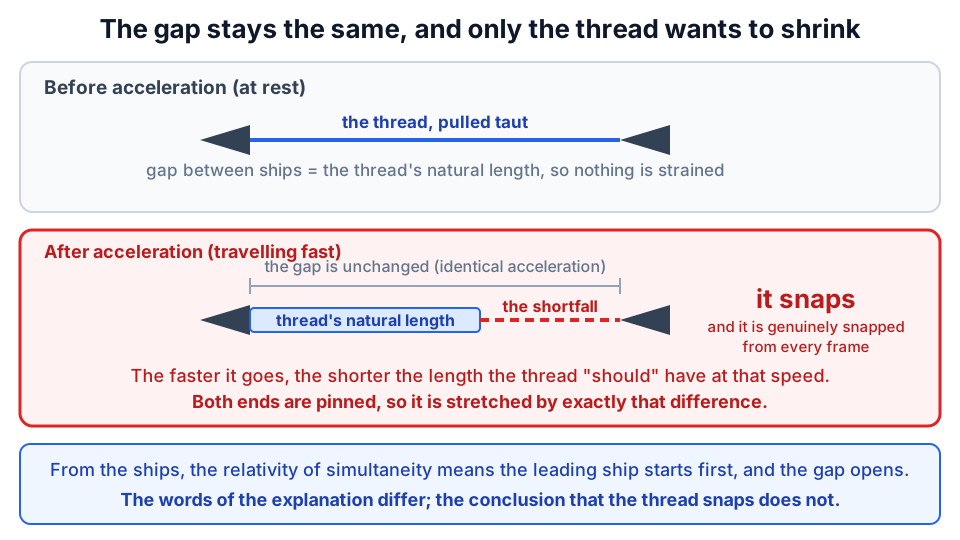
Two ships and a thread
The setup.
Two identical spaceships sit at rest in space, one behind the other. A fine thread runs between them, pulled taut. The thread is extremely fragile: stretch it at all and it breaks.
Now give both ships exactly the same acceleration command. They start simultaneously, accelerate at the same rate, for the same duration. Seen from ground control, their speeds match at every instant.
If the speeds are identical, the gap between them does not change — and indeed, as measured from ground control, the gap stays exactly what it was.
So what happens to the thread?
The researchers at CERN got it wrong
The problem was popularised by John Stewart Bell, known for Bell’s inequality in quantum mechanics.
Raising it in a 1976 paper, he recorded a memorable anecdote. Posing the problem in the CERN theory division canteen, he found “the thread does not break” to be a clear majority answer.
The reason given was clean too: the gap does not change, so there is nothing to stretch the thread.
The correct answer was that the thread breaks. Bell presented the result as a warning about how physics is taught: being able to solve relativity as a set of calculations does not mean understanding what is happening.
Why it breaks
Why does it break? The key is that the thread is not an abstract line but an object made of matter.
A moving object appears contracted along its direction of travel. This is Lorentz contraction, and the faster it goes the greater the contraction.
The thread is accelerating and getting faster, so “the length it ought to have at this speed” — its natural length — keeps getting shorter.
But both ends of the thread are fixed to the ships, and the gap between the ships does not change. A thread that wants to contract is being held stretched instead.
The faster it goes, the greater the strain. At some point it exceeds the thread’s strength and it snaps.
“The gap does not change” was not the reason for safety; it was the reason for the break. For the thread to survive, the gap between the ships would have had to contract too.
What it looks like from the ships
Let me check it from the point of view of someone aboard.
From there, the leading ship slowly pulls away. They are supposedly accelerating identically, and yet the distance between them opens.
The cause is the relativity of simultaneity. “Starting at the same moment” is simultaneous in ground control’s frame, not in the moving ships’ frame. From the ships, the leading vessel appears to have started accelerating first.
The ship that started first moves ahead, so of course the distance opens. And the thread, dragged by that opening distance, breaks.
From ground control: “the gap is unchanged and the thread wants to contract.” From the ships: “the thread’s length is unchanged and the gap is opening.” Different words, identical conclusion.
The concept of a rigid body stops working
What this paradox really demonstrates is that in relativity the idea of a rigid body does not hold.
Everyday intuition says pushing a rod moves it end to end at once. In relativity, the speed at which force propagates also cannot exceed the speed of light. An object whose far end moves the instant you push it cannot exist.
For an object to accelerate while keeping its shape, the rear must accelerate harder than the front. If the accelerations are equal front to back, the object necessarily stretches or compresses.
In Bell’s problem, the two ships accelerate identically. That fails the shape-preserving condition, so strain on the thread between them is unavoidable.
How to accelerate without breaking it
So how should they accelerate for the thread to survive? The answer is clear.
Accelerate the rear ship harder
Motion that accelerates while preserving shape is called Born rigid motion. The condition is simple: the rear ship must accelerate harder than the front one.
Then the gap, as seen from ground control, contracts as speed rises. The gap shrinks by exactly as much as the thread wants to, so nothing is strained.
| How they accelerate | Front vs rear acceleration | Gap seen from ground control | The thread |
|---|---|---|---|
| Identical (Bell’s setup) | Equal | Unchanged | Snaps |
| Born rigid motion | Rear is greater | Contracts | Survives |
| Front harder | Front is greater | Widens | Snaps sooner |
From the point of view of those aboard, Born rigid motion keeps the distance between the ships constant throughout. “Shape unchanged for those aboard” is the condition for the thread’s survival.
This approach has its own limit. The longer the convoy, the harder the rear must accelerate, and beyond a certain length the acceleration required at the tail becomes infinite. There is a fundamental ceiling on accelerating a long object as a whole.
Why even experts get it wrong
As Bell’s anecdote shows, trained people are especially prone to this. Several reasons suggest themselves.
- Lorentz contraction is taught as apparent: understood as a matter of how you measure, you do not expect things to break
- The rigid-body image will not go away: everyday intuition says objects move while keeping their shape
- Forgetting to apply relative simultaneity: known as a formula, but hard to notice it biting here
- The question looks too simple: it seems not to need calculation, so you answer from intuition
Being able to use a formula and being able to apply it to a situation are different states, and this problem makes that point without mercy.
Lorentz contraction is not an appearance
The problem has a second significance.
Lorentz contraction is sometimes explained as “merely how it looks.” Nothing actually contracts; it is a question of measurement.
Bell’s spaceships show that understanding to be inadequate. The thread really does break. And a broken thread is broken in every frame. Illusions do not sever objects.
Length contraction has a real effect on matter, in the form of stress. Establishing that is the greatest value of this thought experiment.
Incidentally, the problem was first published not by Bell but by Edmond Dewan and Michael Beran in 1959. It became widely known through Bell’s treatment, and he himself acknowledged the earlier work.
Can the effect actually be measured?
Testing it with spaceships is some way off, but this is not an unfalsifiable claim.
At the speeds of real vehicles, the contraction is far smaller than an atom and the stress on a thread is well below any measurement limit. There is no way to check it in everyday conditions.
Where near-light speeds are handled, the situation changes. Particle accelerators account, from the design stage, for how an accelerated bunch of particles spreads along its direction of travel. That the shape of the bunch depends on how it is accelerated is a working assumption of operating the machine.
The electric field a fast-moving charged particle creates around it is also flattened along the direction of travel — an effect observed routinely in accelerator operation.
No experiment reproduces Bell’s spaceships as such, but the part that says “fast-moving objects really do contract, and that has physical consequences” has been confirmed indirectly many times.
That identical acceleration snaps the thread strikes me as a fine demonstration of just how far the relativity of simultaneity is from intuition.
Related paradoxes of relativity
Related paradoxes where everyday intuitions about length and simultaneity stop working near the speed of light.




Summary
This article covered “Bell’s Spaceship Paradox.”
The apparently obvious inference that an unchanged gap means safety turns out to be wrong. The reason comes down to one thing: the thread wants to contract and is not allowed to.
Anecdote included, it teaches where familiar intuition gets betrayed. Anyone who has finished learning relativity is worth setting it once.
To return to the full list of paradoxes, follow the link below.
Thank you for reading. We hope to see you in the next article.

Also popular with readers
📚 Series: The World's Paradoxes (39/81)