Thank you for visiting this site. This article covers the “Barber Paradox.”
A village has exactly one barber, trading under the rule that he “shaves everyone who does not shave themselves, and shaves nobody who does.” So who shaves the barber’s own beard? Either answer breaks the rule. It is well known as Russell’s paradox translated into everyday language — but there is a decisive difference between the two.
One barber in the village
Let me set it out carefully first.
A village has exactly one barber, and his business runs on this rule.
Every villager who does not shave himself is shaved by this barber. No villager who does shave himself is ever shaved by this barber.
Put differently, the villagers fall into exactly two groups: those who shave themselves, and those the barber shaves. No overlap, nobody left out.
So far this sounds like an ordinary piece of commerce, and for the villagers nothing goes wrong at all.
The trouble arrives when you remember that the barber is a villager too.
Either answer breaks the rule
There are only two possibilities for the barber’s beard.
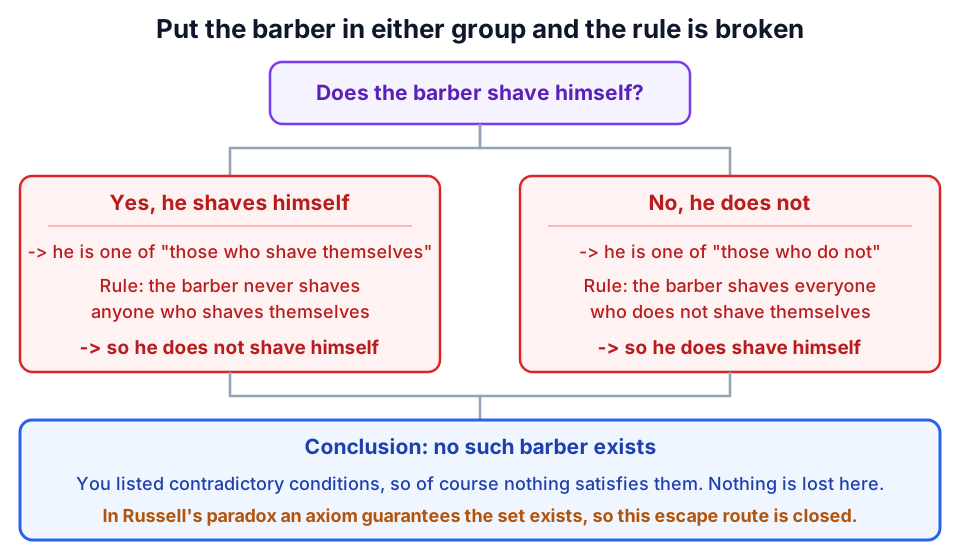
Suppose “the barber shaves himself.” Then he belongs to the group who shave themselves. But the second half of the rule says the barber never shaves anyone in that group. Since the barber is the one doing the shaving, it follows that he does not shave himself.
Now suppose “the barber does not shave himself.” Then he belongs to the group who do not, and the first half of the rule says the barber shaves all of them. So the barber shaves the barber, which means he does shave himself after all.
In both cases the assumption comes straight back negated. There is no way out.
Looking for loopholes misses the point
Hearing this, most people want to poke at the setup, and there are plenty of openings.
- If the barber is a woman: no beard, so out of scope and no contradiction
- If the barber cannot grow a beard: likewise out of scope
- If the barber is not a villager: the rule only applies to villagers
- If there are two barbers: they shave each other and it works
Each does avoid the contradiction, and the fact that it can be avoided is itself evidence that the loophole misses what the problem is about.
All of them work by arranging for the barber not to be in scope. Of course the contradiction disappears once you sever the self-reference; that is just restating what the problem is poking at.
Which also means that where the scope necessarily includes itself, these escape routes are unavailable.
Set theory was exactly that situation. Consider “all sets that do not contain themselves”: since that collection is itself a set, you cannot push it outside the scope. No calling in a barber from the next village.
Hunting loopholes is fun as a puzzle, but you have to see what happens when they are all sealed off, or the next section will not land.
The popular version Russell spread
It was Bertrand Russell who put this into circulation, in his 1918 lectures The Philosophy of Logical Atomism.
The paradox Russell found himself in 1901 is written in the language of set theory. Consider “the set of all sets that do not contain themselves as a member”, and a contradiction arises over whether that set contains itself.
For anyone not at home with the word set this does not land, hence the version with the barber. The structure is identical: the relation “shaves” corresponds to the relation “is contained in.”
Russell noted that the barber illustration was not his own invention but something he had heard, and the actual originator is unknown.
It is not really a paradox
Now the important part. The barber story is often treated as an equal of Russell’s paradox, but the logical seriousness is not remotely the same.
With the barber, the conclusion we should draw from the contradiction is perfectly clear: “no such barber exists.”
If you write down a set of contradictory conditions, obviously nothing satisfies them. It is no more troubling than the non-existence of “a number greater than 1 and less than 0.” The barber story is less a paradox than a proof that no such barber is possible.
Russell himself made this point explicitly, saying the barber case is not a genuine contradiction.
Why Russell’s version was serious
So why could set theory not be dismissed the same way?
Set theory at the time carried a premise called the naive comprehension axiom: “write down a condition and the set of everything satisfying it necessarily exists.”
Under that premise, the moment you write the condition “does not contain itself,” the existence of the corresponding set is automatically guaranteed. You cannot get away with saying it does not exist.
So the barber case ends at “it does not exist,” while the set case becomes “it must exist, and it is contradictory.” The same shape, and completely different destinations.
Once that difference was clear to me, my view of the illustration changed. It is a case where clarity was bought at the cost of losing the single most important part of the problem.
The value depends on whether you can say “it does not exist”
The barber argument ends at “no such thing exists.” Yet the same argument, in some fields, becomes an extremely important theorem.
The dividing line is whether existence was guaranteed
| Object | Does it exist? | Why we can tell |
|---|---|---|
| A barber who shaves only non-shavers | No | Just a list of contradictory conditions |
| A number greater than 1 and less than 0 | No | Likewise |
| The set of all sets not containing themselves | In naive set theory it must | The comprehension axiom guarantees existence |
| A program deciding whether any program halts | No | The same reductio, but the conclusion carries weight |
Only the third row is peculiar. An axiom has already promised existence, so you cannot escape by denying it. The axiom itself had to be rewritten.
When the same argument becomes a theorem
The halting problem in the fourth row is built exactly like the barber.
Assume there is “a program that decides, for any program, whether it halts.” Use it to build a contrary program that “loops forever if the verdict is ‘halts’, and stops if the verdict is ‘does not halt’.”
Feed that contrary program itself to the decider and you get a contradiction: if it halts it does not, and if it does not it does. Therefore no such decider exists.
The conclusion that sounds trivial for the barber becomes, here, an important theorem fixing the limits of computation. Turing’s 1936 result is one of the foundations of computer science.
The difference is that nobody expected the barber to exist, whereas plenty of people believed “a universal decider” could be built. Same argument; the value depends on what you negated.
How the foundations of mathematics were rebuilt
Once the naive comprehension axiom was identified as the cause, mathematicians rebuilt around it.
ZFC, the standard set theory today, abandons the promise that writing a condition produces a set. In its place is the axiom of separation, which only allows you to carve out the part of an already existing set that satisfies a condition.
You cannot conjure a set out of nothing from a condition alone. That restriction means the problematic set can never be formed in the first place, and the contradiction never arises.
Russell took a different road, building type theory, which assigns objects to levels and forbids self-reference. Both approaches share the same instinct: “restrict what a thing may say about itself.”
Related paradoxes of self-reference
Related paradoxes where meaning collapses the moment something tries to speak about itself.
Summary
This article covered the “Barber Paradox.”
Shaving or not shaving both produce a contradiction, which looks hopeless, but the answer is simply that no such barber ever existed. Given that it is a list of contradictory conditions, that is only to be expected.
What I personally find interesting is that the identical structure did not permit the same escape in set theory. A clear illustration can neatly strip away precisely the difficulty that mattered. I think there is a lesson in that as well.
To return to the full list of paradoxes, follow the link below.
Thank you for reading. We hope to see you in the next article.
Also popular with readers
📚 Series: The World's Paradoxes (22/81)