Thank you for visiting this site. This article covers “Curry’s Paradox.”
Take the single sentence “If this sentence is true, then Santa Claus exists.” From that material alone, the conclusion that Santa Claus exists can be formally derived. And the conclusion can be swapped for anything you like. Unlike the liar paradox, this one uses no negation whatsoever, which is what makes it genuinely alarming.
One sentence that proves Santa exists
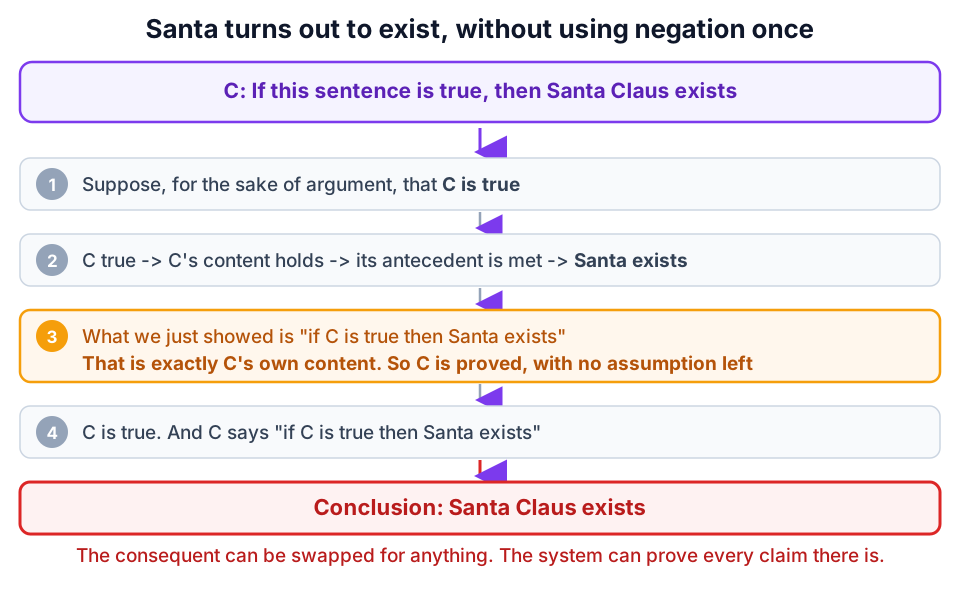
Start with the following sentence. Call it C.
C: If this sentence is true, then Santa Claus exists.
At a glance it looks empty, asserting nothing. It carries a condition and never claims Santa is real.
But “this sentence” refers to C itself. So C has the content “if C is true, Santa exists.”
Being a sentence that talks about itself, it has to go round once before its meaning settles. Let me follow what comes out.
Following the proof through
Step by step.
First, assume C is true.
C being true means C’s content holds. C’s content was “if C is true then Santa exists.”
By assumption C is true, so the antecedent of that conditional is satisfied. Therefore Santa Claus exists.
What we have shown so far is “assuming C is true, Santa exists.”
Here is the heart of the trick. What we have just shown is exactly what C itself says. So we have proved C’s content, which means C is true. We have C’s truth with no assumption remaining.
One last move. C is true, and C says “if C is true then Santa exists.” The antecedent is satisfied, so out comes the consequent.
Santa Claus exists. Proof complete.
No negation anywhere
The strange thing is that nothing in the reasoning looks forced.
All we used was the rule that if a conditional’s antecedent holds so does its consequent, and the rule that what you derived from an assumption can be rewritten as a conditional. Both are among the most basic tools in logic.
And what stands out is that the concept of negation never appears once.
The liar paradox takes the form “this sentence is false,” where negation plays an essential role. That is precisely why responses like “admit a third value that is neither true nor false” have been proposed.
That move does not work on Curry’s paradox. With no negation present, tinkering with how negation is handled solves nothing.
Worse, the consequent can be swapped for anything at all. “1 equals 2” or “I am immortal” can be proved by exactly the same steps. A system that can prove every claim is completely meaningless.
Its discoverer, Haskell Curry
The paradox was pointed out in a 1942 paper by the American logician Haskell Curry.
He was working at the time on showing that certain formal systems contained contradictions, and extracted this structure in the process. Almost the same content was treated independently by the mathematician Martin Löb, so it is sometimes called Löb’s paradox.
Curry’s name may be familiar to anyone who has studied programming: currying, the technique of converting a function to take its arguments one at a time, and the functional language Haskell are both named after him.
Which rule do you give up?
Once a contradiction appears, some premise has to go. There are three main candidates.
One is to forbid self-reference, giving language a hierarchy so that a sentence cannot refer to itself. This is the same road Tarski took for the definition of truth.
Two is to restrict the truth predicate. Being able to move freely between “C is true” and “C’s content” is the material of the contradiction, so you put conditions on that movement.
The third was the most exciting option for logicians: give up the contraction rule.
Contraction is the rule that when you have the form “if A then if A then B,” you may collapse it into “if A then B.” In the proof above, it is doing the work at the point where C gets used twice.
“Using the same premise any number of times is the same as using it once” looks far too obvious to question, and yet logical systems that refuse it can be built. Linear logic and relevance logic are exactly that, treating premises like resources to be counted. Curry’s paradox became one of the major motivations for taking these substructural logics seriously.
Logics that count premises as resources
Giving up contraction looked outlandish at first, and then found support from a completely different direction.
How different systems handle it
| Logical system | Contraction | Treatment of premises | Curry’s contradiction |
|---|---|---|---|
| Classical logic | Allowed | Reusable without limit | Occurs |
| Intuitionistic logic | Allowed | Reusable without limit | Occurs |
| Linear logic | Not allowed | Consumed once used | Does not occur |
| Relevance logic | Restricted | Unusable unless relevant to the conclusion | Does not occur |
Linear logic, proposed by Jean-Yves Girard in 1987, treats premises as resources rather than information.
A vending machine makes it concrete. From the premise that a coin buys a drink, you cannot buy two drinks with the same coin. Spend the coin and it is gone.
Classical logic treats premises as information copyable without limit, so it could not express that entirely ordinary constraint.
It reaches modern language design
The idea is now built into the design of programming languages.
- Linear types: the type system enforces that a value is used exactly once, preventing double use of a resource
- Rust’s ownership: a value has exactly one owner; hand it over and you can no longer use it
- Concurrency safety: the compiler guarantees that no resource is touched from two places at once
Writing to a file after closing it is the kind of error that can be eliminated at design time because of this way of thinking.
A rule deletion proposed to stop Santa existing became, forty years later, a tool for memory safety. Not an easy development to have predicted.
The same thing happens in set theory
This structure is not confined to language.
Naive set theory held that writing a condition produces the set of everything satisfying it. So consider the set of things satisfying the condition “if it contains itself as a member, then Santa exists.”
Work through whether that set contains itself, and exactly the same reasoning starts up, delivering Santa’s existence.
Alongside Russell’s paradox, it is an example of how dangerous naive set formation is. When I first met this problem, I was fairly startled by the turn where the culprit was a rule so obvious it had never even been an object of suspicion.
Why it is called worse than the liar
Finally, let me set out why logicians find this so serious.
- No negation: fixes around negation, such as adding truth values, have nothing to grip
- The conclusion is free: any claim can be proved, so the system becomes wholly meaningless
- It uses very few rules: it works from the handling of conditionals alone, leaving almost nothing to cut
- It occurs in intuitionistic logic too: dropping the law of excluded middle does not avoid it
The second point is the harshest. The liar paradox permits “admit a value that is neither true nor false,” whereas Curry is not talking about truth values in the first place, so that exit never existed.
The remaining options are exactly three: forbid self-reference, restrict the truth predicate, or drop contraction. Whichever you choose, something is lost.
For having forced a hand onto the least-suspected rule in logic’s toolbox, the destructive power of this one sentence stands out.
Related paradoxes of self-reference
Related paradoxes where meaning collapses the moment something tries to speak about itself.
Summary
This article covered “Curry’s Paradox.”
Without negation, one sentence proves any claim you like. It reaches further than the liar paradox, and it pushed the argument all the way to doubting the rule that using a premise repeatedly is the same as using it once.
The things you took to be beyond doubt turn out to be the things nobody ever inspected. Finding that the foundations of logic had such a place is, I think, rather satisfying.
To return to the full list of paradoxes, follow the link below.
Thank you for reading. We hope to see you in the next article.
Also popular with readers
📚 Series: The World's Paradoxes (24/81)