Thank you for visiting this site. This article covers “Moore’s Paradox.”
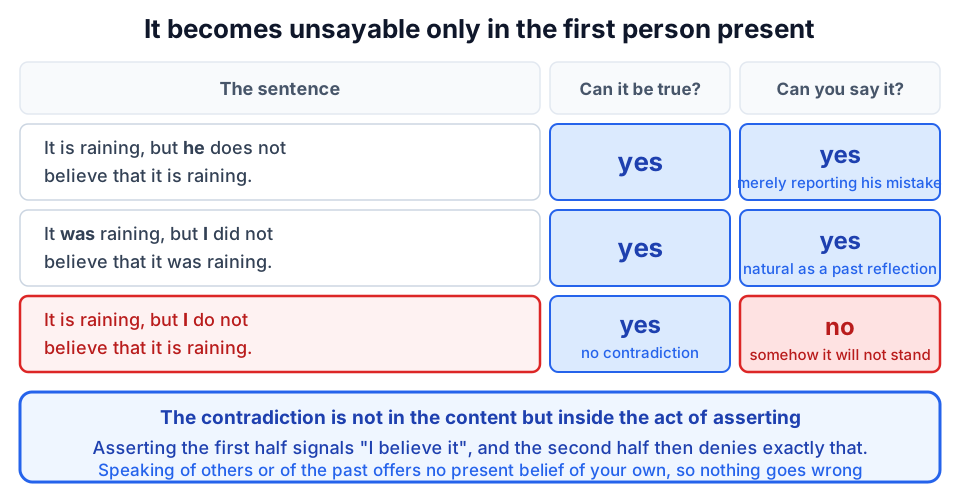
Consider the sentence “It is raining, but I do not believe that it is raining.” It is not logically contradictory at all, and there are perfectly ordinary situations in which it is true. And yet the moment you try to say it out of your own mouth, it stops working. Not contradictory, and not sayable. This is the odd gap the problem is about.
Not contradictory, and not sayable
Here is the sentence again.
It is raining. But I do not believe that it is raining.
The first thing to establish is that this is not a logical contradiction.
The first half is about the world: whether it is actually raining. The second half is about the state of my mind: what I believe.
The weather outside, and the contents of my head. Two separate matters, so there is nothing odd about them disagreeing. People are mistaken about facts all the time.
There is evidence. Saying the same thing about somebody else is completely natural.
It is raining. But he does not believe that it is raining.
Perfectly ordinary, with nothing wrong with it. You are simply saying “he is mistaken.”
Change the subject to I, though, and it becomes unsayable. The content is the same, the situations in which it is true are the same, and as an utterance it does not stand.
Change the tense and it works again
One more check. In the past tense it is a natural sentence too.
It was raining. But I did not believe that it was raining.
That is an ordinary piece of reflection: “at the time I was mistaken.” Anybody can say it.
So it becomes impossible only in the first person, and only in the present tense. Sayable about others. Sayable about your past self. Unsayable only about yourself at this moment.
The way that restriction lands shows the character of the problem. There is no defect in the content of the sentence; something is happening on the side of “me asserting it now.”
To assert is to display belief
The leading explanation focuses on the nature of assertion.
When we assert something, along with uttering the content we also present the attitude of believing it. Barring cases like reading out a weather forecast, asserting what you do not believe is lying.
On that view, what the sentence is doing becomes clear. Asserting “it is raining” in the first half displays that I believe it is raining; in the second half I state explicitly that I hold no such belief.
The content is not contradictory; what is displayed and what is stated disagree. The contradiction is not in the sentence but inside the act of uttering it.
That also explains why speaking of others or of the past causes no problem: you are not presenting a current belief of your own.
Which forms work, and which do not
Vary the conditions in detail and the range where it fails turns out to be narrow.
Sayable and unsayable forms
| Form | Example | Can it be true? | Can you say it? |
|---|---|---|---|
| Omissive, first person present | It is raining, but I do not believe it | Yes | No |
| Commissive, first person present | It is raining, but I believe it is not | Yes | No |
| Third person | It is raining, but he does not believe it | Yes | Yes |
| Past tense | It was raining, but I did not believe it | Yes | Yes |
| Interrogative | It is raining, but do I believe it? | Yes | Yes |
| Conditional | If it is raining and I do not believe it | Yes | Yes |
It fails only when first person, present tense and assertion all coincide.
Questions and conditionals cause no problem because no belief is presented. Asking, or raising something as a condition, does not include an assertion.
Swap belief for knowledge and you get a harder problem
What if you replace believe with know?
It is raining. But I do not know that it is raining.
Again unsayable. But this version connects to something deeper.
“Truths that are true but not yet known to anybody” certainly exist, and the moment you try to state one, you have come to know it.
Pushing that structure to its limit gives Fitch’s paradox of knowability, which concludes that if every truth is knowable in principle, then every truth is already known. There is a straight line running from Moore’s observation to a central problem of epistemology.
Moore and Wittgenstein
The problem was raised by the British philosopher G. E. Moore, in lectures and papers in the 1940s.
Moore himself presented it as an interesting observation. The person who reacted strongly was Ludwig Wittgenstein, who wrote to Moore that this was his most important contribution.
What Wittgenstein cared about was that the phrase “I believe” does something completely different from “he believes.”
“He believes” is a report about somebody else’s mental state, verified or falsified by observation. “I believe,” by contrast, is not a report from observing your own mind; it does something much closer to asserting. The same verb, and the grammar differs in the first person present alone.
The point is recorded in Part II of the Philosophical Investigations and leads into the question of what it is to know one’s own mind.
A different kind of thing from the liar
It gets listed alongside other self-referential puzzles, and Moore’s problem is quite different in character from the liar paradox.
| The liar paradox | Moore’s paradox | |
|---|---|---|
| Truth value of the sentence | Cannot be settled | Can be true |
| Where the contradiction lives | In the content itself | In the act of asserting |
| Said by somebody else | Contradictory as before | No problem at all |
| What resolution requires | Rebuilding the logical system | Tidying up the rules of utterance |
| Impact on mathematics | Ripples out to incompleteness and more | Almost none |
The liar sentence has no settled truth value whoever says it, whenever. The sentence itself is broken, so logic had to be rebuilt.
Moore’s sentence, by contrast, has nothing broken in its content. What breaks is only the scene in which you assert it right now.
So Moore’s paradox belongs not to logic but to speech act theory: the field that asks not what a sentence means but what uttering it does.
Logic has long treated sentences as detached from their speakers — true or false regardless of who says them. Moore’s single sentence is a modest but genuine counterexample showing that the detachment does not always hold.
The preface paradox, a relative
There is a closely related problem with rather more bite: the preface paradox.
The author of a book believes every claim made in the text. In the preface, they also write “this book certainly contains errors.” That is not modesty but a rational prediction from past experience.
Put the two together and you get “I believe all of my claims are correct, and I believe at least one is wrong” — the same shape as Moore’s paradox.
The difference is that this attitude is intellectually honest, if anything. The author is merely admitting fallibility, which is hard to fault.
A form that supposedly cannot be uttered turns out, in some situations, to be the most truthful thing to say. That discomfort is what lifts Moore’s problem out of mere wordplay.
Related paradoxes of self-reference
Related paradoxes where meaning collapses the moment something tries to speak about itself.
Summary
This article covered “Moore’s Paradox.”
Some sentences can be true and cannot be asserted. That fact presses a distinction that is obvious once stated and easy to miss: a sentence being correct and a sentence being sayable are different things.
Logic textbooks handle only truth values, while real language carries a layer of who says it and when. As the problem that first shone a light on that layer, it holds a quiet but important position.
To return to the full list of paradoxes, follow the link below.
Thank you for reading. We hope to see you in the next article.
Also popular with readers
📚 Series: The World's Paradoxes (14/81)