Thank you for visiting this site. This article covers the “Flying Arrow Paradox.”
Take an arrow in flight and freeze it, photographically, at one instant. At that instant it occupies exactly a space the size of itself, and is not moving anywhere. So at that instant the arrow is at rest. How, then, does something at rest at every instant manage to fly? It is an argument denying motion itself, by the same Zeno who gave us Achilles and the tortoise.
The arrow is at rest the whole time it flies
The construction of the argument is almost disappointingly simple.
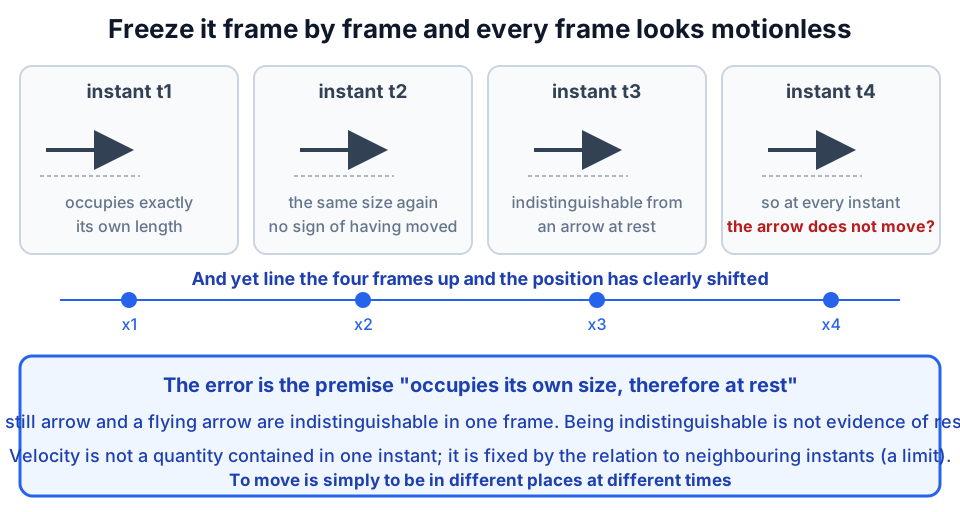
Take an instant. At that instant the arrow occupies some place. The space it occupies is exactly the size of the arrow itself — no larger, no smaller.
Next, consider “a thing that fits exactly into a space its own size.” Such a thing is not moving, so it is at rest.
Put those together and you get the conclusion that at that instant the arrow is at rest. And the time during which the arrow flies is made of such instants.
If it is at rest at every instant, then the whole assembled from them must also be at rest. Therefore the arrow does not fly, and motion does not exist. That was Zeno’s conclusion.
What Zeno was actually doing
It may look like mere quibbling, but Zeno had a purpose of his own.
Zeno of Elea, a fifth-century BCE philosopher, is said to have constructed these arguments to defend the thought of his teacher Parmenides. Parmenides held, from the position that “what is, is; what is not, is not,” that change, motion and plurality are all appearances manufactured by the senses.
Naturally, people at the time laughed at the claim. Things are visibly moving in front of you.
So Zeno counter-attacked, laying out how strange the conclusions become once you grant that motion is real. It is probably one of the earliest uses in history of reductio ad absurdum — extracting an absurdity from your opponent’s premises.
The argument is recorded in Book VI of Aristotle’s Physics, which is how it reached us.
Which premise is wrong
To modern eyes the argument has a clear weak point. The suspect is the second premise.
“If it occupies a space its own size, it is at rest.” Is that actually true?
Freeze either a stationary arrow or a flying arrow at an instant and both occupy exactly their own length. So looking at that single instant, you cannot distinguish a flying arrow from a still one.
Being unable to distinguish is not grounds for asserting rest. Zeno has substituted “cannot be distinguished” for “is at rest.”
Motion was never a property closed within a single instant. It is something that only has meaning in relation to neighbouring instants, and that is what the argument misses.
The answer calculus gave
The clean answer from mathematics arrived once calculus was developed in the seventeenth century.
Velocity at an instant — instantaneous velocity — is not obtained by measuring how far the arrow moves within that instant. It is defined as “the limit, as the interval tends to zero, of the distance travelled in a very short time divided by that time.”
With that definition, the arrow fitting exactly into a space its own length and the arrow moving at 50 metres per second coexist without any contradiction.
Put plainly, velocity is not “a quantity contained in the instant” but “a quantity fixed by the surroundings of the instant.” Zeno was peering only inside the instant and reporting that no motion was there.
To move is to be elsewhere at another time
Philosophy tidied this up in the twentieth century too, with what Bertrand Russell proposed as the “at-at” theory of motion.
That a thing is moving means simply that it is at different places at different times. That was Russell’s claim.
No special something called motion resides in each instant. The positions differ instant by instant, and the whole sequence is what we call motion.
On that view the flying arrow paradox dissolves naturally. Of course no motion is found at each instant; nothing ever resided there in the first place.
Honestly, reading this the first time felt like an anticlimax. After sitting with it a while, I came round to the view that going looking for something like “the feeling of moving” as a substance was itself the assumption to drop.
The other three paradoxes of motion
Zeno is said to have left four arguments against motion.
The dichotomy paradox says that to reach a destination you must first reach the halfway point, and to reach that you must reach its halfway point, receding infinitely, so you cannot even set out.
Achilles and the tortoise, the most famous form, has swift Achilles never catching the tortoise that started ahead of him.
The flying arrow is the third, and the fourth, the stadium paradox, derives a contradiction about the smallest unit of time from the relative speeds of passing rows.
All four share a purpose: showing that whether you grant that space and time are infinitely divisible or grant that there is a smallest unit, you end up in trouble. Being that well organised 2,500 years ago is genuinely impressive.
What the four arguments were aiming at
Zeno’s four are built to attack different premises. Lined up, the care in the design becomes visible.
| Paradox | Premise attacked | Absurdity derived | Modern resolution |
|---|---|---|---|
| Dichotomy | Space is infinitely divisible | You cannot even set out | Infinite series converge to finite values |
| Achilles and the tortoise | Both space and time are infinitely divisible | The fast never catches the slow | The same convergence |
| Flying arrow | Time is a collection of instants | Motion does not exist | Define velocity as a limit |
| Stadium | Time has a smallest unit | Half a smallest unit appears | Handle relative velocity correctly |
The first two attack the assumption of infinite divisibility; the last two attack the assumption of a limit to division. They are arranged so that either choice causes trouble, which shows this is not mere sophistry.
The quantum Zeno effect, a modern descendant
Zeno’s name survives into physics 2,400 years later.
Watched, it does not decay
An unstable particle left alone decays at a fixed rate. Repeat observations at extremely short intervals and the decay barely proceeds at all.
Each observation resets the quantum state, giving change no time to accumulate. Misra and Sudarshan pointed this out in 1977 and named it the quantum Zeno effect after the flying arrow.
Confirmed experimentally
In 1990, Itano and colleagues at the US National Institute of Standards and Technology used beryllium ions to measure the suppression of state change as observation frequency rose. The effect appeared exactly as theory predicted.
It is a real phenomenon, not a metaphor. Zeno’s insight that “cut out only the instant of looking and change disappears” literally holds in the quantum world. The connection is more than nominal.
Incidentally, observing at intermediate intervals can instead accelerate decay, which is called the anti-Zeno effect. The direction of the effect switches with observation frequency.
In quantum computing, methods using this property to suppress the corruption of intermediate states are under study. A 2,400-year-old piece of sophistry turning up in the context of quantum error suppression is a rather satisfying turn of events.
Related paradoxes involving infinite operations
Related paradoxes where the idea of dividing infinitely finely collides directly with intuition.




Summary
This article covered the “Flying Arrow Paradox.”
Cut out an instant and motion vanishes. And still the arrow reaches the target. The discrepancy arose from looking for motion inside the instant.
It took more than two thousand years to answer, and what was needed was neither a new observation nor an experiment but a proper redefinition of the word velocity. It is that kind of problem.
To return to the full list of paradoxes, follow the link below.
Thank you for reading. We hope to see you in the next article.

Also popular with readers
📚 Series: The World's Paradoxes (13/81)