Thank you for visiting this site. This article covers the “Black Hole Information Paradox.”
Black holes are usually pictured as holes that swallow everything, but by Hawking’s calculation they slowly emit radiation, evaporate, and eventually cease to exist. The problem is what happens next. The radiation that came out contains no information whatsoever about what fell in. And quantum mechanics does not permit information to be destroyed. It is a collision that has troubled physicists for half a century.
Black holes evaporate
The starting point is Hawking’s 1974 calculation.
In classical general relativity nothing can escape a black hole. Consider quantum effects just outside the horizon, however, and the story changes.
The vacuum is not nothing; it seethes with fluctuations in which particle-antiparticle pairs appear and vanish. When such a pair appears just outside the horizon, one can fall in while the other escapes.
From outside this looks like the black hole emitting radiation. That is Hawking radiation. Losing energy, the black hole grows lighter, and over an enormous span of time finally evaporates.
A black hole is not an eternal grave; it eventually disappears. Up to here it was a great discovery.
The radiation carries nothing about the contents
The problem lies in the character of that Hawking radiation.
By the calculation, the radiation is perfectly thermal — random radiation fixed by a temperature, depending only on three quantities: the black hole’s mass, charge and angular momentum.
That a black hole has only those three properties as seen from outside is known as the no-hair theorem. Whether an encyclopedia fell in or a rock of the same mass, the black hole seen from outside is indistinguishable.
And once evaporation is complete, what remains is that random radiation. The contents of the encyclopedia have left no trace anywhere.
Why quantum mechanics forbids it
You might ask what is so bad about information disappearing. A short detour to settle that point.
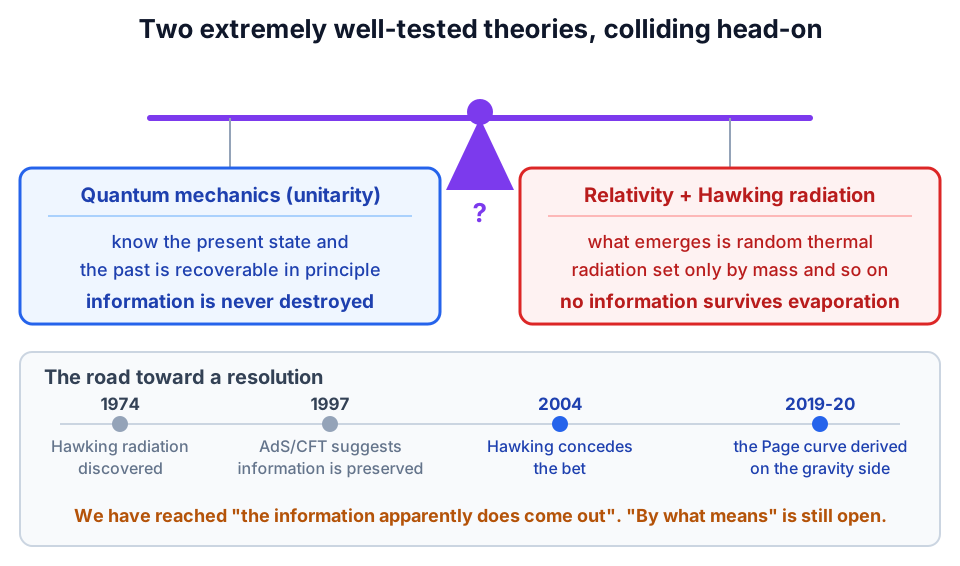
Time evolution in quantum mechanics has a property called unitarity. Roughly, it is the reversibility that says knowing the present state completely, you could in principle reconstruct the past.
Burning a sheet of paper to ash is the same. Impossible in practice, but in principle, examine the state of every particle of smoke, ash and light and you could reconstruct what was written. That was physics’ premise.
With a black hole, what remains after evaporation is thermal radiation unrelated to the contents. Examine anything you like and you cannot get back. A fundamental premise of physics has been broken.
Calculate by general relativity and information disappears; follow quantum mechanics and it does not. Both are extremely well tested, and on this one point they collide head-on.
Hawking’s bet, and his concession
The conflict has a famous episode attached.
In 1997, Hawking and Kip Thorne took the “information is lost” side in a bet with the quantum information researcher John Preskill. The loser would give the winner an encyclopedia.
Then in 2004 Hawking publicly conceded defeat. He switched to the position that information is not lost after all, and presented Preskill with a baseball encyclopedia.
If information does come back, then the reference could be recovered from the ashes, which makes it rather a well-judged gift.
That said, what Hawking conceded was the conclusion that “information appears to be preserved,” not an explanation of “how it gets out.” Thorne, his partner in the bet, was reportedly not yet convinced at that point.
The holographic principle opens a way
What changed the situation was a result from an entirely different field.
The AdS/CFT correspondence, put forward by Juan Maldacena in 1997. Roughly, it claims that a theory of gravity in a certain kind of space and a gravity-free quantum theory living on that space’s boundary are the same content told in different languages.
What matters is that the boundary theory is manifestly unitary, a theory in which information is not destroyed. If the two are the same content, information is not destroyed on the gravity side either.
The idea that interior information is written on a bounding surface is called the holographic principle. Proposed by Gerard ‘t Hooft and Leonard Susskind in the 1990s, it treats a black hole’s information as recorded on the surface that is the horizon.
This sequence of developments lies behind Hawking changing his position.
The Page curve and the island formula
Even so, most physicists were not satisfied by an indirect argument via a correspondence. Unless information can be shown to return in a direct calculation on the gravity side, the problem is not solved.
The benchmark here is the Page curve, identified by Don Page in 1993. If information is preserved, the entanglement of the radiation should rise through the first part of the evaporation and then, at a certain point, turn over and fall back to zero. In Hawking’s original calculation this quantity only rises and never comes down.
It was out of reach for a long time, and then things moved between 2019 and 2020. Techniques known as quantum extremal surfaces and the island formula reproduced the Page curve from a gravity calculation.
This was received as a major advance, though a concrete picture of the physical process by which information is carried out has still not been fully obtained. New difficulties have been found too, such as the firewall problem raised in 2012.
Half a century has got us to “the information apparently does come out.” “By what means” remains in progress. I find that state of affairs a rather good specimen of physics at the frontier.
The proposed solutions, side by side
Many answers have been offered over the half century. Here are the main ones.
The main positions and their difficulties
| Position | Claim | Difficulty |
|---|---|---|
| Information is lost | Hawking’s original conclusion; amend quantum mechanics instead | Severe side effects such as violating energy conservation |
| Encoded in the radiation | Information rides on the apparently thermal radiation as fine correlations | No explanation of how the correlations arise |
| Black hole complementarity | Both descriptions, infalling and external, are correct | Comparing the two can produce a contradiction |
| Firewall | A high-energy wall at the horizon incinerates what falls in | Conflicts with the equivalence principle |
| A remnant survives | It does not fully evaporate; a tiny object holding the information remains | Requires a minuscule object with infinitely many states |
| It exits to another universe | Information moves to a severed spacetime | No way to check it observationally |
Black hole complementarity, proposed by Susskind and others in 1993, was long considered promising. The claim is that nothing happens to someone falling through the horizon, while from outside they are incinerated at it — and both are correct.
Then in 2012 the four AMPS authors, Polchinski among them, pointed out that pushing this picture to its conclusion produces a high-energy wall at the horizon. That is the firewall problem.
Why nothing is decisive
The difficulty common to every proposal is that nobody can yet correctly calculate a regime where gravity and quantum mechanics both matter at once.
Near the horizon, gravity is strong and quantum effects are not negligible. Handling that regime requires a theory of quantum gravity, which is itself unfinished.
What earned the island formula its reception after 2019 was that, in restricted settings, the Page curve could be produced directly from the gravity side. Even so, the crucial picture of what information rides on as it leaves remains untouched.
Related paradoxes of quantum mechanics
Related paradoxes where quantum mechanics’ demands stop meshing with our naive picture of the world.

Summary
This article covered the “Black Hole Information Paradox.”
General relativity and quantum mechanics, each extraordinarily successful, collide head-on at the single point of black hole evaporation. A situation where one of them must be wrong is precisely the doorway to the next theory.
Where does what falls in go? That such a plain question has dragged quantum gravity, the hardest field there is, this far forward is something I find genuinely impressive.
To return to the full list of paradoxes, follow the link below.
Thank you for reading. We hope to see you in the next article.
Also popular with readers
📚 Series: The World's Paradoxes (42/81)