Thank you for visiting this site. This article covers the “Traveler’s Dilemma.”
Two travelers separately declare what an airline should pay for a souvenir it broke. Reason it through and the declared amounts keep falling, all the way down to the lowest sum permitted. Yet gather actual people for the experiment and almost all of them write a number close to the maximum, taking home far more money than the theory recommends. It is a problem that turns suspicion on the concept of rationality itself.
The airline’s strange terms
The setup first.
Two travelers bought the same antique and, on the way home, the airline broke their luggage. The items are identical, so their true value should be identical too.
The manager takes the two into separate rooms and says this.
Declare the value of the item, anywhere from $2 to $100. No conferring. If your figures match, you each receive that amount. If they differ, the lower figure is the basis. The one who declared lower gets $2 extra; the one who declared higher has $2 deducted.
Writing an honestly high figure looks profitable, but the mechanism penalises you for being higher than the other person.
The machinery that makes you shade down
Put yourself in the position.
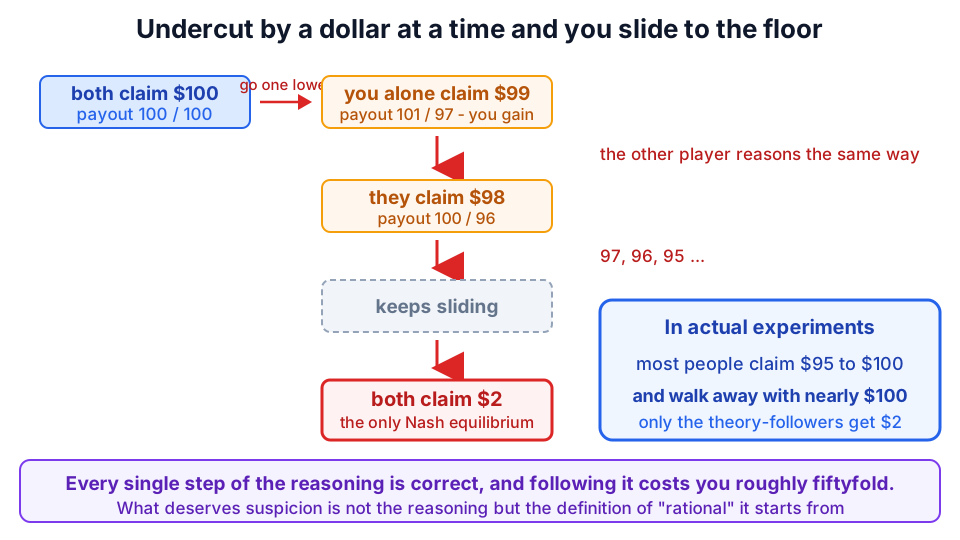
Suppose you think “I will write $100.” If the other person also writes $100, you each get $100.
But if you can predict they will write $100, you are better off writing $99. You are the lower declarer, so $99 plus the $2 bonus gives you $101. One dollar more than $100.
Which means the other person is thinking the same thing. If you can read them writing $99, you should write $98: $98 plus $2 is $100, better than $99.
The mutual reading does not stop. 97, 96, 95, and down it goes, all the way to the floor at $2.
At $2 there is no room left to shade. If they write $2 you must write $2, and no reason to move remains. Both declaring $2 is the unique Nash equilibrium of this problem.
Real people write close to $100
The theoretical answer is $2. Put the problem to actual people and the results look nothing like it.
In many experiments the great majority of participants declare somewhere in the $95 to $100 range. Very few write $2.
And what matters is what those people receive. Since almost everyone writes high, almost everyone gets close to $100. The minority who wrote $2 as the theory prescribes receive $2.
“The rational players end up poorest.” In the prisoner’s dilemma, rational behaviour producing a bad outcome for everyone is as far as it goes; the traveler’s dilemma is more extreme, with a roughly fiftyfold gap between what theory recommends and what people actually collect.
Proposed by a World Bank chief economist
The problem was presented in 1994 by the Indian economist Kaushik Basu, who later served as chief economist of the World Bank.
Basu’s aim was not to construct an entertaining puzzle. It was to reopen the question of whether the definition of rationality game theory has assumed is actually defensible.
There is nothing wrong with the procedure of backward induction itself. Every individual step of the reasoning is correct. And yet the behaviour that comes out as the conclusion produces a plainly worse result than what real people achieve.
If the reasoning is sound and the conclusion is bad, Basu argued, what deserves suspicion is the premise it starts from.
Can you really believe the other side is rational?
Why do people not shade down to $2? One strong explanation is trust and depth of reading.
Reaching the conclusion of $2 requires piling up condition after condition: “the other person is perfectly rational, and knows that I am perfectly rational, and knows that I know…”
In reality nobody stacks dozens of levels of mutual reading. Most people go one or two levels deep, expect the other person to write high, and write high themselves.
What is interesting is that changing the bonus and deduction changes the results. Make it $20 rather than $2 and declarations drift down toward the theoretical value. The larger the reward for undercutting, the closer people move to the reasoned side.
So people are not simply irrational. While the gain from undercutting is small they prioritise trust; when it grows, they prioritise the calculation. They switch between the two.
Change the bonus and behaviour moves
What keeps this from being a simple “humans are irrational” story is that behaviour changes systematically with the conditions.
Reward for undercutting versus declared amount
A 1999 experiment by Capra and colleagues varied only the bonus and deduction, and measured how declarations changed.
| Bonus / deduction | Reward for undercutting | Tendency of the mean declaration |
|---|---|---|
| Small (a few dollars) | Barely any | Stays high, near the ceiling |
| Moderate | Meaningful | Falls to the middle |
| Large (around 40% of the ceiling) | Very large | Drops near the theoretical value |
Theoretically the equilibrium remains the minimum whatever the bonus is, so nothing should change. Real behaviour moves smoothly.
Which means people are not mechanically deciding whether to run backward induction to the end. They are weighing what defection pays against what trust pays.
Other games of the same shape
The structure where step-by-step reasoning accumulates into an unreasonable conclusion appears elsewhere.
- The centipede game: players alternately take or continue, and the pot grows the longer it continues. Backward induction makes taking immediately on the first move the equilibrium; real people continue for a while
- The beauty contest game: guess the number closest to two-thirds of everyone’s average. Iterated reasoning converges on 0; actual answers cluster around 20 to 30
In both, “how many levels the other player reads” decides the outcome. The deeper everyone reads, the less everyone gets — the same property as the traveler’s dilemma.
How the word “rational” gets used
I find this problem carries straight into practical work.
Reasoning forward in a negotiation on the assumption that “the other side is as clever as I am” frequently lands on a conclusion nobody wanted. Price wars and over-generous terms are the obvious cases.
Whether you can stop before that depends on whether you can trust the other side. There are situations where everybody being slightly naive leaves everybody richer than everybody being clever, which is a satisfying conclusion to sit with.
Real negotiations that slide down the same hill
The setup looks abstract, but the structure appears constantly in practice. The common feature is a series of moves that each say “let me be just slightly better placed than them.”
- Price competition: undercut slightly and win the business. Every firm does it and only margins are consumed
- Bidding down: win by a hair, then discover the contract does not cover its costs
- Pulling deadlines forward: proposals compete to be one day earlier until the schedule is impossible
- Advertising spend: an exchange of out-exposing each other that only inflates both budgets
In every case, no individual judgement is wrong. Each decision stays correct while the whole moves somewhere nobody wanted.
There are two ways to stop it. One is for everyone to read less deeply — to trust that the other side will not do something reckless. The other is to fix the floor from outside.
Minimum wages, rules against predatory pricing, and reserve prices in tenders are the second kind: putting up a wall so the hill cannot be descended. Knowing the structure of the traveler’s dilemma makes the purpose of those rules much clearer.
Related paradoxes of social dilemmas
Related paradoxes where everyone behaving rationally leaves everyone worse off.
Summary
This article covered the “Traveler’s Dilemma.”
Every step of the reasoning is correct, and at the end of it the people who ignored the theory collect nearly fifty times more. With a gap that blatant, it becomes tempting to conclude that what is wrong is the theory rather than the humans.
Following a correct procedure does not guarantee a good outcome. I think this problem shows that about as clearly as it can be shown.
To return to the full list of paradoxes, follow the link below.
Thank you for reading. We hope to see you in the next article.
Also popular with readers
📚 Series: The World's Paradoxes (62/81)