
Thank you for visiting this site. This article covers the practical ace of probability puzzles: “the secretary problem.”
To hire one secretary, you interview 100 candidates one at a time. The rules are severe: you must decide on the spot immediately after each interview, and a rejected candidate can never be recalled. Whether the next person will outshine everyone so far is unknowable until you meet them. Under these conditions, how do you maximize the probability of hiring the single best person of the whole hundred? Mathematics’ answer comes with a weirdly specific number: “reject the first 37 unconditionally.”
What Is the Secretary Problem?
The secretary problem asks: when gathering more information shrinks your remaining options, when should you stop exploring and commit? In mathematics it is the flagship of the field called optimal stopping. The rules:
- n candidates, interviewed one by one in random order
- After each interview, you know exactly how that person ranks against everyone seen so far
- Decide on the spot. A rejected candidate is gone forever
- You may hire exactly one person. The goal: hire the best of all n. Second-best counts as failure
These rules distill the dilemma to purity. Decide early and you miss unseen talent; wait too long and you’ve already turned the best one away. The anxiety everyone knows from house-hunting, secondhand shopping, and dating — placed on a mathematical stage.
The Answer: Skip 37%, Then Grab the Next Record-Breaker
The optimal strategy is startlingly simple in form:
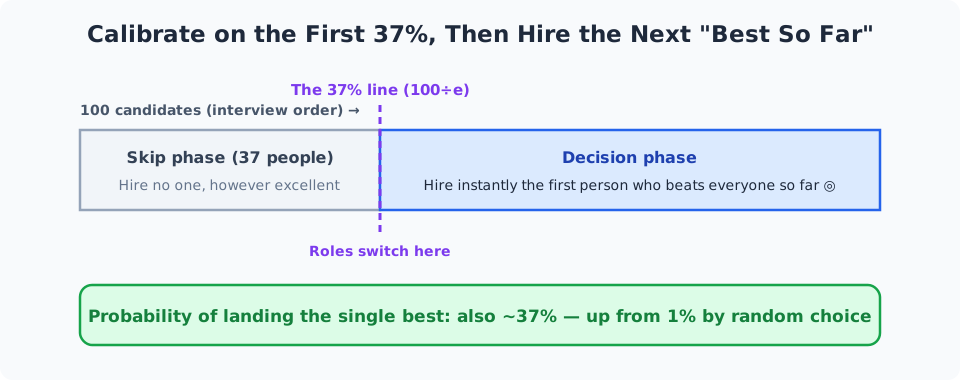
Let the first ~37% (n÷e people; 37 out of 100) pass, no matter how excellent. From then on, hire the first person who beats everyone seen so far — instantly.
The opening 37% is, in effect, a preview screening for calibration. Build your sense of the market there; in the second phase, pounce on the first person to exceed the preview’s best. And beautifully, this strategy lands the single best candidate with probability about 37% (precisely 1/e ≈ 36.8%) — regardless of how many candidates there are. The elegant coincidence that the skip fraction and the success rate are both 37% flows from the properties of e, the base of natural logarithms.
Picking one person out of 100, no backsies, one shot. In a game where random choice succeeds 1% of the time, lifting the odds to nearly 40% is genuine magic.
Verifying Optimality with Three Candidates
Let’s check the 37% number’s payoff on the smallest example. With three candidates there are effectively three strategies. The quality orderings number 6, and each strategy’s success probability works out to:
| Strategy | Description | Success probability |
|---|---|---|
| Snap decision | Hire the first candidate unconditionally | 2/6 (~33%) |
| Skip one | Pass on the first; hire the next record-breaker | 3/6 (50%) |
| Wait too long | Hold out for the third | 2/6 (~33%) |
Merely using candidate one as a benchmark vaults success from 33% to 50%. If the order runs second-best → best → third-best, the first person’s “second-best” benchmark means that the instant the true best walks in, you recognize a record-breaker and lock them in.
As n grows, the optimal skip fraction converges to 37%. Skip too few and your benchmark is soft — you pounce on mediocrity; skip too many and you burn the best candidate on calibration. The balance point lands exactly at 1/e: that is the problem’s mathematical heart.
Why does e of all numbers appear? The intuition, briefly: the strategy succeeds, roughly, when “the best person arrives after the skip phase, AND the best of everyone before them fell inside the skip phase.” Write that probability as a formula in the skip fraction and a logarithm appears; maximize, and the answer is 1/e. That both the skip fraction and the resulting success rate equal 1/e (~36.8%) is no coincidence but a necessity of the formula’s very shape.
Gardner’s Column and Kepler’s Remarriage
The problem’s pedigree is a little tangled. By the 1950s it was already circulating orally among mathematicians under names like the “fiancée problem,” and it became famous in print via Martin Gardner’s celebrated “Mathematical Games” column in February 1960. The rigorous solution followed in the 1960s, founding the field of optimal stopping theory. The history of who solved it first became a controversy of its own — in 1989 a paper appeared under the title “Who Solved the Secretary Problem?”
The favorite historical garnish is the remarriage of the astronomer Johannes Kepler. Widowed in 1611, Kepler spent two years interviewing eleven candidates for remarriage, and after agonized deliberation chose the fifth. He left a detailed account in letters to a friend — living, four hundred years early, the exact secretary-problem situation of evaluating irreversible choices in sequence. As it happens, 37% of 11 is about 4: theory says “skip four, then take the next record-breaker” — and the woman actually chosen was number five. Theory and history, coincidentally neighbors.
Cautions for Real-Life Use
The secretary problem is the poster child of “algorithmic thinking” applied to house-hunting, parking, even dating. Before using it, though, check where the math’s premises and reality part ways.
First, the model’s goal is the extreme one — “anything but the single best is failure.” In real life, second-best is usually plenty happy. Relax the goal to “top 10% counts as success” and the optimal skip fraction shrinks sharply while the success rate soars. Just retiring perfectionism makes the game far easier.
Second, reality sometimes lets you go back to someone you declined — and sometimes they decline you. If returning is possible, the case for deciding early weakens; if being rejected is possible, moving early becomes urgent. Change the model and the optimal skip fraction changes with it.
In recent years the problem headlines books applying algorithmic thinking to life decisions, popularizing usages like “spend the first month house-hunting without committing, purely to calibrate the market.” And the essential lesson does hold up in real life: exploration has a defined job — building a benchmark — and it deserves a scheduled end time. Searching forever for “maybe something better” is a losing strategy even mathematically. Decide that the first several are calibration-only; after that, commit on the first benchmark-breaker. Just owning that template changes the quality of your decisions.
The 37% Rule Under Different Sizes and Goals
With 1,000 or 10,000 Candidates, Does the Success Rate Drop?
No. This is the problem’s marvel: the 37%-skip strategy succeeds at about 36.8% no matter how large n grows. With 1,000 candidates you skip 368; with 10,000, you skip 3,679 — and the chance of catching the single best person stays the same. Considering that random choice sinks to 0.1%, then 0.01%, the strategy’s value only sharpens as the field grows.
What If “Top Few” Is Good Enough Instead of “the Best”?
The looser the goal, the smaller the optimal skip fraction and the higher the success rate — this is well established. In the extreme, if “above average” counts as success, it becomes rational to sample only a handful and then decide fast. The 37% rule, in other words, is the prescription for the greediest possible goal — “nothing but number one will do” — and the dosage changes with the diagnosis. That is the accurate way to hold it.
Doesn’t It Fail If Candidates Arrive in Order of Quality?
It fails. The theory assumes candidates arrive in random order. If the best come first, hire the first one; if the order is reversed, wait until the end. This is one of the key cautions for real-world use: good real-estate listings, for instance, vanish from the market fastest, so arrivals are not purely random. Thinking through how conclusions shift when premises crack — that is the right way to keep company with mathematics of this kind.
Related Logic Puzzles
See survival raised by engineering how probabilities overlap in “the 100 prisoners problem”; the gap between expected value and human feeling in “the St. Petersburg paradox”; and the framework of rational decision-making in “expected utility theory.”



Summary
This article covered “the secretary problem.”
For searches with no obvious stopping point, mathematics supplies a crisp template: “first 37% for calibration; thereafter, commit instantly on a record-breaker.” Reality never matches the premises exactly, but the skeleton — separate the exploration phase from the decision phase, and fix exploration’s end time in advance — is wisdom you can carry into house-hunting, hiring, and everyday shopping alike.
Since endless deliberation is itself a cost, deciding requires discipline. The secretary problem is the puzzle that first wrote that discipline down as an equation.
To return to the full list of logic and probability puzzles, follow the link below.
Thank you for reading. We hope to see you in the next article.

Also popular with readers
📚 Series: Logic & Probability Puzzles (11/11)