Mythology & Religion Power Ranking TOP100
This article introduces Rank 59: Athena from the “Mythology & Religion Power Ranking TOP100”, which ranks the gods, monsters, and heroes of world mythology, religion, and legend in order of strength.
If you want to see the full TOP100 list and the criteria behind the rankings, check out the overview article below.

Rank 59: Athena (Greek Mythology)

🦉 What happens if Athena fights the other gods?
I built a simulator that pits the 100 entries in this ranking against each other. It opens with Athena already picked, and an opponent of the same tier chosen for you.
⚔ Send Athena into battleOverview
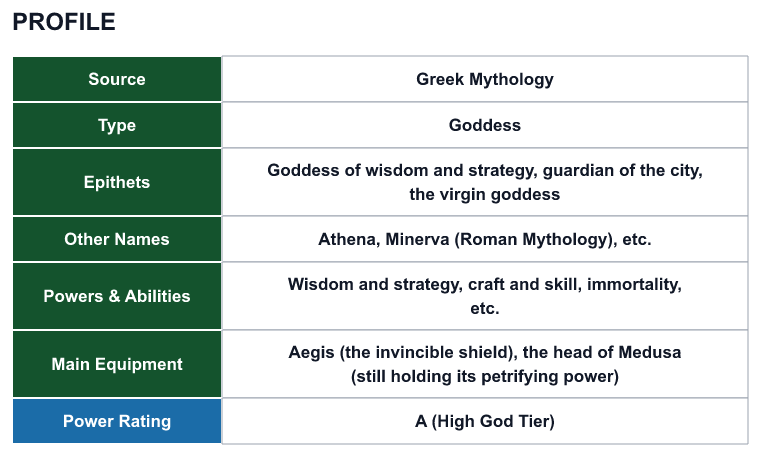
Athena is one of the most popular goddesses in Greek mythology, serving as the goddess of wisdom and strategy. She also presides over arts and crafts, and is regarded as the guardian deity of cities. She is often contrasted with Ares, the violent god of war — while both are associated with warfare, Athena is said to fight in order to protect cities and preserve peace.
She also has Nike, the goddess of victory, as a subordinate deity (some traditions describe Nike as an aspect of Athena herself), making Athena a symbol of victory in battle.
Although Athena has relatively few direct combat scenes, she bestows her blessing on many heroes throughout the myths, and her reputation rises as those heroes achieve great deeds.
Among the heroes she blessed are superhuman warriors such as Diomedes and Heracles. Diomedes, empowered by Athena’s blessing, managed to repel Ares himself — the single greatest martial feat ever accomplished by a purely human warrior.
Of course, the heroes’ own strength played a part, but the fact that Athena’s blessing could grant the power to defeat a god speaks to the magnitude of her power.
Among Athena’s direct demonstrations of power, notable examples include slaying the giant Pallas (or Palas) and Enceladus during the Gigantomachy — the war between the gods and the giants — striking Ares with a massive boulder and knocking him unconscious during the Theomachia, and defeating the goddess of beauty Aphrodite with a single blow to the chest.
These depictions confirm that she ranked among the strongest of those called war gods.
A signature piece of equipment associated with Athena is the Aegis — a shield (or breastplate) that is actually the supreme defensive armament of Zeus, the chief god of Greek mythology, but is usually entrusted to Athena.
In mythology, it is said to have the power to ward off all evil and calamity, and in later tradition it is commonly treated as an invincible shield capable of blocking any attack.
Within the myths, the hero Perseus is said to have attached the severed head of Medusa to the Aegis, meaning it is thought to also carry Medusa’s power of petrification.
Considering Medusa’s mythological record, her head is effective even against divine beings — combined with Athena’s own power, an average war god would have virtually no chance of winning.
Ranking Rationale
In the myths, Athena has relatively few direct combat scenes, and her overall impression leans more toward that of a goddess who bestows blessings on heroes and leads them to victory rather than fighting herself. The full extent of the Aegis’s defensive capabilities has never been tested in an explicit episode, so its actual performance remains somewhat mysterious.
These factors make her ranking genuinely difficult to determine, but considering that she easily defeated gods like Ares and Aphrodite, performed admirably in the war against the giants, and possesses the near-invincible Aegis along with the powerful head of Medusa, she can reasonably be considered a step above other war gods.
A further detail that supports Athena’s exceptional status: she was originally destined to be born as a goddess who would surpass Zeus — a prophecy that led Zeus to swallow the titaness Metis whole before she could give birth, and then to claim Athena as his own child, thereby averting the foretold fate.
Given that Athena was fated to surpass even Zeus by birth, it seems appropriate to regard her as a tier above ordinary war gods, which is why she holds this position.
Athena (Greek Myth) | Myth Power Ranking #59 - Senko’s Activity Log
About the Book
I wrote a book that compiles this entire ranking! The reasoning behind each placement is grounded in the actual lore and episodes from each mythology, so I think it makes for a fairly convincing read.
The book also contains many columns and extras not published on this blog, so if you are interested, please check it out below.

Also popular with readers
📚 Series: Mythology Power Ranking (Individual Characters) (42/100)