Thank you for visiting. This article is the second installment in a series explaining the original texts of Aztec mythology.
Last time (Article 1), I looked at how the world and the sun were born. This time, I look at the myths of how humanity was born into that world and was granted civilization. The protagonist is the feathered serpent and culture hero Quetzalcoatl.
The source of the myths dealt with here also differs by original text. The creation of humanity and the origin of maize are conveyed in the “Legend of the Suns,” and the legend of the Toltec holy king Topiltzin Quetzalcoatl in the Sahagun-compiled “Florentine Codex,” Book 3, and the “Annals of Cuauhtitlan (Codex Chimalpopoca).” In this article, I explain while showing at key points which original text it relies on.
For an overview map of the original texts of Aztec mythology as a whole, please see this summary article.
Who Is Quetzalcoatl — the Feathered Serpent Who Brings Civilization
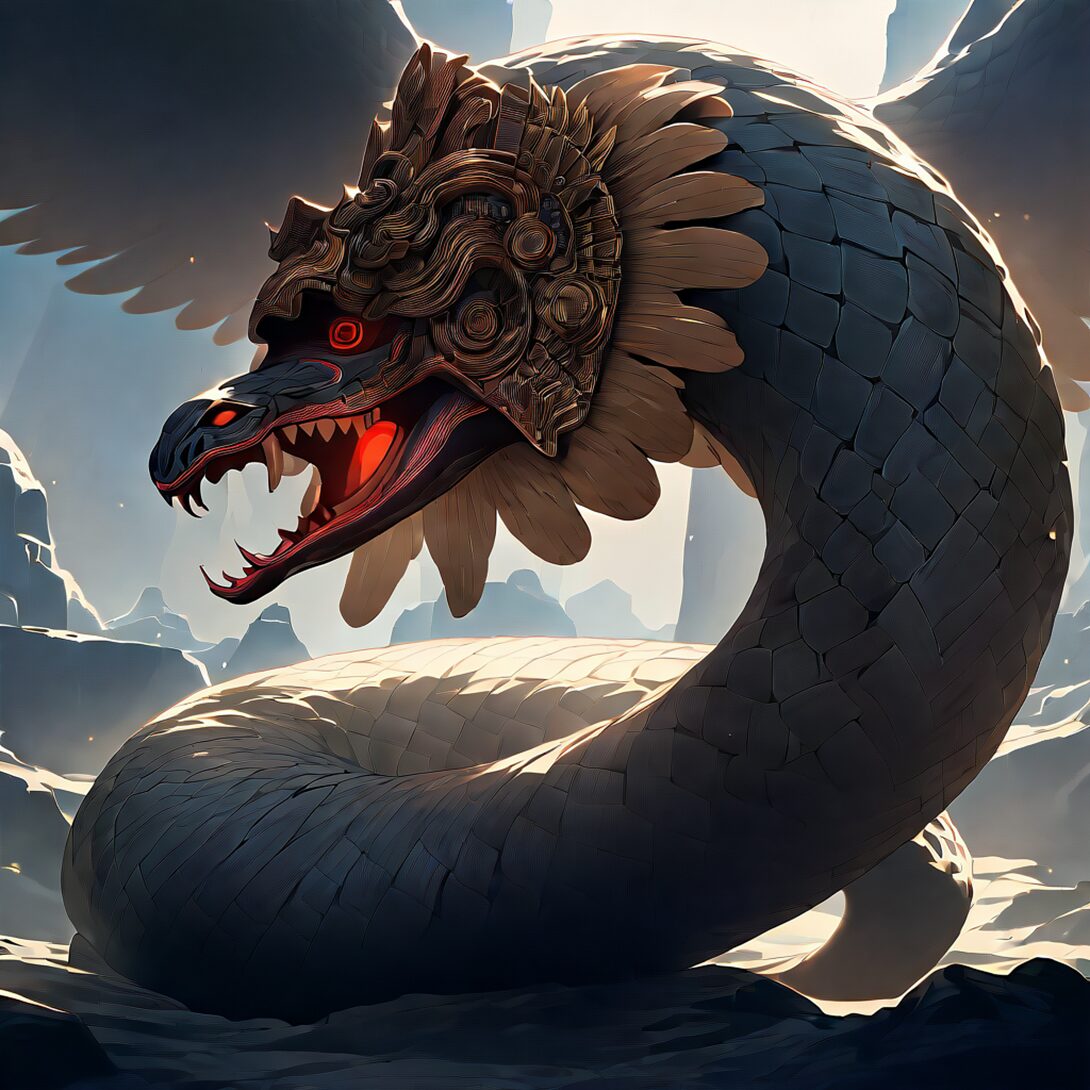
“Quetzalcoatl” is a great god long revered across all of Mesoamerica, whose name means “the feathered (quetzal bird) serpent (coatl).” His figure, a serpent yet clad in beautiful feathers, is also said to symbolize the union of earth (serpent) and heaven (bird).
Quetzalcoatl is the wind god Ehecatl, and at the same time the god governing civilization itself, such as wisdom, learning, the calendar, and agriculture. Amid Aztec mythology, which has many wild gods, he is depicted as a merciful and intelligent god who brings blessing to humans. As we see now, it was this Quetzalcoatl who created humanity, gave food, and granted civilization.
The Creation of Humanity — the Desperate Journey to Mictlan
As seen last time, the age of the Fifth Sun began. But there was still no human there. This is because the humanity of the past four worlds was changed in form at each destruction.
What conveys this story of the creation of humanity is the Nahuatl manuscript “Legend of the Suns.” According to it, Quetzalcoatl, to create a new humanity, descended to the underground land of the dead, “Mictlan,” in search of the “bones” of past humanity.
The king of Mictlan, Mictlantecuhtli, put an impossible demand to Quetzalcoatl as the condition for handing over the bones. “Blow a conch shell with no holes, and circle my land four times,” he said. But the conch shell handed over had no hole to make sound. The troubled Quetzalcoatl used his wit and had worms bore holes inside the conch, put bees inside, and blew it splendidly.
Still, the king of death, unwilling to hand over the bones, had his servants dig a pit. Quetzalcoatl, fleeing with the bones in his arms, was startled by a quail that suddenly flew up, fell into the pit, and fainted. At this time the bones he held fell to the ground and shattered to pieces. The Aztec people explained, “That people’s heights each differ is because the bones shattered unevenly at this time.”
Still, Quetzalcoatl gathered up all the shattered bones and brought them back to the gods’ paradise Tamoanchan. There the goddess Cihuacoatl ground the bones to powder in a stone mortar. And when Quetzalcoatl poured his own blood onto that powder, and the other gods too offered their blood, from it the present humanity was born.
Here too, the point that humanity was created by the sacrifice (blood) of the gods is decisive. Precisely for this reason, the Aztec people thought of themselves as “those redeemed by the gods’ blood,” and felt it a duty to repay that debt with blood (human sacrifice).
The Discovery of Maize — the God Who Turned into an Ant
Humanity was born. But this time, there was no staple food for people to eat. For the people of Mesoamerica, including the Aztecs, that was “maize.” Its origin too is told by the myth of Quetzalcoatl.
Once, Quetzalcoatl saw a single red ant carrying fine grains of maize from somewhere. When he pressed it, “where is that food,” the ant reluctantly told that it was hidden inside the “Mountain of Sustenance (Tonacatepetl).”
So Quetzalcoatl himself changed into a black ant, followed the red ant, slipped through a narrow crack in the mountain, and got inside. And he carried out the maize grains that filled the mountain and gave them to humanity. People grew this and at last gained a stable life. It is a myth that well shows that maize was held to be a sacred blessing that the god took pains to deliver to humans.
The Origin of Pulque — the Divine Drink That Gives Joy
Quetzalcoatl tried to give people the joy of life too. That is the fermented drink made from the agave, “pulque.”
According to tradition, Quetzalcoatl descended to the earth together with the agave goddess Mayahuel, and brought, from its sap, the drink people drink at festivals. A drink for singing, dancing, and praising the gods. But, as we see later, this pulque in time also became the trigger of Quetzalcoatl’s own fall.
The Toltec Holy King Topiltzin Quetzalcoatl
The interest of Aztec mythology lies in the point that the god Quetzalcoatl is also told overlapping with an ideal historical king. This legend of the holy king is recorded in detail in the Sahagun-compiled “Florentine Codex,” Book 3, and the “Annals of Cuauhtitlan.” According to them, the advanced civilization the Aztecs looked up to as a model, “Toltec,” had a legendary holy king, “Topiltzin Quetzalcoatl,” who ruled its capital Tula (Tollan).
His reign was a very golden age. Maize ripened big, cotton grew in many colors, and arts such as goldwork and featherwork flourished. And especially notable is that this holy king disliked human sacrifice and offered the gods only butterflies, snakes, and incense. The figure of this king, who refused fierce sacrifice, was the very image of Quetzalcoatl, god of intellect and mercy.
Fall and Departure to the East — the Prophecy of Return
But there was a god who did not welcome this peace. Quetzalcoatl’s eternal rival, Tezcatlipoca. Tezcatlipoca devised a scheme and ensnared Topiltzin Quetzalcoatl.
In tradition, Tezcatlipoca disguised himself as an old man and showed the king a mirror. The king, who had thought himself perfect like a god, saw in the mirror his own aged and decayed face, and was deeply ashamed. Further, Tezcatlipoca recommended pulque to the king and got him drunk. The drunken Quetzalcoatl, though a priest, forgot temperance and disgraced himself, and broke his own precept.
The next morning, the king, realizing his fault, in deep remorse abandoned Tula and set out to the east. His end is told differently by original text. In one tradition, he rode a raft woven of serpents and departed beyond the eastern sea. In another (Codex Chimalpopoca), he threw himself into fire, and his heart ascended to heaven and became the “morning star (Venus).”
And on departing, Quetzalcoatl is told to have prophesied, “Someday, in my year, I will surely return from the east.” This prophecy of “return from the east” came to cast an unexpected shadow on later history.
The Prophecy of Return and the Spanish Conquest
Time passed to 1519. The Spanish conqueror Cortés came to the Aztec land from the very eastern sea.
According to later records, the Aztec king Moctezuma II, before the unknown ones who came from the east, is told to have been bewildered, “Has the prophecy of Quetzalcoatl’s return been realized?,” and hesitated in his response. Thus the Aztec Empire was destroyed in a short period.
However, this famous story of “Cortés = the return of Quetzalcoatl” also has a prevailing view that it was embellished and exaggerated after the conquest, to justify the conquest. Even so, in the very fact that the myth of the god’s coming-and-going and the prophecy of return has been told overlapping with real history, one can feel the depth of Aztec mythology.
A God Transcending Age and Region — the Spread of the Feathered Serpent
Quetzalcoatl is not a god of the Aztecs alone. Faith in the feathered serpent was inherited across the whole of Mesoamerican civilization for over a thousand years. Knowing this long history behind the original texts (manuscripts) makes the god’s weight even greater.
Already in the great city of Teotihuacan around the turn of the era, a “Temple of Quetzalcoatl (Pyramid of the Feathered Serpent),” with feathered serpents carved densely over its walls, was built. In Maya civilization, the same god was called “Kukulkan” (feathered serpent), and at the great pyramid “El Castillo” of the World Heritage Chichén Itzá, on the days of the spring and autumn equinox, the figure of the “descending serpent,” made by light and shadow on the side of the stairs, still emerges.
Thus Quetzalcoatl, as the god governing wind, water, Venus, civilization, and agriculture, and as the symbol of the ideal king (priest-king), kept being revered, changing form in each age and each people. The story the Aztec manuscripts convey was the last chapter of that long history of faith.
How Strong Are the Characters? — the Strongest Ranking
The gods and heroes who appeared in this article are also introduced in order of strength in the “Mythology, Religion, and Legend Strongest Ranking.” Please enjoy both their activity in the original texts and their “strength.”
To Learn More
Conclusion
In this article, centering on Quetzalcoatl, I explained in detail the myths of the origin of humanity and civilization. How was it?
Quetzalcoatl was a true benefactor of civilization, who created humanity by retrieving bones from the land of the dead, brought maize by turning into an ant, and gave pulque. Further, as the Toltec holy king Topiltzin Quetzalcoatl, while building a golden age that refused human sacrifice, he fell by Tezcatlipoca’s scheme and departed, prophesying his “return from the east.”
The contrast of these two gods — Quetzalcoatl, god of mercy and wisdom, and Tezcatlipoca, the wild god of fate — is the very great axis that moves Aztec mythology.
In the next Article 3, I will explain the Aztec gods such as Huitzilopochtli and Tezcatlipoca, and the founding myth of the capital Tenochtitlan.
I hope you’ll read the next article too.
Also popular with readers
📚 Series: The Original Texts of Aztec Mythology (3/5)