Thank you for visiting. This article is the second installment in a series explaining the original texts of Celtic mythology.
This time, we look in detail at the story of the center of Ireland’s “Ulster Cycle” and Celtic mythology’s greatest hero, “Cú Chulainn.”
For an overview map of Celtic mythology’s original texts as a whole, please see this summary article.
Let me show in a diagram the flow of Cú Chulainn’s short but brilliant life, traced in this article.
Cú Chulainn’s Birth and the Origin of His Name
Cú Chulainn is a demigod hero with the light god “Lugh” (see Article 1) as his father, with the childhood name “Sétanta.” He was a boy of extraordinary strength from birth.
One day, Sétanta heads late to a feast of the smith “Culann.” The feast had already begun, and Culann had loosed the ferocious hound he kept as a guard dog. When that hound attacked him, Sétanta struck it down bare-handed (in one account, by driving a ball down its throat).
Feeling sorry for Culann, who had lost his guard dog, Sétanta offered, “Until a replacement dog grows up, I will serve as the guard dog of this house.” From this event, he came to be called “Cú Chulainn,” meaning “the hound of Culann.”
The Boy’s Feats and the “Day He Took Up Arms”
Many anecdotes showing his extraordinary gifts remain from Cú Chulainn’s boyhood (called the “Boyhood Deeds (Macgnímrada)”).
As a small boy, he alone took on and defeated Ulster’s band of 150 boy-warriors and was recognized by King Conchobar.
Especially famous is the story of the “day he took up arms.” One day, Cú Chulainn overhears a Druid (priest) prophesy, “Whoever takes up arms for the first time today will leave a name forever as a hero, but his life will be short.” Without hesitation, he chose to take up arms that day. His attitude of choosing a short but brilliant life — “Even if I live only a single day, if I am remembered forever, that is my wish” — symbolizes the hero Cú Chulainn.
And on that very day he took up arms, he slew three brother-warriors feared as “never to be harmed,” marking his first battle as a warrior.
Training Under the Warrior-Woman Scáthach, and the Magic Spear Gáe Bolg
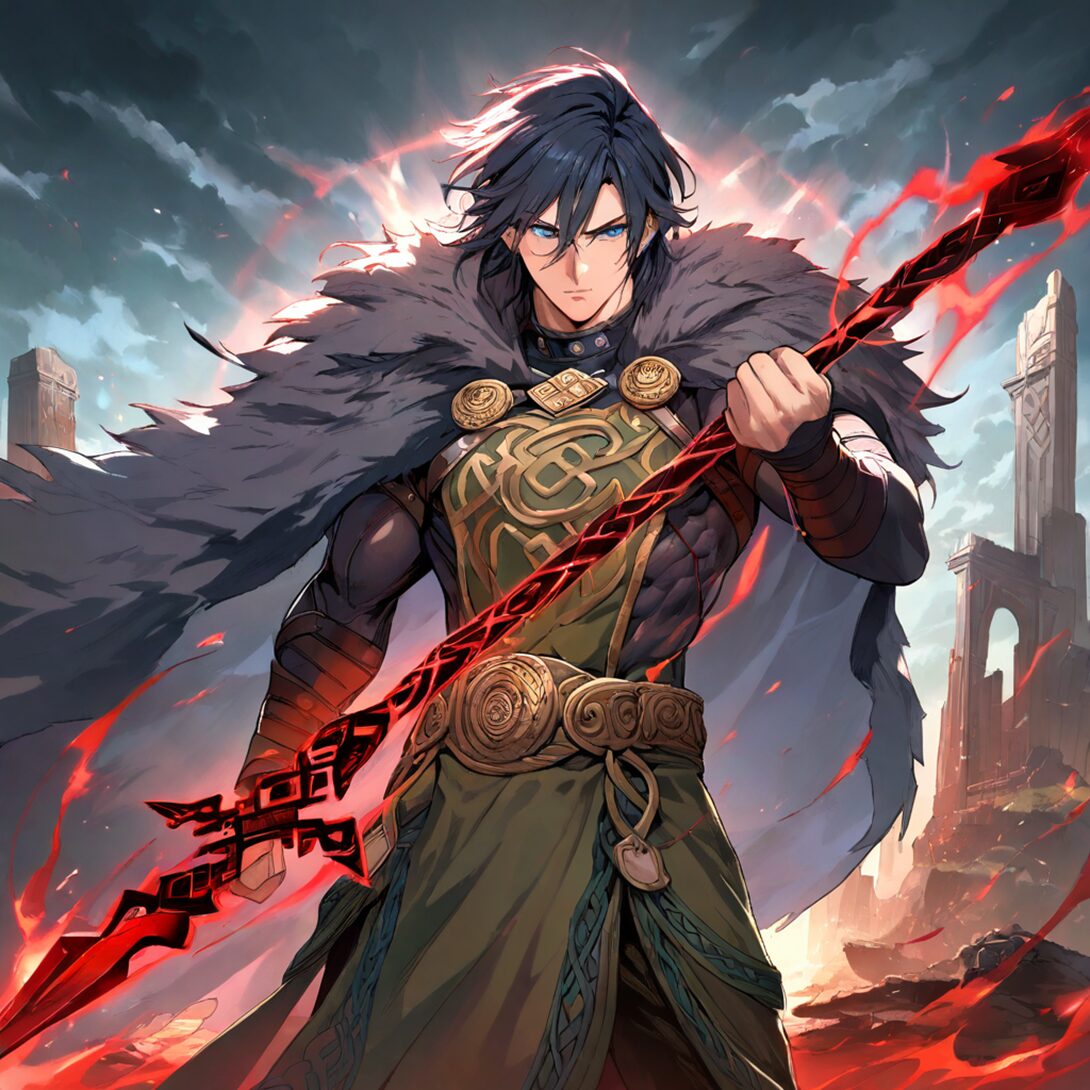
The grown Cú Chulainn trains under the “warrior-woman Scáthach,” who dwells in the Land of Shadows, to master the martial arts. From her he received, along with every fighting technique, the deadly magic spear “Gáe Bolg.”
This Gáe Bolg is an extremely vicious deadly weapon that is launched from the water with the toes, and once it pierces the body, countless barbs open inside so it can never be pulled out.
Also, when his excitement reached its peak in battle, Cú Chulainn underwent a terrible transformation called the “ríastrad (warp-spasm).” His body twisted, one eye bulged out, his hair stood on end scattering sparks, and a pillar of black blood spurted from his head — he fell into a battle-frenzy so extreme he could no longer tell friend from foe, and no one could stop him.
The Cattle Raid of Cooley — a One-Man Defense
The center of the Ulster Cycle is the “Cattle Raid of Cooley (Táin Bó Cúailnge).”
Queen “Medb” of Connacht, to win a comparison of wealth with her husband, leads a great army to seize the famed “Brown Bull” in Ulster.
But at this time, the warriors of Ulster had fallen, by a certain curse, into a state in which they were struck by pains like the agonies of childbirth and none could fight. The only one unaffected by that curse was Cú Chulainn, still a youth at the time.
Cú Chulainn resolves to defend Ulster all alone. He invokes the old warrior law of “single combat” and, at the ford on the army’s route, challenges Medb’s warriors to a duel, one each day. And he struck down the enemy champions one after another, holding off the great army’s advance for months alone. To him, wounded all over from the daily battles, his father, the light god Lugh, is said to have appeared and fought in his place for three days, putting him to sleep and healing his wounds.
The Confrontation with the War Goddess the Morrígan
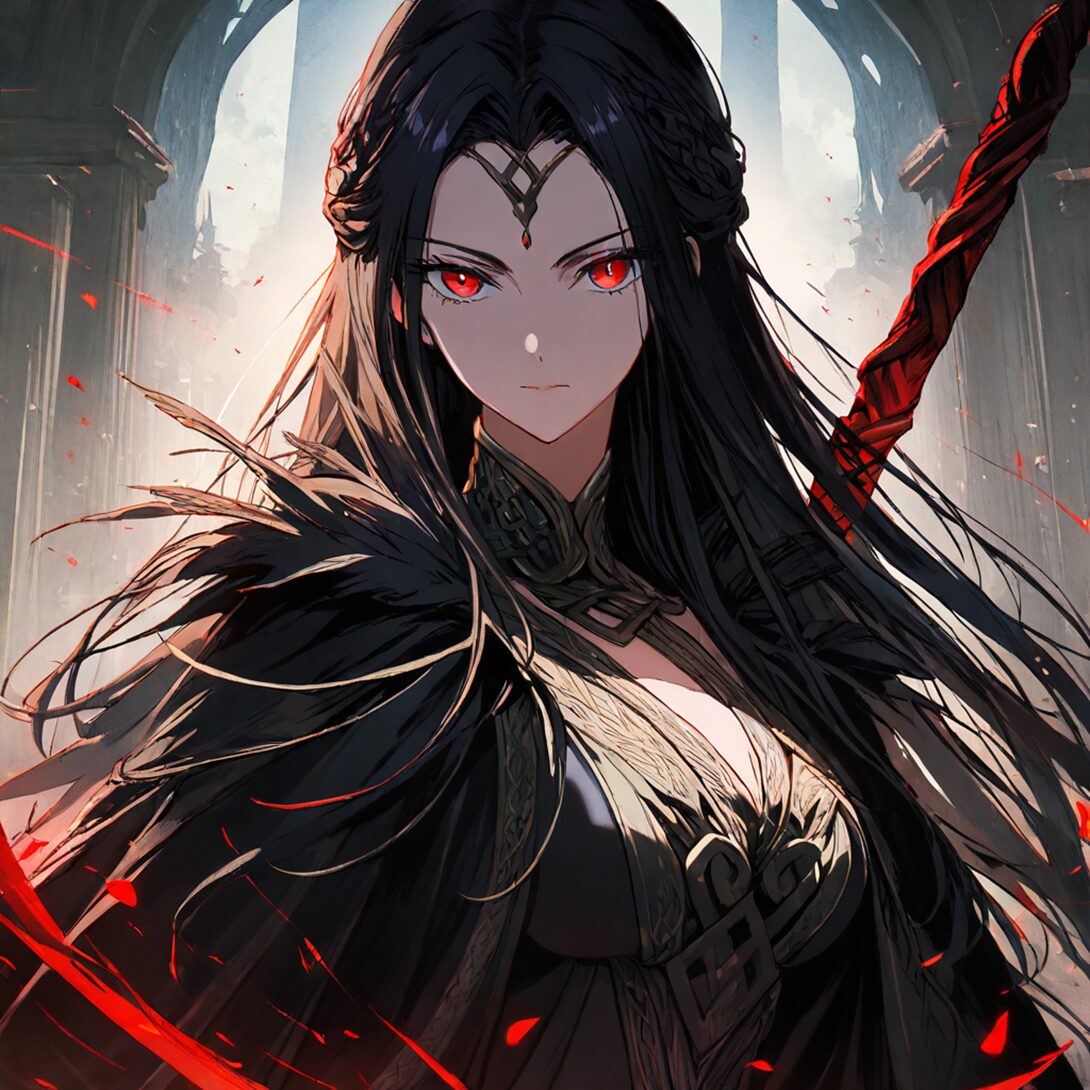
During this defense, the goddess of battle and death, “the Morrígan,” appears before Cú Chulainn in the form of a beautiful maiden and declares her love. But because he rejected it in the midst of battle, the Morrígan grew angry and declared she would obstruct his fighting.
The Morrígan obstructs Cú Chulainn, transforming in turn into an eel, a wolf, and a cow. He repels all of them but wounds the goddess. Later there is an anecdote that Cú Chulainn, not realizing the Morrígan disguised as an old woman was begging him to tend her wounds, unthinkingly spoke words of blessing, and by the power of those words the goddess’s wounds healed. This goddess the Morrígan is the very being who later foretells Cú Chulainn’s death.
The Duel with His Friend Ferdiad
To defeat Cú Chulainn, Medb finally sends his “sworn brother.” His friend “Ferdiad,” with whom he had once trained under Scáthach.
The two, inseparable friends, yet forced to fight. Their duel becomes a life-or-death struggle lasting three days. By day they cross swords with all their might, and by night they share medicine to heal each other’s wounds and food — such a sorrowful battle was repeated.
And on the final day, the cornered Cú Chulainn finally looses the deadly magic spear “Gáe Bolg” and slays his friend Ferdiad. Cú Chulainn grieved fiercely at having killed his friend with his own hand. This scene is known as one of the finest tragedies in Celtic mythology.
The Duel of the Two Bulls — the End of the Cattle Raid
Eventually the warriors of Ulster, recovered from the curse, rush in, and Medb’s army finally withdraws. But in the confusion of the retreat, Queen Medb had succeeded in carrying off the target, the “Brown Bull of Cooley (Donn Cúailnge).”
And the story reaches an unexpected end. The Brown Bull, carried off to Connacht, meets the “White-Horned Bull (Finnbennach)” that Medb’s husband boasts of, and the two giant bulls wage a terrible fight, racing across all of Ireland. The Brown Bull gores the White-Horned Bull on its horns and tears it apart, scattering the corpse across the land (said to be the origin of place names), and just as it reaches its own home, its strength gives out and its heart bursts and it dies.
What remained after so much war and sacrifice was only the corpses of two bulls. Quietly announcing the emptiness of war brought on by kings’ greed, “The Cattle Raid of Cooley” comes to a close. The two bulls are also said to have originally been the incarnations of two spirits who kept fighting in changed forms.
The Hero’s End
Even the seemingly invincible Cú Chulainn meets his end.
He had been laid with several “geasa (taboos that must not be broken).” For example, “he must not eat dog meat” (deriving from his name being “the hound”).
His enemies use a stratagem to corner Cú Chulainn into a situation where he has no choice but to break his taboo. Having broken the taboo and weakened his power, he was finally given a grave wound by a magic spear.
Sensing his death drawing near, Cú Chulainn, to face his enemies standing to the end, binds his own body to a standing stone. And because he kept standing even after he died, no enemy could approach. Eventually, seeing the crow that the war goddess “the Morrígan” had taken form as land on his shoulder, the enemies are said to have finally been sure of his death. A heroic end, frightening his enemies even in death.
Another Famous Scene of the Ulster Cycle — “The Tragic Love of Deirdre”
The Ulster Cycle includes a tragedy renowned alongside the story of Cú Chulainn — “the tragic love of Deirdre.” A story that greatly influenced later literature too.
When a baby girl is born at the court of the Ulster king “Conchobar,” a Druid prophesies, “This girl will become a peerless beauty, but for her beauty she will bring ruin on Ulster.” Even so, the king, intending to make the girl “Deirdre” his own future wife, had her raised secretly in a remote place.
But the beautifully grown Deirdre falls in love with the young warrior “Naoise” and elopes with him and his brothers to Scotland. King Conchobar, having lost face, called them back to Ulster by pretending, “I will not hold your crime against you,” and broke his promise and killed Naoise and his brothers.
Deirdre, having lost her loved one, spends a year in deep grief and then takes her own life. The senior vassal Fergus and others, enraged at this betrayal, left Ulster and ran to Queen Medb, which is said to be a remote cause of the later “Cattle Raid of Cooley.” As prophesied, the tragedy of one woman shook a kingdom.
How Strong Are the Characters Here? — The Power Ranking
The gods and heroes appearing in this article are also introduced in strength order in the “Mythology, Religion & Legend Power Ranking.” Enjoy their exploits in the original text alongside their “strength.”
To Learn More
Conclusion
In this article, I explained the story of Celtic mythology’s greatest hero, “Cú Chulainn,” in detail, based on the Ulster Cycle. How was it?
A boy who won his name by slaying a hound, with the magic spear Gáe Bolg and the “warp-spasm” as his weapons, holds off a great army all alone, passes through a tragic duel with his friend, and, bound to a standing stone, frightens his enemies even in death — Cú Chulainn’s life is emblematic of the Celtic image of a hero.
In the next article (Article 3), I will explain the story of another great hero, “Fionn mac Cumhaill” (the Fenian Cycle), and the Welsh myth collection the “Mabinogion.”
I hope you’ll read the next article too.
Also popular with readers
📚 Series: The Original Texts of Celtic Mythology (3/5)