Thank you for visiting. This article is the first installment in a series explaining the original texts of Celtic mythology.
This time, based on the center of the Irish mythological cycle, the “Book of Invasions,” we look in detail at the age of the gods.
For an overview map of Celtic mythology’s original texts as a whole, please see this summary article.
Celtic Mythology’s Original Texts — Four Cycles and Manuscripts
Before getting into the main subject, let’s grasp in what original texts Celtic mythology comes down. Unlike Greece or the North, the Celts (the Druids) avoided recording their teachings in writing and kept them by oral tradition. So the myths became writing only after Ireland was Christianized, when monastery monks wrote them down in the medieval period (from around the 12th century). The Book of the Dun Cow (Lebor na hUidre) and the Book of Leinster are representative manuscripts.
The stories handed down divide broadly, by content, into four “cycles.”
| Cycle | Content |
|---|---|
| Mythological Cycle | The divine clan Tuatha Dé Danann and the Book of Invasions (= this article) |
| Ulster Cycle | The hero Cú Chulainn and “The Cattle Raid of Cooley” (Article 2) |
| Fenian Cycle | The warrior band Fianna and Fionn mac Cumhaill (Article 3) |
| Cycle of the Kings | Legends concerning the successive kings |
This article treats the “Mythological Cycle,” which tells of the beginning of the world and the gods, especially its center, the “Book of Invasions.”
What Is the “Book of Invasions” — Six Comings to Ireland
The “Book of Invasions (Lebor Gabála Érenn)” is a mythic history book recording, in order from the beginning of the world, the rise and fall of the six peoples who came one after another to Ireland.
The story begins with a clan that came around the time of the great flood, and several peoples come and go. Among them, especially important are the fifth to come, the divine clan “Tuatha Dé Danann,” and the sixth, the human people who became the ancestors of present-day Irish people, the “Milesians (Gaels).”
| People who came | Overview |
|---|---|
| Cessair’s people | The first clan, said to have come before the great flood |
| Partholón’s people | Early comers. Perish from plague |
| Nemed’s people | Tormented by the demonic Fomorians |
| Fir Bolg | A people who divided and ruled Ireland |
| Tuatha Dé Danann | The divine clan skilled in magic and craft |
| Milesians | Defeat the gods, become the ancestors of present humans |
Putting this broad flow of “coming and rise-and-fall” into a diagram gives the following. The skeleton of Celtic mythology emerges — a divine clan appears, drives off the demons, and finally yields the land to humans and departs.
The Tuatha Dé Danann — the Divine Clan
The “Tuatha Dé Danann” means “the people of the goddess Danu,” a divine clan excelling in every craft — magic, poetry, medicine, smithing. They came to Ireland bearing four treasures (an unbeatable sword, an ever-victorious spear, a cauldron that satisfies hunger, and a stone of destiny that cries out under a rightful king).
The main gods are as follows.
| God | Domain |
|---|---|
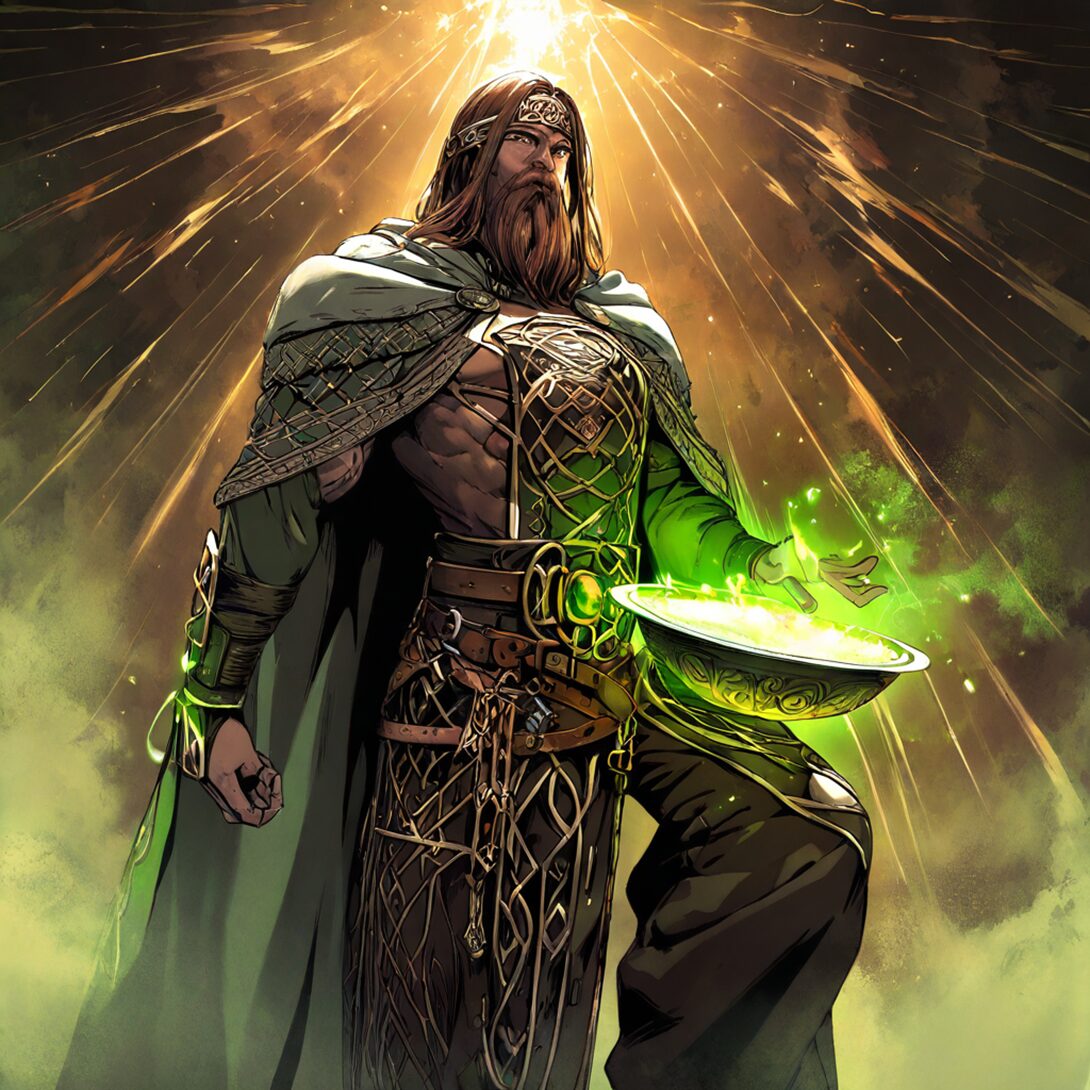
| The Dagda | Father god. Holds a club that controls life and death, a cauldron that never empties, and a harp that controls the seasons |
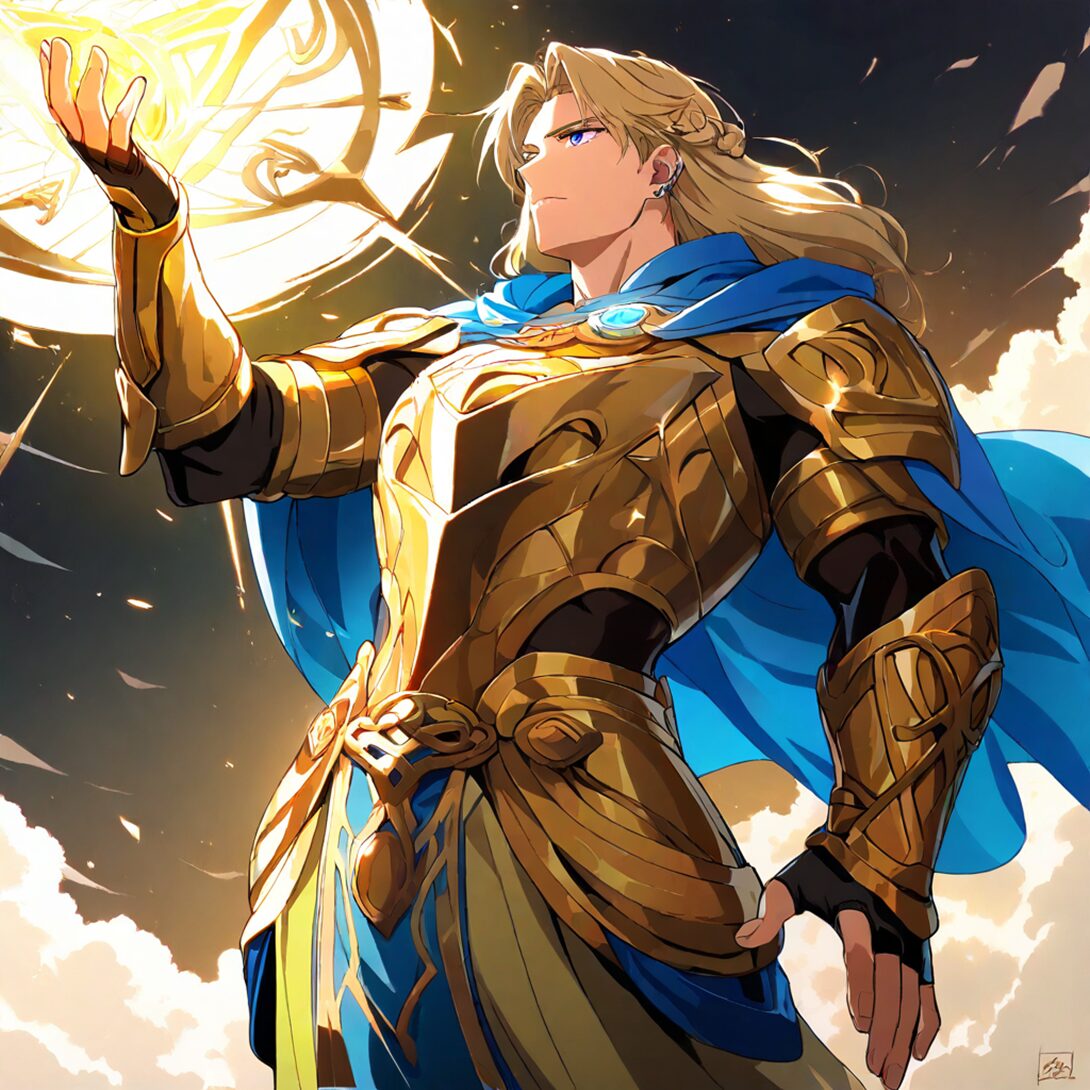
| Lugh | The light god. The all-skilled warrior “Samildánach,” skilled in every art |
| Nuada | King of the clan. “Nuada of the Silver Hand” |
| The Morrígan | Goddess of battle, fate, and death. Takes the form of a crow |
| Brigid | Goddess of poetry, medicine, and smithing |
| Dian Cécht | God of medicine |
| Manannán mac Lir | God of the sea. Controls mist and magical items |
The Four Treasures of the Tuatha Dé Danann
The Tuatha Dé Danann are said to have come to Ireland bearing “four treasures,” one each from four cities. These are the treasures that symbolize Celtic mythology.
| Treasure | Power |
|---|---|
| The Dagda’s cauldron | No matter how much is eaten, it never empties, and none leave it unsatisfied |
| Nuada’s sword (Claíomh Solais) | Once drawn from its sheath, no one can escape it — an unbeatable sword |
| Lugh’s spear (Brionac) | A magic spear that always brings victory to its wielder and never misses |
| The Stone of Destiny (Lia Fáil) | A stone that cries with joy when a rightful king touches it |
These treasures are thought to have influenced later European stories, such as the later “Grail legend” (the Dagda’s cauldron) and “Excalibur” (the unbeatable sword).
The True Faces of the Major Gods
The Father God, the Dagda
The “Dagda,” meaning “the good god (the one skilled in all things),” is the elder-statesman god of the Tuatha Dé Danann. Depicted as a great eater of bold character, he holds three treasures: a “giant club” that kills with one end and revives with a touch of the other, a “cauldron” that never empties, and a “magic harp” that turns the seasons and controls human emotions. There is an anecdote that once, when the Dagda went to recover his harp stolen by enemies, he called out to it, and the harp flew to him on its own, mowing down the enemies.
The Sea God, Manannán mac Lir
“Manannán mac Lir” is the god who rules the sea. He had a horse that rides the waves and a self-sailing boat, the “wave-sweeper,” and could control mist freely to hide himself. He is also taken to be the king of the otherworld (the Land of Eternal Youth) and is depicted as a wise being who grants many magical items to humans and gods. The name of the Isle of Man is said to derive from this god.
The Two Battles of Mag Tuired
The Tuatha Dé Danann experience two great battles over the hegemony of Ireland.
The First Battle — Nuada of the Silver Hand
The first battle was against the native “Fir Bolg.” The Tuatha Dé Danann won, but their king “Nuada” lost an arm in this battle.
By Celtic law, “one with a bodily defect cannot be king.” So Nuada had to step down from the throne and, gaining a “silver prosthetic hand” made by the god of medicine, came to be called “Nuada of the Silver Hand” (he later recovers his real arm).
The one who became king in Nuada’s place was the beautiful “Bres,” of Fomorian blood. But Bres was terribly miserly and imposed tyranny, drawing the people’s discontent, and was deposed.
The Light God Lugh Appears at the Court of Tara
Before the second battle comes the famous scene of “Lugh’s arrival.”
One day, an unfamiliar youth, Lugh, visits the gate of the royal court Tara. The gatekeeper says, “None may enter the court unless skilled in some art.” So Lugh names his skills one after another. “I am a carpenter,” “a smith,” “a warrior,” “a harper,” “a poet,” “a sorcerer,” “a physician.”
The gatekeeper refuses each time, “We already have one with that skill at court.” Then Lugh retorts, “Then let me ask: is there any one person here who possesses all of these together?”
To this the gatekeeper had no reply, and Lugh was welcomed into the court. Thus Lugh was acknowledged as “Samildánach (skilled in many arts)” and was entrusted with overall command of the battle against the Fomorians.
The Second Battle — the Light God Lugh and Balor of the Evil Eye
Resentful of his deposition, Bres leads the army of the demonic “Fomorians” and attacks. This is the fateful “Second Battle of Mag Tuired.”
Under the light god “Lugh,” entrusted with overall command, the gods prepare for the decisive battle. The smith god Goibniu instantly reforged broken weapons, and the medicine god Dian Cécht revived wounded warriors at the “healing well.” It was a total war marshalling the gods’ skill and magic.
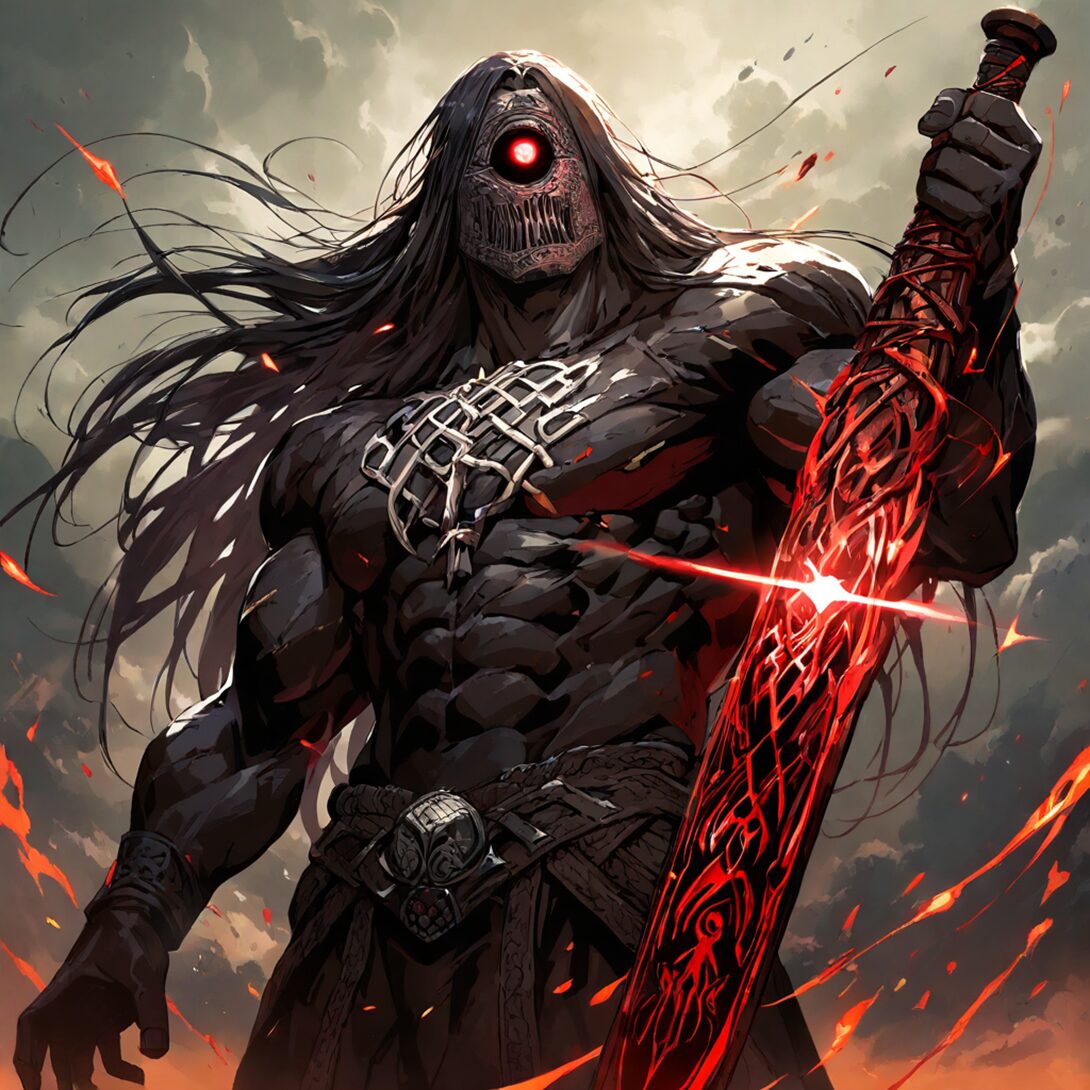
The mightiest being on the Fomorian side was “Balor.” He had an “evil eye” that destroys all it sees, and his eye was so heavy that several people were needed to lift the eyelid to open it.
In fact, Lugh was the very grandson of Balor, who, fearing the prophecy that he would be “killed by his grandson,” had dreaded this. On the battlefield, at the very moment Balor tried to open the evil eye, Lugh loosed a sling-stone (or a magic spear) and shot through Balor’s evil eye, socket and all. The evil eye, turned backward, burned up the Fomorian army instead, and so, as prophesied, the grandson Lugh defeated his grandfather Balor, and the battle was decided.
Tragic Tales of the Age of the Gods — the Children of Lir and the Children of Tuireann
Among the stories set in the age of the gods, especially beloved in Ireland are the tragic tales called “the Three Sorrows of Storytelling of Ireland.” Two of them are set in this age of the Tuatha Dé Danann (the remaining one is “the tragic love of Deirdre,” treated in Article 2).
One is “the Children of Lir.” The god “Lir,” closely tied to the sea god too, had four lovely children. But their stepmother, “Aoife,” driven by jealousy, turned the four into swans by magic. The children had to spend 900 long years as swans on lakes and seas, keeping only their beautiful singing voices. Eventually, when the time was full, they returned to human form with the sound of a Christian bell, but by then they had become 900-year-old elders — a sad and beautiful story.
The other is “the Children of Tuireann.” Tuireann’s three sons kill “Cian,” the father of the light god Lugh. Learning of his father’s death, Lugh set, as atonement (compensation), a series of nearly impossible tasks to gather treasures from all over the world. The three brothers accomplish nearly all of them after a superhuman adventure, but are gravely wounded in the final trial and lose their lives. A heroic adventure tale that ends in tragedy. These tragic tales show well that Celtic mythology is a “story world where glory and grief are inseparably joined.”
From Gods to “Fairies”
The Tuatha Dé Danann, who flourished at their height having driven off the Fomorians, are eventually visited by the last comers, the human people, the “Milesians (Gaels).”
The Tuatha Dé Danann fight them and are defeated, and come to yield the surface of Ireland to humans. And the gods vanish into another world underground and within the hills (burial mounds), “Tír na nÓg (the Land of Eternal Youth).”
Having come to dwell in the underground mounds (sídhe), they later came to be called the “Aos Sí (fairies).” This is the origin of the “fairies” handed down in Celtic tradition. The once-great gods came, with the passage of time, to be handed down as small fairies.
How Strong Are the Characters Here? — The Power Ranking
The gods and heroes appearing in this article are also introduced in strength order in the “Mythology, Religion & Legend Power Ranking.” Enjoy their exploits in the original text alongside their “strength.”
To Learn More
Conclusion
In this article, based on the Celtic “Book of Invasions,” I explained the age of the gods in detail. How was it?
The gods of magic and craft, the “Tuatha Dé Danann,” win two battles against the demonic Fomorians, and the light god Lugh defeats Balor of the Evil Eye — and the defeated gods depart underground as fairies. I hope you have grasped this distinctive Celtic worldview.
In the next article (Article 2), set in the age of humans, I will explain the story of Celtic mythology’s greatest hero, “Cú Chulainn.”
I hope you’ll read the next article too.
Also popular with readers
📚 Series: The Original Texts of Celtic Mythology (2/5)