Thank you for visiting. This article is the first installment in a series explaining the original texts of Mesopotamian mythology.
This time, based on the Babylonian creation epic the “Enūma Eliš,” we look in detail at how the world and the gods were born.
For an overview map of Mesopotamian mythology’s original texts as a whole, please see this summary article.
What Is the Enūma Eliš?
“Enūma Eliš” means the work’s opening words, “When on high.” It is the Babylonian creation epic, recorded in cuneiform on seven clay tablets.
This is not a mere story of creation; it is a work with political and religious meaning, praising how Babylonia’s patron god “Marduk” rose to the top of all the gods. It is said to have been recited by priests at the annual “New Year festival (Akitu).”
This story is divided into seven clay tablets and unfolds roughly as follows. Tablets 1–4: the birth and conflict of the primeval gods, up to Marduk defeating Tiamat. Tablets 5–6: the creation of the world and humankind. And tablet 7: the gods chant the “50 names” praising Marduk.
These tablets long slept underground, but in the 19th century large numbers were excavated and deciphered from the ruins of the ancient Assyrian “library of King Ashurbanipal.” By this, Mesopotamian myth far older than the Bible became known to the world again.
The broad flow of the story is as follows.
The Primeval Sea — Apsu and Tiamat
When there was as yet neither heaven nor earth, only two primeval waters existed: the freshwater god “Apsu” and the saltwater goddess “Tiamat.” From the mingling of these two waters, the first gods were born, generation after generation.
But because the young gods were so noisy and disturbed the primeval calm, the father god Apsu thought, “Let us just slaughter the young gods altogether.”
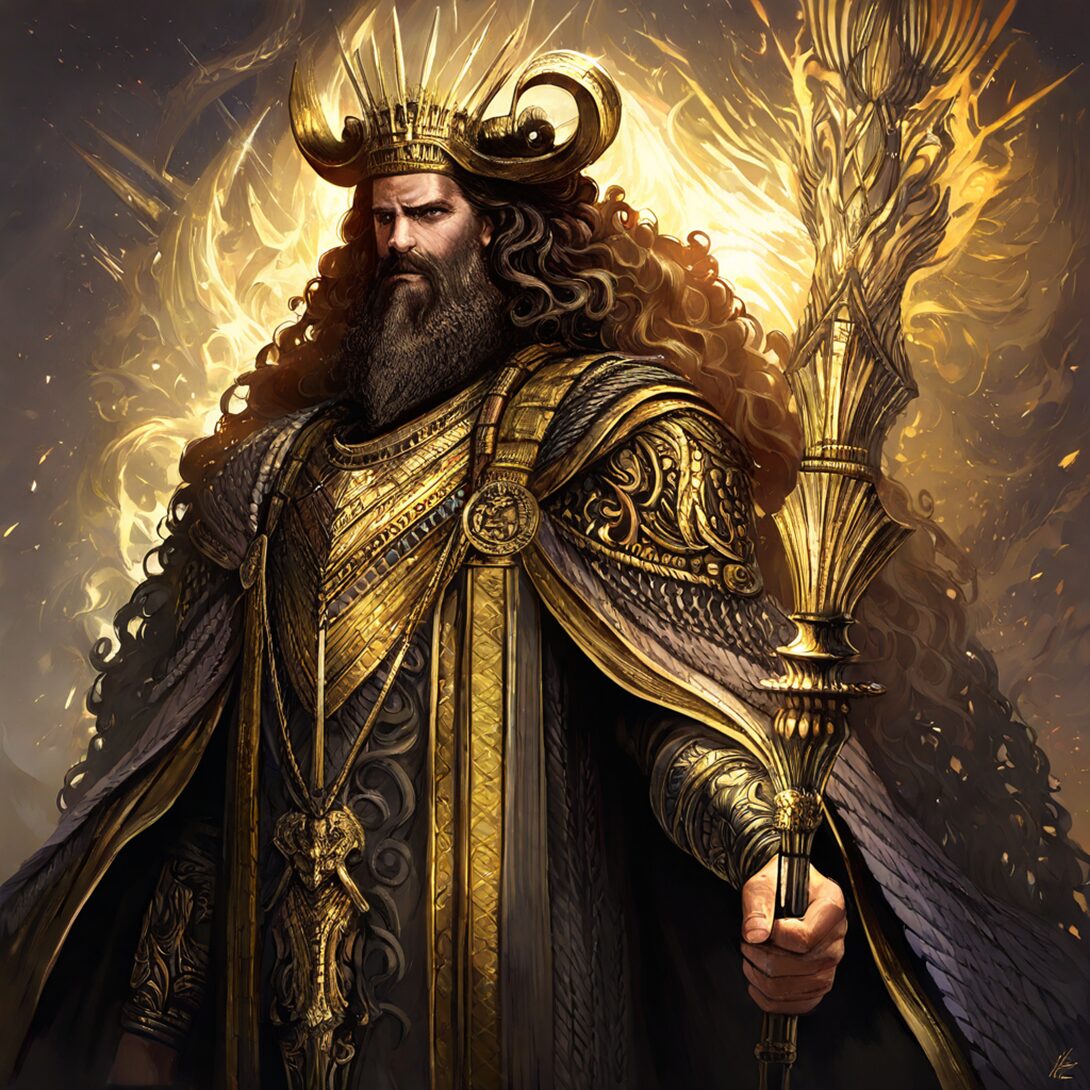
Sensing this, the wisdom god “Ea (Enki)” struck first, put Apsu to sleep, and killed him. Ea built his own dwelling upon the slain Apsu. And there, as Ea’s son, the later hero “Marduk” was born. Marduk was an outstandingly strong and wise god from birth.
Tiamat’s Revenge
The mother goddess “Tiamat,” her husband Apsu killed, at first stood by, but, egged on by those around her, finally resolved on revenge against the young gods.
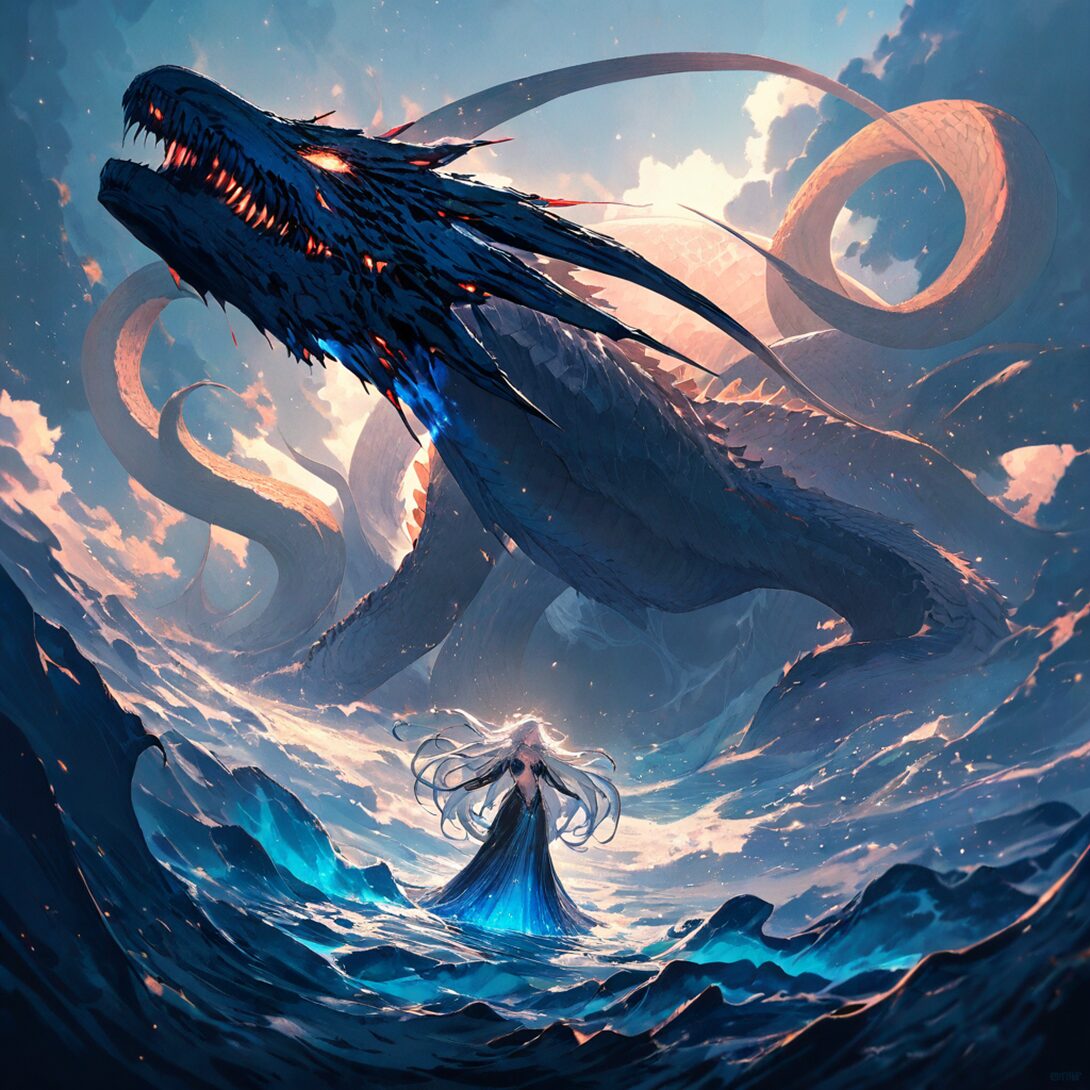
Tiamat produced as many as 11 terrible monsters — venomous snakes, dragons, scorpion-men — as her army, and appointed the god “Kingu,” whom she took as her new husband, supreme commander. Further, she gave Kingu the “Tablet of Destinies,” which fixes the fates of the gods, granting him immense authority.
Before the army of Tiamat, the embodiment of chaos, the young gods trembled, and there was no one who could stand against her. Even the wisdom god Ea was at a loss.
Marduk’s Appearance and Victory
The one who then stepped forward was the young hero god “Marduk.” In exchange for fighting Tiamat, he set a condition.
“If I win, acknowledge me as king of all the gods, with the highest rank.”
The cornered gods agreed. Marduk, clad in storm and lightning, bow and arrows, and four winds as weapons, faced the decisive battle with Tiamat all alone.
At the very moment Tiamat opened her great mouth to swallow Marduk, Marduk blew in a gale so she could not close her mouth, shot an arrow through her swollen belly, and finally slew the giant dragon Tiamat. The supreme commander Kingu and the army of monsters were captured too, and Marduk seized the “Tablet of Destinies” from Kingu.
The Creation of the World and the Birth of Humankind
Victorious, Marduk uses the giant corpse of the slain Tiamat to build the world.
He split Tiamat’s body in two like a shell, making one half “heaven” and the other “earth.” He set in heaven the paths of the stars, the sun, and the moon, made the calendar, and from Tiamat’s eyes made flow the great rivers that water Mesopotamia, the “Tigris and Euphrates.”
Finally, so the gods could be freed from labor, Marduk decided to make “humans.” Humans were made from the blood of Kingu, executed as the ringleader of the rebellion, and were given the role of working in the gods’ place.
For Marduk, who completed the world, the gods built the city “Babylon” and its temple (the holy tower Esagila). And the story concludes with the gods chanting the “50 names” praising Marduk’s greatness. Thus Marduk became the supreme god of Babylonia in name and in fact. In Assyria, which later conquered Babylonia, the same epic was recited with its protagonist replaced by their own god “Ashur.” From this too one can see that the creation myth bore a political role of justifying the hegemony of its city or nation.
Before the Enūma Eliš — the Sumerian View of Creation
The “Enūma Eliš” is a Babylonian epic, but the earliest bearers of Mesopotamian civilization were the Sumerians. Let’s also grasp the older view of creation they left on clay tablets. Marked by no hero god like Marduk appearing, the making of the world is told plainly.
In Sumer, from the primeval sea “Nammu,” the mother of all things, the “cosmic mountain” with heaven and earth united was born. Its summit was the sky god “An,” its foot the earth goddess “Ki,” and the air god “Enlil,” born between them, separated heaven and earth, making a space (the world) between.
The birth of humankind is also distinctive. Because the gods complained of the labor (digging canals, farming) of obtaining their own food, the wisdom god Enki and the mother goddess “Ninmah (Ninhursag)” kneaded the clay from the surface of the primeval sea and made humans to work in the gods’ place. The idea consistent in Mesopotamian mythology, that “humans were made to take over the gods’ labor,” already appears in this Sumerian original text. Also, in the myth of Enki and his wife Ninhursag is depicted a pure paradise without illness, aging, or strife, “Dilmun,” whose resemblance to the Garden of Eden in the Old Testament is often pointed out.
The Major Gods of Mesopotamia
The gods of Mesopotamian mythology are marked by their names changing with era and people — Sumerian, Akkadian, Babylonian (even the same god has two names, a Sumerian and an Akkadian one). The major gods are as follows.
| God (Sumerian / Akkadian) | Domain |
|---|---|
| An / Anu | The sky god. Elder of the gods, the nominal supreme god |
| Enlil | God of air and storm. Holds the real power among the gods, rules the earth |
| Enki / Ea | God of water, wisdom, magic, and craft. Most favorable to humankind |
| Inanna / Ishtar | Goddess of love and war, governing Venus. The most popular goddess |
| Utu / Shamash | God of the sun, justice, and judgment |
| Nanna / Sin | The moon god |
| Marduk | Patron god of Babylon. Becomes king of all the gods in the Enūma Eliš |
| Ereshkigal | Queen who rules the underworld (the land of the dead) |
| Nergal | God of the underworld, plague, and war |
| Ninhursag | Mother goddess of the earth. Nurtures life |
Especially important are three gods: An of the sky, Enlil of the air, and Enki (Ea) of water and wisdom. Among them the wisdom god “Enki (Ea)” often appears as humankind’s ally, and is active in important scenes of Mesopotamian mythology, such as secretly warning humans at the time of the great flood (explained in Article 3).
On the other hand, the air god “Enlil” is a powerful being holding the real power among the gods, but is often depicted as a god harsh toward humans, raising the great flood out of dislike for human noise.
How Strong Are the Characters Here? — The Power Ranking
The gods and heroes appearing in this article are also introduced in strength order in the “Mythology, Religion & Legend Power Ranking.” Enjoy their exploits in the original text alongside their “strength.”
To Learn More
Conclusion
In this article, I explained the Babylonian creation epic the “Enūma Eliš” in detail. How was it?
The hero god “Marduk” defeats the chaos of the primeval sea goddess “Tiamat,” and builds an ordered world from her body — this structure of “prevailing over chaos to produce order (the world)” is emblematic of Mesopotamian mythology. The point that humans were “made to take over the gods’ labor” is also an important idea connecting to the later myths (Article 3).
In the next article (Article 2), I will explain the world’s oldest literature, born in Mesopotamia — the “Epic of Gilgamesh.”
I hope you’ll read the next article too.
Also popular with readers
📚 Series: The Original Texts of Mesopotamian Mythology (2/5)