Thank you for visiting this site. This article covers “Bertrand’s Paradox.”
We use the phrase “choose at random” all the time, but it is not a single well-defined operation. With the same problem, simply changing the definition of “random” makes the answer 1/3, 1/2, or 1/4 — three different values.
The Problem
This problem was posed by French mathematician Joseph Bertrand in 1889.
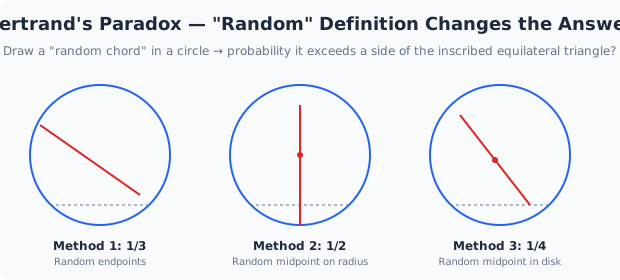
A circle has an equilateral triangle inscribed in it. Draw a “random chord” of the circle. What is the probability that the chord is longer than a side of the inscribed equilateral triangle?
Intuitively, one answer seems to follow naturally. But considering three different methods of “drawing a random chord” yields three different answers.
Method 1: Random Endpoints (Answer: 1/3)
Fix one point on the circumference, then choose a second point on the circumference uniformly at random to form a chord.
Setting the fixed point at a vertex of the triangle, the chord is longer than a side of the triangle only when the other endpoint falls on the arc opposite the fixed vertex — which is 1/3 of the circumference.
Probability: 1/3.
Method 2: Random Midpoint on a Radius (Answer: 1/2)
Choose the midpoint of the chord uniformly at random along a radius of the circle.
A chord is longer than a side of the triangle when its midpoint falls within the inner half of the radius (closer to the centre). Choosing uniformly along the radius, the probability of satisfying this condition is 1/2.
Method 3: Random Midpoint in the Disk (Answer: 1/4)
Choose the midpoint of the chord uniformly at random from all points inside the circle.
A chord is longer than a side of the triangle when its midpoint falls inside a smaller circle centered at the centre of the original circle with radius equal to half the original. The area of the smaller circle is 1/4 of the larger, so the probability is 1/4.
The Same Problem, Different Answers
All three methods are solving the same problem — “draw a random chord in a circle.” Yet the answers are 1/3, 1/2, and 1/4 respectively.
Each calculation is internally correct. The issue is that the operation “draw a random chord” does not have a unique definition.
“Choose endpoints at random,” “choose a midpoint along a radius at random,” and “choose a midpoint in the disk at random” each define a different probability distribution, and they naturally yield different answers.
It runs into a foundational problem in statistics
This is not a geometrical diversion; it connects directly to a central dispute in statistics.
With no information at all, treat every value as equally likely. Try to put that state of “no information” into a formula and you hit the same wall every time.
Suppose you know only that the side of a square lies between 1 and 2. With no other information, it looks natural to treat the side length as spread evenly from 1 to 2.
Consider the same situation in terms of area, though, and the area lies between 1 and 4. Treat that as evenly spread and you get a different distribution from the one you got by spreading the side length evenly.
- Probability the side is at most 1.5: 50 percent if the side is uniform
- Probability the area is at most 2.25: about 42 percent if the area is uniform
Both describe “the side is at most 1.5,” and the values disagree.
The cause is exactly that of Bertrand’s chord: the word “even” means nothing until you say which quantity it is even in.
The difficulty is known as the problem of the principle of indifference, and it is the starting point of a long argument about choosing priors in Bayesian statistics. In practice the response is sensitivity analysis: compute under several priors and check whether the conclusion moves.
Probability cannot be discussed without assumptions. The constraint Bertrand demonstrated with a single chord is one that anyone using statistics still faces 150 years later.
Is There a Correct Answer?
The standard view is that Bertrand’s Paradox has “no single correct answer,” though deeper arguments exist.
In 1973 the physicist E. T. Jaynes argued that invariance requirements uniquely identify the “correct” probability distribution. What he brought in was the principle that anything the problem does not specify must not affect the result.
The problem statement says nothing about where the circle sits or how large it is. So, Jaynes reasoned, moving the circle or rescaling it must leave the probability unchanged.
- Unchanged under rotation: all three methods satisfy this
- Unchanged under rescaling: only Method 2 satisfies this
- Unchanged under translation: only Method 2 satisfies this
Impose all three and the only survivor is Method 2, giving 1/2. Jaynes also showed experimentally that throwing thin straws onto a circle at random produces values close to 1/2.
That said, the problem is not thereby fully solved. The requirement that the answer be invariant under transformations the problem does not mention is itself an additional assumption, and it is nowhere in the problem statement.
Settling on one answer always means importing something from outside the problem. Bertrand’s paradox is still discussed because there is no escaping that structure.
The three methods side by side
Set out as assumptions, the reason the answers diverge:
| Method | What is chosen at random | What ends up uniform | Answer |
|---|---|---|---|
| Method 1 | two points on the circumference | positions of the chord’s endpoints | 1/3 |
| Method 2 | the midpoint’s position along a radius | distance from the centre | 1/2 |
| Method 3 | the midpoint’s coordinates within the disk | area within the disk | 1/4 |
Each is faithful to the phrase “draw a chord at random,” and they differ in what gets spread evenly.
The difference between Methods 2 and 3 is the clearest. Make distance from the centre uniform and the outside thins out; make area uniform and the outside thickens. The area of a circle goes as the square of the radius, so an annulus of the same width holds more area further out.
Put another way, the word “random” only acquires meaning once you specify which coordinate it is uniform in. Without that, the answer is undetermined.
What This Paradox Teaches
Bertrand’s Paradox shows that in probability problems, failing to define “random” precisely makes the problem itself incomplete.
In everyday life, when we say “choose at random,” we implicitly assume some probability distribution. But that implicit assumption can vary from person to person, causing the same problem to yield different answers.
In modern statistics and data science this lesson is critical. When we say “sample users at random,” are we sampling from active users, all registered users, or with probability proportional to visit frequency? The results can differ dramatically. Bertrand’s Paradox showed nearly 140 years ago that leaving “what exactly is random?” ambiguous leads to misinterpretation.
Joseph Bertrand, who set it
The paradox was presented by the French mathematician Joseph Bertrand in his 1889 book Calcul des probabilités.
By then he already had a body of work in number theory and differential geometry and was teaching at the École Normale Supérieure in Paris. His name also survives in Bertrand’s postulate on prime numbers.
The interesting part is that he did not present it as an unsolvable problem. In the book it is a warning against leaving the setup of a probability problem vague.
For Bertrand himself, in other words, this was not a contradiction but a note of caution. Getting three answers is a defect in the problem statement, not a defect in probability theory.
That it went on being argued about for so long is because “how, then, do you make the setup unique?” turned out to have no easy answer. Something written as a warning was grown into a hard problem by the people trying to heed it.
Incidentally, statistics textbooks refer to another Bertrand problem as well: the three boxes, still widely used as a teaching example for conditional probability.
Related paradoxes that defy probabilistic intuition
Related paradoxes where the arithmetic is correct and the answer refuses to sit with intuition.
Summary
This article covered “Bertrand’s Paradox.”
“Random” is not an obvious, self-evident concept, as this paradox vividly demonstrates. Handling probability correctly requires defining assumptions precisely.
To return to the full list of paradoxes, follow the link below.
Thank you for reading. We hope to see you in the next article.
Also popular with readers
📚 Series: The World's Paradoxes (34/81)