Thank you for visiting this site. This article covers “The Sleeping Beauty Problem.”
Published by philosopher Adam Elga in 2000, this problem looks simple on the surface — yet experts are split down the middle between 1/2 and 1/3 as the correct answer. The debate is still ongoing.
The Setup
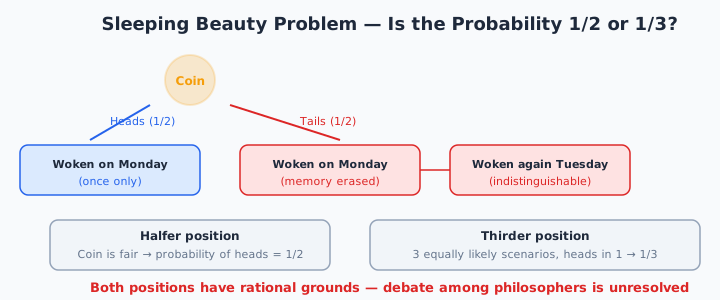
Sleeping Beauty agrees to participate in the following experiment and falls asleep on Sunday. The rules are:
- A fair coin is flipped on Sunday (heads and tails each with probability 1/2).
- If heads: Sleeping Beauty is woken on Monday, asked one question, then put back to sleep. She is not woken on Tuesday. The experiment ends Wednesday.
- If tails: She is woken on Monday, asked the question, given a memory-erasing drug, and put back to sleep. She is woken again on Tuesday and asked the same question. The experiment ends Wednesday.
- When she wakes, Sleeping Beauty cannot tell whether it is Monday or Tuesday (due to memory erasure).
The one question asked each time she wakes: “What probability do you assign to the coin having landed heads?”
The Halfer Position (answer: 1/2)
The logic for answering 1/2 is straightforward.
The coin is fair. The probability of heads is 1/2. The fact that Sleeping Beauty is woken does not change the physical probability of the coin. No matter how many times she is woken, the coin’s outcome is already fixed, and that probability cannot deviate from 1/2.
Even knowing the experimental protocol, she has not received any new information at the moment of waking. “Being woken” is an event that happens whether the coin shows heads or tails, so there is no reason to update the probability.
The Thirder Position (answer: 1/3)
The logic for answering 1/3 runs as follows.
There are exactly three possible scenarios in which Sleeping Beauty might be awake:
- Coin was heads; it is Monday.
- Coin was tails; it is Monday.
- Coin was tails; it is Tuesday.
Sleeping Beauty cannot distinguish which scenario she is in. Assigning equal probability to each scenario, heads appears in only one of three, so the probability of heads is 1/3.
Under this view, “being woken” is itself new information. Since tails produces two wakings and heads only one, being awake is relatively more likely under tails.
The Betting Angle
Translating the problem into a bet reveals something interesting.
Each time she is woken, Sleeping Beauty bets $10 on “the coin was heads.”
If heads: she bets once on Monday and wins $10. If tails: she bets on both Monday and Tuesday, losing $20 total.
In the long run, heads and tails occur equally often, so on average she wins $10 and loses $20. Betting on heads loses money. From a decision-making perspective, 1/3 is the correct credence to act on.
The halfer camp replies: “This is a question about probability, not about betting. She loses money because tails generates more bets, not because the probability is 1/3. The physical probability of heads remains 1/2.”
Why No Consensus
The reason the problem resists resolution is that it connects to a deeper question: what is probability?
If probability means physical frequency, the coin is 1/2. But if probability means subjective degree of belief — how confident the agent should be given her information at the moment of waking — then 1/3 is justified.
In other words, the “correct” answer depends on one’s philosophy of probability — making this a philosophical debate more than a mathematical one.
What exactly is at issue
The reason the problem has stayed unsettled for nearly thirty years is that the word “probability” is being used in two different senses.
- A probability about the world: am I in the world where the coin came up heads?
- A probability about my own position: which of the waking episodes am I in right now?
Ask only the first and the coin is fair, so the answer is one half. Include the second and the tails world contains two wakings, so the answer is one third.
| Position | What it counts | Answer |
|---|---|---|
| Halfers | the event of the coin landing heads or tails | 1/2 |
| Thirders | the total number of waking episodes | 1/3 |
They are counting different things, so each is correct within its own frame.
Because the wording asks only for “the probability that it is heads”, which question is being posed is never fixed. That is where the deadlock comes from.
Information about where you are
What makes the problem philosophically important is that it touches on how to handle self-locating information.
In an ordinary probability problem the observer stands outside the world. Somebody rolling a die does not wonder where they are.
Sleeping Beauty, however, is placed in a state of not knowing which waking she is currently in. The observer’s own position is uncertain.
- Ordinary probability: only the state of the world is uncertain
- Self-location: your position within the world is uncertain as well
The same structure appears in arguments about the anthropic principle in cosmology and in probability calculations for the simulation hypothesis. The problem is how to count yourself when there are several observers.
That is why the Sleeping Beauty problem is not a mere puzzle and papers on it are still being written. It is less that no answer exists than that the framework for producing one has not settled.
Put it as a bet and the answer is fixed
As a probability it stays unsettled; state the terms of a bet and the answer becomes determinate. For practical purposes this is the more useful version.
Suppose that each time Sleeping Beauty wakes she is asked whether to bet on heads or tails, and is paid if she is right.
| How the bet settles | The better choice | Why |
|---|---|---|
| Settled at each waking | tails | tails lets her bet twice |
| Settled once for the whole experiment | either, equally | the coin is fair |
In the same situation, the optimal bet changes with how many times it is settled.
The thirder answer corresponds to the first row, the halfer answer to the second. The two were answering different questions.
Because the wording never states how settlement works, it can be read either way — which makes the source of the deadlock fairly clear.
Push the setup to an extreme and it becomes visible
The quickest way to test the intuition is to make the number of wakings extreme.
Change it so that tails means being woken a million times. On waking, would you think the coin had come up heads?
- If heads: one waking only
- If tails: a million wakings
- You, currently awake: overwhelmingly likely to be in the tails world
Counting waking episodes, the probability of tails is 1,000,000 out of 1,000,001.
And the coin is still fair. The probability of heads is still one half.
It looks contradictory and it is not, because how the coin falls and which episode you are in are different matters. Set out this way, it is easy to feel that two questions had been mixed together.
Related paradoxes that defy probabilistic intuition
Related paradoxes where the arithmetic is correct and the answer refuses to sit with intuition.
Summary
This article covered “The Sleeping Beauty Problem.”
More than two decades after it was posed, the debate between 1/2 and 1/3 remains unresolved. Deep within the familiar concept of probability, an unresolved philosophical problem still hides. That is what makes this a particularly stimulating paradox.
To return to the full list of paradoxes, follow the link below.
Thank you for reading. We hope to see you in the next article.
Also popular with readers
📚 Series: The World's Paradoxes (33/81)