Thank you for visiting this site. This article covers the “China Brain.”
Hand a radio to every citizen of a country and have each person play the part of exactly one neuron. They simply follow a rule sheet: when a signal arrives from this person, send that signal to those people. Taken as a whole, the connectivity of a human brain is reproduced exactly.
So: does this enormous arrangement feel pain? Does it see red and taste the redness?
Almost everyone feels that it surely cannot. And accept, straightforwardly, an influential position holding that mind is an arrangement of functions, and the collective does have a mind. Here is the trap Ned Block set in 1978, step by step.
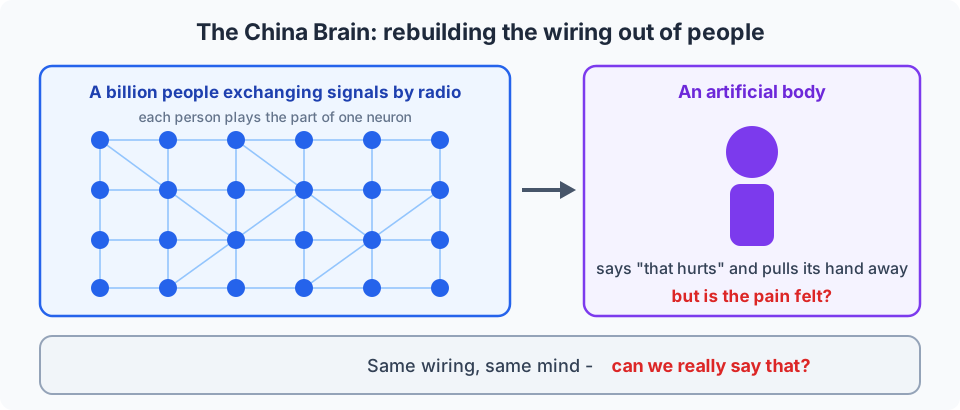
Rebuilding a brain’s wiring out of a population
The setup, concretely. What Block described in his paper “Troubles with Functionalism” is this arrangement.
China’s population at the time was roughly a billion (the figure current when the paper was written in 1978). Give every one of them a two-way radio. Each receives a rule sheet: “on receiving which signal from whom, send what to whom next.” That is the input-output relation a single neuron performs inside a brain, assigned to a person.
The collective also gets a body. The artificial body carries cameras and sensors whose signals reach the population by satellite, and the signals the population emits move its limbs.
In this way, a functional organisation identical to some human brain is realised on top of a billion radio links. Its reactions, its conversation and its behaviour are indistinguishable from the original person’s.
A real brain has tens of billions of neurons, so the obvious objection is that there are not enough people. That is not the point of the thought experiment, though. Allow the headcount to grow as needed, and concentrate on the question of whether mind arises given only the same organisational form.
The target was functionalism
Block aimed at functionalism: the position that a mental state is fixed not by what the brain is made of but by the role it plays between inputs, outputs and other mental states.
The view has a great strength. It does not tie mind to a particular substance, so whether the brain is carbon or silicon, anything playing the same role can be granted a mind. It leaves room for minds in aliens and in AI — an open theory.
Block suspected that openness went too far. He organised the problem as two kinds of failure.
| Position | The failure it invites | Example |
|---|---|---|
| Too exclusive (chauvinism) | Unfairly narrows what can have a mind | ”Without the substance of a human brain there is no mind” |
| Too liberal | Grants minds to things that surely cannot have them | ”Same wiring, so a population also has a mind” |
Insist on brain matter and you narrow the range of mind too far; decide by role alone and you widen it too far. The China Brain is a device for making the second excess visible.
And crucially, what Block took issue with was not “cleverness” but “feeling.” Grant that the collective behaves intelligently. But can we say the painfulness of pain and the redness of red are there as well? That is what he framed as doubtful.
A windmill, three hundred years earlier
A similar idea is in fact much older: the German philosopher Leibniz’s passage about a “mill,” written in the early eighteenth century.
Suppose there were a machine that thought and felt, he says, and suppose it were enlarged to the size of a mill so that you could walk inside it. What you would find are only parts pushing one another, and nothing whatever that explains perception.
The China Brain is that mill rebuilt out of people. Two thought experiments three centuries apart sharing a shape says how deep the puzzlement runs about “how does an interior feeling come out of an assembly of parts?”
Does an intuition count as evidence?
The strongest counter-attack is simple: “it feels as though there is no mind” is merely an intuition.
We are thoroughly accustomed to the picture of mind residing in soft tissue inside a skull. Our reluctance to grant a mind to a crowd holding radios may be nothing but that habituation getting in the way. Perhaps we are mistaking prejudice against the unfamiliar for a philosophical discovery.
There is an argument suggesting the intuition is unreliable. The well-known one imagines replacing neurons one at a time with artificial components.
- Replace exactly one neuron with a component of identical input-output. The mind should be unchanged
- Replace a second, a third; nothing changes at any step
- Continue and the whole brain becomes artificial
- So at which single component did the qualia disappear?
If they vanish abruptly somewhere, one component was carrying all of consciousness, which is implausible. And if they fade gradually, you accept the strange state of “the experience thinning out while the person notices nothing.” Some philosophers argue from this that it is more natural to hold that the same function means the same consciousness.
And yet, even given that counter-attack, the unease about the China Brain does not go away. That the thought experiment settled nothing is itself a measure of how hard the problem of consciousness is.
How it differs from the Chinese Room
The names are similar and get confused; they are different things, by different authors, with different aims.
| The Chinese Room | The China Brain | |
|---|---|---|
| Proposer | John Searle (1980) | Ned Block (1978) |
| Who executes | One person in a room | A collective of a billion |
| What is reproduced | A symbol-manipulating program | The connectivity of neurons |
| What it denies | Understanding, grasp of meaning | Qualia, felt quality |
| Target | Strong AI (mind from symbol processing) | Functionalism (mind fixed by role) |
The Chinese Room argues that “a person merely following rules does not understand Chinese.” The China Brain says nothing about understanding. It asks only whether a collective perfectly imitating the wiring is accompanied by the feeling of pain.
What both share is the structure of “whoever is doing something from the inside has no idea what the whole is doing.” Just as the person in the room knows no Chinese, no individual with a radio knows what dream they are currently having.
How to take the China Brain
Does this mean companies and nations have minds?
An interesting derivation. Firms and states are also made of many humans exchanging information, and from outside they behave as though making decisions. If you accept the China Brain, must you not grant minds to such organisations too?
What is special about Block’s setup is that it copies the functional organisation of a human brain accurately, down to the details. A company org chart is not shaped like brain wiring, so it is not the same case as it stands. And yet nobody has managed to write down the line for “how similar must it be before we grant a mind?”
Is the communication not far too slow?
It is. Humans exchanging radio messages are orders of magnitude slower than neural transmission, so one “second” for this collective would be years of real time.
Whether that is an essential objection is disputed, because if speed decides whether there is consciousness, that needs its own explanation. To say a slow consciousness is not consciousness, you must decide how many seconds still count.
Does this bear on today’s AI?
Directly. Present-day AI is made of many simple computing elements exchanging signals to produce the behaviour of the whole — structurally rather like the China Brain.
The China Brain’s point that “behaving intelligently and feeling something may be separate matters” bites now that AI responds in human ways. Read as a warning that you cannot settle the interior by looking only at behaviour, this thought experiment from over forty years ago is startlingly current.
Related thought experiments
Thought experiments in philosophy of mind about the conditions under which a mind arises. Read alongside the China Brain, what each is trying to deny becomes clear.
Summary
This article covered the “China Brain.”
Told that a crowd of a billion with radios has a mind, we cannot simply nod along. But try to justify the refusal and you fall back on the poorly grounded claim that it has to be human brain matter. Decide by role alone and the range widens too far. Block built an arrangement where either escape is uncomfortable.
More than forty years on there is still no agreed answer. But now that AI answers indistinguishably from a person, the question of “if the behaviour is the same, may we say the interior is too?” is turning from a philosophy exercise into a practical issue.
To return to the full list of thought experiments, follow the link below.
Thank you for reading. We hope to see you in the next article.
Also popular with readers
📚 Series: Famous Thought Experiments (7/60)