Thank you for visiting this site. This article covers “The Devil’s Proof.”
How would you answer somebody who said “prove to me that ghosts do not exist”? You would have to search every place on earth at every moment, so it cannot be done. That outrageous difficulty of proving a negative is what the phrase probatio diabolica, the devil’s proof, has come to name.
Strictly it is the name of a manoeuvre rather than a thought experiment, but it has long been used in philosophy the way thought experiments are — as a device for asking “which side carries the burden of proof?” And the phrase originally meant something quite different, which is worth knowing too.
It started as a problem about ownership
The phrase comes from medieval European law. What jurists called probatio diabolica had nothing to do with ghosts or aliens. It was proving that you are the owner of a piece of land or property.
Why is that hard? A complete proof of ownership goes like this.
- I received it lawfully from the previous owner
- But was that previous owner the lawful owner?
- They too must have received it from someone before them
- And this has to be traced back to the point where it belonged to nobody
However far you go back, there is always an earlier link, so the proof never closes. Records of transfers from centuries ago do not survive, and a single irregularity anywhere brings the whole chain down (let stolen goods into the chain once and every transfer after it is suspect). On these terms nobody could ever say their property was theirs.
So the legal system gave way instead. It set up a presumption that whoever is actually in possession is treated, for now, as the owner, and machinery granting ownership to someone who has possessed a thing for a set period. Acquisitive prescription and the presumption attaching to possession — the same idea, in the civil codes descended from this tradition.
In other words, the devil’s proof was originally a phrase about the need for devices that stop us demanding impossible proofs.
How the meaning moved
In ordinary usage today — and this is especially entrenched in Japanese, where 悪魔の証明 is a common expression — the devil’s proof almost always means proving that something does not exist. The ownership story rarely comes up. The English-speaking version of the same idea usually travels under the slogan “you can’t prove a negative.”
Exactly how the meaning shifted is not clear, but the bridge was presumably the shared feature of being a proof that is impossible in practice. Both do demand a search with no end to it.
So it pays to watch which sense your listener will take. Inside a legal discussion the original sense is still live, and conversations can slide past one another.
The asymmetry between “is” and “is not”
Why is proving a negative so hard? The reason is in the logical form.
| Form of the claim | Work required to prove it | Difficulty |
|---|---|---|
| ”X exists” | find one and stop | easy, provided you find it |
| ”X does not exist” | check the whole range | hopeless as the range grows |
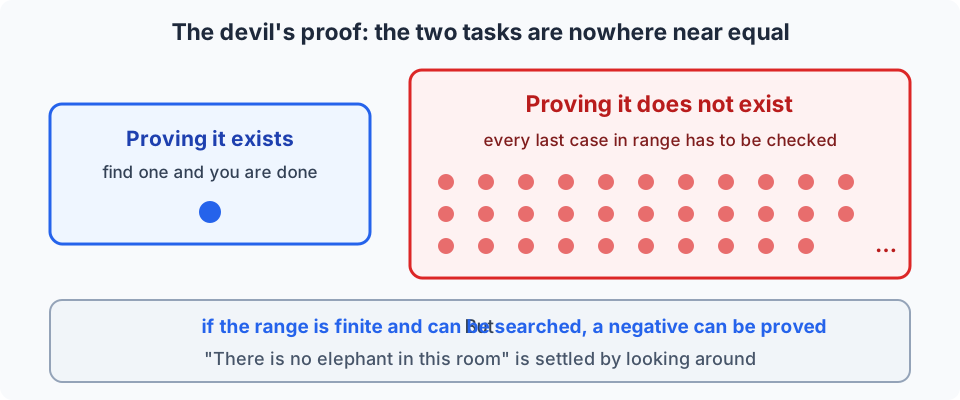
A claim of existence is settled by a single instance. To say “there is a crow that is not black” you bring in the one bird. To say “there is no crow that is not black” you must check every crow in the world without exception.
That asymmetry underlies how we build arguments generally. One reason the side making a claim has to produce the evidence is that the work is lighter on that side. Whoever says a thing exists is simply the efficient party to go looking.
But with a bounded range, it can be proved
This, I think, is where the phrase gets misused most. Proving a negative is not always impossible.
“There is no elephant in this room” is easy to prove: look around. “That transaction is not recorded in this ledger” is the same — check every page and the matter is settled.
Proof becomes impossible only when the range to be searched is infinite, or has not been fixed.
| Situation | Provable? |
|---|---|
| Range is finite and can be checked exhaustively | Yes |
| Range is large but can in principle be narrowed | Yes, well enough for practical purposes |
| Range is infinite, or the other side will not bound it | Effectively no |
So before answering “that’s a devil’s proof, I can’t do it,” there is something to check. Is the range the other party is asking about really impossible to bound? If it can be bounded, this is not a devil’s proof; it is an investigation that takes some effort.
The phrase is not a free pass
One more point worth holding on to: the phrase is not a card for shutting down an explanation.
The objection lands correctly only when the other party has pushed the burden of proof onto you. When somebody presses you with “if you can’t prove it doesn’t exist, it must exist,” pointing out that the move is illegitimate is the proper use.
These uses, on the other hand, do not hold up.
- Making a positive claim yourself and answering “that’s a devil’s proof” when asked for grounds
- Being asked for a bounded check and switching the topic to infinite search
- Refusing to produce records you hold, when you are the one under suspicion
The third happens constantly in real life. There is an asymmetry: a check that is trivial for the party holding the records is impossible for the party without them. Here fairness puts the burden on the side that can bear it. The reason allocation of the burden of proof gets discussed in such detail in law is precisely to tune this.
How science and the courts handle it
Practitioners have built up ways of not demanding impossible proofs.
Science has given up on strictly proving non-existence. Instead it predicts the effect that would be observed if the thing existed, searches to sufficient precision, and treats the thing as absent if nothing turns up. That is how the luminiferous ether was dropped: not proved not to exist, but looked for and not found.
Courts assign in advance which party must prove what. Where a negative fact has to be established, the method is to accumulate surrounding facts until it becomes natural to conclude the thing did not happen. Perfect proof is not demanded; a standard for deciding is fixed instead.
What both share is the idea of admitting that perfect proof is unavailable, and settling the decision procedure ahead of time. That, I think, is the most practical thing to take away from the phrase.
Questions about the devil’s proof
Why is “it can’t be proved false, so it’s true” wrong?
Because it uses a state of not knowing as evidence for one particular conclusion. The form is known as the argument from ignorance (argumentum ad ignorantiam) and has been recognised as a fallacy for a long time.
The same reasoning runs the other way too. “It can’t be proved true, so it’s false” is the identical mistake. Absence of evidence supports neither conclusion. It is a state calling for suspended judgement, not one you may tip toward whichever side suits you.
Are there cases where non-existence has been proved?
Within a bounded framework, yes. Mathematics has proved any number of theorems of the form “no number satisfying these conditions exists.” The range is precisely defined and can be handled by logic alone.
Physics too can prove claims like “within this theory, no such solution exists,” once the theoretical framework is fixed. The hard case is only where the framework itself cannot be bounded. Draw that distinction and it becomes clear when the phrase applies.
If somebody uses it on me, how should I reply?
Ask about the range first. “Which range would you like me to check?” usually makes the conversation concrete on the spot. If they can name a range, go and check it; if they cannot, the demand has just shown itself to be ill-formed.
The other effective move is to restore the order of play. “Tell me first why you think so” puts the burden of evidence back where it started. It has the advantage of not requiring you to deny their claim, so the disagreement does not escalate.
Related thought experiments and paradoxes
Articles approaching the problem of what to do with claims that cannot be proved, from other angles.



Summary
This article covered “The Devil’s Proof.”
A legal phrase about a proof of ownership that regresses without end has come to mean proving a negative. Both really do share a structure: they demand a search that never finishes.
The important thing, I think, is that the phrase is not a universal rebuttal. If the range can be bounded, a negative can be proved; and someone who holds the records refusing to explain by crying “devil’s proof” is not making a valid move. Used in the right place it is powerful; used in the wrong place it is a card that merely stops the conversation. The phrase is worth learning together with that judgement.
To return to the full list of thought experiments, follow the link below.
Thank you for reading. We hope to see you in the next article.

Also popular with readers
📚 Series: Famous Thought Experiments (14/60)