Thank you for visiting this site. This article covers “The Tree in the Forest.”
Deep in a forest, a great tree falls. There is not a person or an animal anywhere nearby.
“Was there a sound?”
Famous as a doorway into philosophy, the question is often treated as the very type of hair-splitting. Unpick it carefully, though, and you find it is two entirely different problems laid on top of each other. One is a question about how a word is used; the other is a genuine problem in metaphysics. Whether you can separate the two is what makes the question worth having.
Berkeley did not write it
The question is often introduced as one posed by the Irish philosopher George Berkeley. But Berkeley never wrote about a falling tree.
What he argued in his 1710 work was more abstract. Told to “imagine a tree that nobody perceives,” we picture the tree in our heads. But that is precisely a state in which our own mind is perceiving the tree. The attempt to imagine an unperceived existence is doomed by its own form.
The falling-tree phrasing appears in print only at the end of the nineteenth century, in a magazine that put the question “if a tree falls on an island where there is nobody, is there a sound?” along with an answer (the answer being: sound is vibration in the air, so yes). The association with Berkeley came later.
The answer is decided by what “sound” means
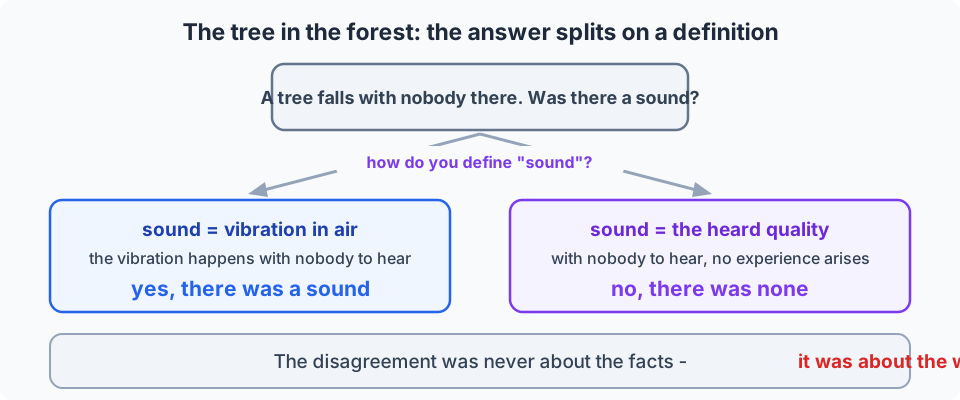
To the substance. Try to answer the question and something odd shows up immediately: the word “sound” can pick out two different things.
| Sense of “sound” | When the tree falls | Answer |
|---|---|---|
| Vibration in the air | The vibration occurs whether or not anyone is there | there was a sound |
| The quality experienced by hearing | With nobody to hear, no experience arises | there was none |
So the reason the question seems to have two answers is that two people are talking about two different things. One is discussing vibrations, the other is discussing the experience of hearing, and both use the word “sound,” which is why the argument never converges.
If that diagnosis is right, the question is not a deep mystery but an apparent conflict produced by a slipped word. Fix the definition first and the dispute ends instantly.
James’s squirrel
A dispute with exactly the same structure is recorded elsewhere. The philosopher William James wrote it up as something that happened to him.
Returning from a walk in the mountains, he found his companions in a fierce argument (a scene from a camping holiday, by his account). The subject was this.
- A squirrel clings to a tree trunk
- A man stands on the other side
- The man moves rapidly round and round the tree
- The squirrel moves round the trunk just as fast, always keeping opposite the man and facing him
The question: does the man go round the squirrel?
The group was split down the middle. James’s answer was this. Both sides are right, depending on what you mean by “go round.”
- If “going round” means passing in turn to the squirrel’s north, east, south and west, then he does
- If it means occupying in turn the squirrel’s front, right side, back and left side, then he does not
Since the squirrel keeps facing him, the man is never once behind it. The two definitions pick out different things, and there is no question of which is correct.
Whenever the falling tree comes up, I think it is worth recalling the squirrel alongside it. When an argument drags on, first check whether the words line up. That move transfers directly to everyday disagreements.
The real question that remains
But there is a part that sorting out definitions does not settle: if nobody observes it, is the vibration in the air really happening either?
How can we assert the existence of an event that nobody perceives? We say the vibration occurs by extrapolating from the many times we have observed it before. About this particular occasion, by stipulation, nobody has checked.
Here two positions meet.
Realism holds that things exist regardless of whether they are perceived. The world carries on whether we are watching or not. It is an entirely natural position, and science is built on it.
Idealism holds that to exist is to be perceived (Berkeley’s famous slogan: esse est percipi). This is Berkeley’s position. He claims that the very notion of matter apart from perception is without meaning.
This disagreement does not vanish when the definitions are lined up. Both sides use the same phrase “vibration in the air” and fight about whether it can obtain independently of perception. From here on is the real body of the falling-tree question.
Berkeley’s answer, and a pair of limericks
So how did Berkeley himself answer? To the obvious worry — does the furniture in an unwatched room disappear? — he had a clear reply.
God perceives everything at all times, so things continue to exist with no person present. The world does not blink in and out from moment to moment because there is an uninterrupted perceiver.
There is a famous pair of limericks teasing the solution.
There was a young man who said, “God Must find it exceedingly odd To think that the tree Should continue to be When there’s no one about in the quad.”
And the reply:
“Dear Sir, your astonishment’s odd; I am always about in the quad. And that’s why the tree Will continue to be, Since observed by, Yours faithfully, God.”
As compressions of a philosophical point go, that is about as tight as it gets. Two verses show you exactly where Berkeley’s system is bearing the load.
Keeping quantum mechanics out of it
The question often gets tied to the measurement problem in quantum mechanics, because “the state is not settled until it is observed” sounds similar.
I would be careful about overlaying the two. Observation in physics means a physical interaction with an apparatus or an environment, not a human consciousness looking at something. A detector nobody is watching still performs a measurement.
Interpretations on which consciousness collapses the wave function have been proposed, but they are not the mainstream view. The same word “observation” is being used in two quite different senses. Which is ironic: this is another confusion of words, committed in the vicinity of the very question meant to teach you to avoid it.
Questions people raise about the tree
Does the question mean anything in the end?
I think it does — but as posed it is ambiguous. Fix the meaning of “sound” first and one branch becomes trivial while the other remains as a genuine philosophical question.
So the value is not in the answer. Unpicking the question and separating where it is a matter of words from where it is a matter of substance is the useful exercise. That is presumably why it turns up so early in introductions to philosophy.
What if an animal heard it?
A good place to push. If “the experience of hearing” is what sound means, then a deer hearing it makes it a sound. What about an earthworm? A plant? A device that registers vibration?
The question of where to draw the line around perceivers shows its face here. Drawing that line is the debate about consciousness itself — one example of an innocent-looking question opening onto the philosophy of mind.
Has realism versus idealism been settled?
No. Though few philosophers today adopt idealism straight. The success of science, obtained on the assumption of a world independent of perception, puts considerable weight on the realist side.
At the same time Berkeley’s starting point — that all we can know of the world comes through perception — still holds. As long as no one has found a way to show that the world exists independently of perception without relying on perception, the dispute will not close completely.
Related thought experiments
Articles approaching from other angles the question of whether unperceived things exist.



Summary
This article covered “The Tree in the Forest.”
Treated as the archetype of hair-splitting, the question turns out on inspection to be an apparent conflict from a slipped word laid over a real metaphysical one. The first dissolves by the same manoeuvre as James’s squirrel; the second is still open.
When an argument fails to connect, line up the words first. Whatever conflict survives that is the actual subject. This two-stage procedure works well beyond philosophy, in any discussion at all. The sound of a falling tree is simply the handiest material for practising it.
To return to the full list of thought experiments, follow the link below.
Thank you for reading. We hope to see you in the next article.

Also popular with readers
📚 Series: Famous Thought Experiments (15/60)