Thank you for visiting this site. This article covers “Solipsism.”
That I am having the experience of reading this sentence is beyond doubt. But how did I establish that whoever wrote it has a mind?
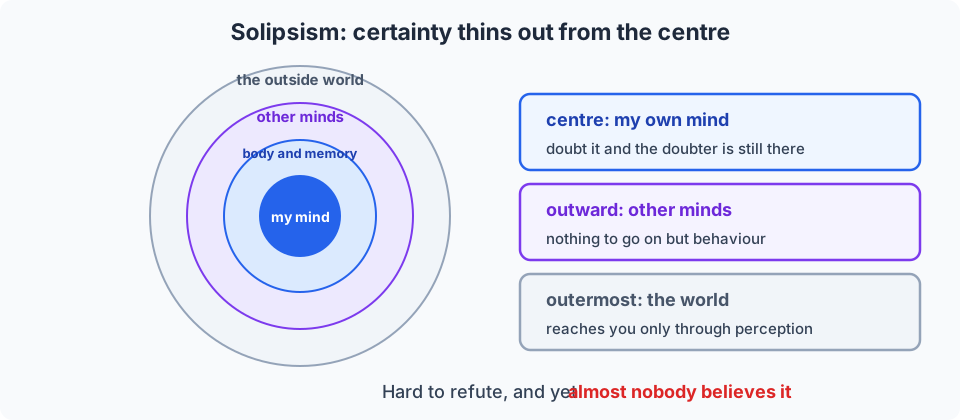
I did not. I watch people laugh and cry and infer that there is probably a mind behind it. Nobody has ever looked directly inside anybody else.
From here comes the position that “the only thing that can be said to exist for certain is my own mind.” That is solipsism. Strictly it is a philosophical position rather than a thought experiment, but it has an unusual property — almost nobody believes it, and refuting it properly is extremely hard — which keeps it in service as a yardstick for the limits of knowledge.
The door Descartes opened
The road to solipsism was laid by Descartes in the seventeenth century.
He went looking for an absolutely certain starting point by discarding every belief that could be doubted at all (the procedure known as methodical doubt). The senses err; dreaming cannot be told from waking; even mathematical truths cannot be secured against the possibility of a malicious deceiver.
What survived at the end was the activity of doubting itself. Whatever I doubt, I cannot doubt that I, the doubter, exist. Hence the famous conclusion: I think, therefore I am.
The problem is what comes next. The only certainty is now the existence of my own mind. How do we get back to the external world and to other people? Descartes himself recovered the world by way of a God who, being no deceiver, would not mislead us. But if you are unconvinced by that bridge, you are left shut inside your own mind.
Three kinds of solipsism
Positions called solipsism vary a great deal in strength. Distinguishing them keeps arguments in order.
| Kind | What it claims |
|---|---|
| Metaphysical solipsism | Nothing exists except my own mind |
| Epistemological solipsism | Other things may exist, but they cannot be known |
| Methodological solipsism | A procedural policy: start only from what is certain |
The first is the strongest, and almost no philosopher in history has asserted it in earnest.
What actually comes up in argument is usually the second. Whether I can in principle establish that other people have minds is treated seriously today under the heading of the problem of other minds.
The third is less a position than a policy. Building up from what is certain is a method you can adopt without believing solipsism at all.
The argument from analogy, and its weakness
The most natural ground for thinking other people have minds is the argument from analogy.
It runs like this. I know that when I feel pain I grimace and cry out. The person in front of me has a similar body, is in a similar situation, and behaves similarly. So it is natural to suppose that something similar is happening on the inside.
For everyday purposes that is plenty. As an argument it has a weak spot: the only case I have ever verified directly is myself.
Generalising to the whole from a single instance is inference nobody would normally accept. It has the same form as eating one apple and concluding that all apples are sweet. And the conditions are worse still, because checking other instances is impossible in principle.
Accepting it as the best explanation
So contemporary philosophy tends to take a different route. The thought is that the hypothesis “other people have minds” best explains what is observed.
They answer aptly, read your intentions, respond to unexpected questions. As a hypothesis explaining that behaviour, a mind is far simpler than a mindless machine that happens to behave that way.
This is not a proof. It is the same procedure science uses to choose theories: adopt the hypothesis with the most explanatory power. It does not show that solipsism is false; it shows that there is no reason to choose it.
That, I think, is the most honest available response. If you demand certainty, solipsism cannot be knocked over. But we are able to make judgements without certainty.
No words to state it in
There is an objection from an entirely different direction, put by Wittgenstein in the twentieth century.
What concerned him was whether a wholly private language could work. Suppose you attach your own private name to a sensation only you can feel. The next day, taking the same sensation to have returned, you use the same name.
He then asks: how do you confirm that it really is the same sensation? The only means of confirmation is your own memory, and there is no means of confirming that the memory is right. At which point the distinction between “using it correctly” and “believing you are using it correctly” disappears.
Where that distinction disappears there is no rule, and what has no rule is not a language. So a private language cannot work. For words to mean anything, other people to check usage against were required all along.
If the argument holds, solipsism does not even have the words to state its own claim. It is a powerful objection, though the interpretation of the argument is itself still disputed, so nothing is settled.
Nobody believes it, and nobody can knock it down
The strange thing about solipsism is that it has almost no adherents and yet no decisive refutation is on offer.
An anecdote related by Russell captures the situation. He received a letter from someone (a logician, by the usual account) reporting that they were a solipsist and were surprised that other people were not solipsists too.
The letter, needless to say, betrays itself. Without believing there is somebody else to read it, there is no motive to write. The act of trying to persuade people of solipsism is already a denial of it.
That said, the observation is not a logical refutation. It only records that nobody can act as a solipsist in practice. A solipsist may doubt other people aloud, but still stops at red lights, and when hungry counts on somebody to make the food.
Questions about solipsism
If it can’t be refuted, might it be true?
Being irrefutable and having reasons in its favour are different things. Solipsism is built so that no observation can deny it. Other people behaving as though they have minds is entirely consistent with it.
And a claim built to be undeniable is not thereby strong. If anything it is weak, because it predicts nothing. The structure is identical to the five-minute hypothesis and to Russell’s teapot.
Does this bear on AI and robots?
Directly. The situation of having to judge whether there is a mind without being able to check the inside is the problem of other minds itself.
With humans we grant minds on behaviour alone. So why do we demand a different kind of proof from machines? Producing a consistent answer to that is not easy. Solipsism shows you the structure at the root of the difficulty.
Thinking about it makes me uneasy
A common reaction. But the argument is not there to threaten you with the possibility that the world is empty.
The right use of solipsism, I think, is to confirm that much of what we are confident about is placed there as an assumption rather than a proof. Other minds, the external world, the reality of the past — none of these are believed on the strength of a proof. And we get through our days regardless. Once you have seen that much, the argument has done its job.
Related thought experiments
Articles on how far we can verify what lies outside ourselves. Set beside solipsism, the differences in what each of them doubts stand out.
Summary
This article covered “Solipsism.”
Only my own mind is certain. The position is something like the hole Descartes dug himself into while looking for certainty. Nobody believes it seriously and nobody knocks it down decisively — a state of affairs going on four hundred years now.
But there is no need to be gloomy about the failure to refute it. We live by analogy and explanatory power, taking other minds for granted. How much of the foundation of our thinking is assumed without proof? Passing through solipsism once makes it easier to face that fact calmly.
To return to the full list of thought experiments, follow the link below.
Thank you for reading. We hope to see you in the next article.
Also popular with readers
📚 Series: Famous Thought Experiments (16/60)