Thank you for visiting this site. This article covers “The Beetle in a Box.”
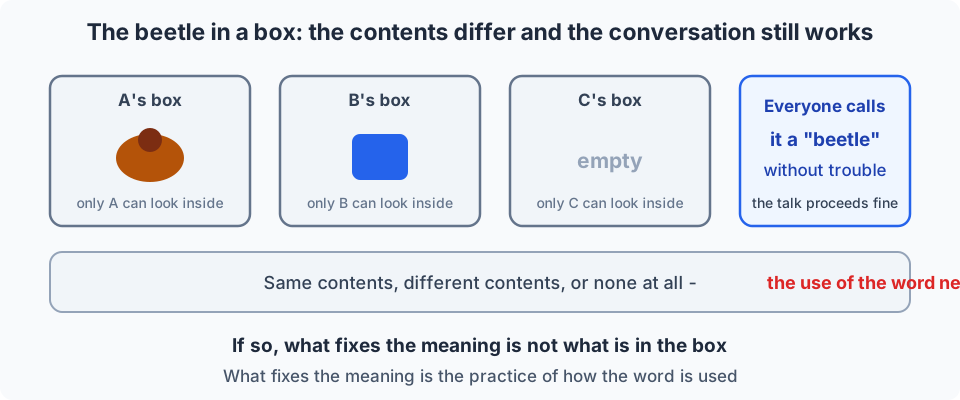
Everybody has a box. You can look inside your own, and you can never look inside anybody else’s. And everybody calls what is in their box a “beetle.”
So what does the word “beetle” refer to?
The contents may differ from person to person. They may be changing constantly. Somebody’s box may be empty. And conversation using the word proceeds without any difficulty at all.
Ludwig Wittgenstein introduced this odd setup in order to reopen the question of what we are doing when we talk about pain and sensation.
The setup
The image sits in Philosophical Investigations, published after his death. (The only philosophical book published in his lifetime was an entirely different one.) The original passage is very short.
Suppose everyone had a box with something in it: we call it a “beetle”. No one can look into anyone else’s box, and everyone says he knows what a beetle is only by looking at his beetle.
Line up the possible situations.
- Every box contains the same creature
- Different people have entirely different things
- The contents change from moment to moment
- Some boxes are simply empty
The decisive point is that no means exists of distinguishing these four from outside. Nobody can look into anybody else’s box, so there is no way to check.
The contents drop out of the language game
Wittgenstein then says this.
Whatever is in the box, the use of the word “beetle” does not change at all. Whether everyone holds the same thing, or different things, or everyone’s box is empty, the conversation proceeds identically.
If so, the meaning of the word is not fixed by the contents of the box. What fixes the meaning is the practice of how the word is used.
And he sums up memorably. The thing in the box has no place in the language-game at all; not even as a something, for the box might even be empty, and even that emptiness plays no part.
The target is the word “pain”
What the image is about is clear from context. The contents of the box are our sensations, pain above all.
We ordinarily think this: the word “pain” refers to a private sensation occurring inside me. Only I can feel it, and it never reaches anybody else.
Wittgenstein doubted that picture. If it were right, how did we ever learn the word “pain”?
A child does not peer inward and attach a name. Having fallen over and started crying, the adults around them say “that hurt, didn’t it.” Eventually the child says “it hurts” instead of crying.
Which is to say the word is acquired as a replacement laid over natural behaviour. No act of pointing at an inner object is involved anywhere.
A private language cannot work
The beetle in a box is part of a larger argument: his claim that a “private language” is impossible.
A private language is one only the speaker can understand. Suppose you attach your own private name to a sensation only you can feel.
He then asks: when the same sensation seems to come the next day and you use the same name, how do you confirm that it really is the same sensation?
The only means of confirmation is your own memory. And there is no means of confirming that memory is correct. At which point the distinction between “using it correctly” and “believing you are using it correctly” disappears.
If the distinction disappears, there is no rule there. What has no rule is not a language.
Not a claim that sensations do not exist
This is the point most often misread. Wittgenstein is not saying that pain does not exist.
He heads off the misreading in the Investigations itself. Asked “are you really saying that there is no pain?” he answers that this is not what he means.
What he denies is the picture that treats a sensation as an “inner object” that a word names. Pain is certainly real. The meaning of the word pain is simply not fixed by pointing at that object.
This distinction is, I think, the main checkpoint when reading the argument. Miss it and you end up with the crude reading that he denied sensations exist.
Its relation to the argument about qualia
The argument runs straight into contemporary philosophy of mind.
There is a thought experiment called inverted qualia. What I experience as red you may experience as blue, and since both of us use words and behave identically, there is no way to check the difference.
That setup has exactly the shape of the beetle in a box. Both hold that conversation succeeds while the contents differ.
And from there the two go in opposite directions.
| Position | What it draws from the contents being uncheckable |
|---|---|
| Taking inverted qualia seriously | There really is an inner quality that words cannot reach |
| Wittgenstein’s side | What plays no part in the working of language cannot ground meaning |
From one observation, some assert an existence and others question the framing of the question. The disagreement continues.
Things people wonder about the beetle
Does this mean we cannot know other people’s pain?
Not that conclusion. If anything the reverse: closer to his view is that we know other people’s pain rather well in practice.
Seeing somebody doubled over, we read pain off directly without an intervening inference. Pain appears in behaviour rather than hiding inside. It is positing a private object that puts other minds out of reach; drop the posit and the problem changes shape.
How does the argument explain poets expressing sensation in words?
Being able to express sensation in words is not in conflict with his argument. What is at issue is the single point of whether meaning is fixed by naming a private object.
We can convey sensation through metaphor and description because writer and reader share the same practice. It is the shared web of usage that lets delicate expressions land. Richness of expression is explained as richness on the side of practice.
Is there a practical use?
Reconsidering where the phrase “there are things only I can know” earns its keep.
In argument, the phrase gets deployed as a last resort. What the beetle in a box shows is that contents nobody can check contribute almost nothing to the content of the discussion. If you have something to convey, explaining it on the side of shared usage will in practice get through better.
Related thought experiments
Articles on the relation between inner sensation and the words for it. Read alongside the beetle, you can see where the argument forks from the same observation.

Summary
This article covered “The Beetle in a Box.”
Contents nobody may see have no effect whatever on the working of the word, even if the box is empty. A single short image shakes the picture that treats sensation as an inner object.
Part of what makes the argument interesting is that it is unsettled. Looking at the same setup, some come away certain of an inner quality and others diagnose a badly framed question. As a thought experiment that shows exactly where opinion divides, it is extremely well made.
To return to the full list of thought experiments, follow the link below.
Thank you for reading. We hope to see you in the next article.

Also popular with readers
📚 Series: Famous Thought Experiments (12/60)