Thank you for visiting this site. This article covers “Molyneux’s Problem.”
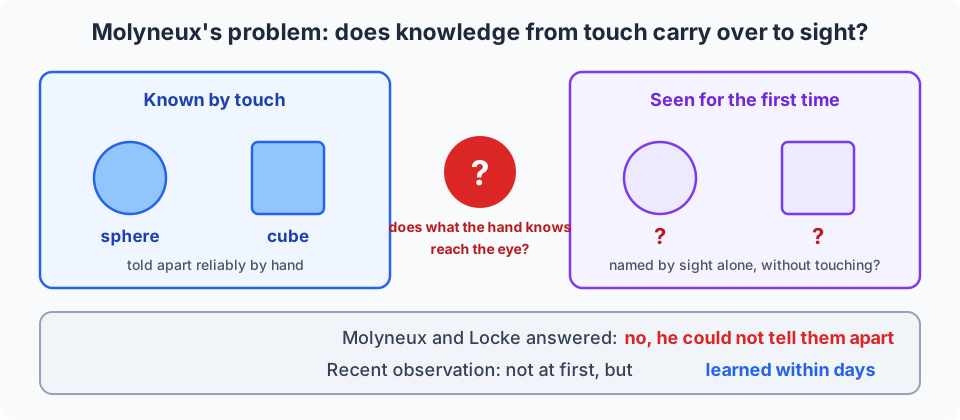
Suppose a person blind from birth has learned to tell a sphere from a cube reliably by touch. Pick either one up and they know at once which is which.
Now suppose that one day this person gains sight. A sphere and a cube sit side by side on a table in front of them. Without touching, by looking alone, could they say which is the sphere?
Posed in a letter in 1688, the question has an unusual career: it divided philosophers for over three hundred years, and then, recently, it became possible to actually observe the answer.
It started with a letter
The question was put by the Irish scientist William Molyneux. In 1688 he wrote to John Locke and set out the problem.
There was a personal background. His wife had lost her sight shortly after their marriage (illness, by the usual account). What it means not to see was something he had reason to think about in daily life.
Locke was taken with the question and added it to the second edition of his Essay Concerning Human Understanding. From then on the problem became a standard fixture in arguments about the relation between the senses and knowledge.
The answer “no”
Molyneux’s own answer was unambiguous: no, he could not.
The reasoning goes like this. What the person knows is “a sphere is the thing that feels like this in the hand,” not “a sphere is the thing that looks like this to the eye.” Those are experiences of entirely different kinds.
Locke agreed. For him knowledge comes from experience, so the work of joining an idea got by touch to an idea got by sight must itself be learned through experience.
The reason we can look at something now and imagine how it would feel is that we have been seeing and touching simultaneously since birth. Gain sight without that accumulation and the patterns landing on the eye should mean nothing.
Berkeley later took the same line in his writing on vision. He pushed further, arguing that sight alone does not even give you distance.
The answer “yes”
Leibniz came down the other way. He thought the person would be able to do it.
His grounds were geometrical. A sphere has no corners; a cube has eight. That structural difference is the same whether you learn it by touch or by sight. The claim is that knowledge of shape can be held as a common understanding, independent of which sense delivered it.
Leibniz did attach a condition: provided the person has been told in advance that what they are about to see is that sphere and that cube, and is in a position to reason calmly. Shown the objects out of the blue in a state of confusion, he allowed, they might fail.
The disagreement mirrors a much larger one. Is our grasp of space and shape proper to each sense, or shared across the senses? Take the first and you are saying it is learned from experience; take the second and you are saying some framework is there from birth.
Could it actually be checked?
What is peculiar about this question is that, thought experiment though it is, in principle it can be checked (an example you will hardly find elsewhere in this field). If somebody born blind gains sight, you can watch what happens.
In the eighteenth century a surgeon who operated on patients with congenital cataracts reported on their condition afterwards. By that record the patients could not distinguish shapes at first. The report was long cited as evidence supporting Locke’s answer.
But the case needs careful handling. Cataracts do not block light entirely, and how good the post-operative vision was is unclear. The strict conditions of Molyneux’s problem may not have been met.
What recent observation showed
Things moved in the twenty-first century.
Working within a humanitarian programme bringing treatment to children with visual impairments, researchers got the chance to test the question. Newly sighted people, just after surgery, were shown objects they knew by touch and asked to identify them.
The result came in two parts.
| Stage | What happened |
|---|---|
| Immediately after surgery | Objects known by touch could not be identified by sight |
| Days to weeks later | Identification came rapidly |
The first half is exactly what Molyneux and Locke predicted. Knowledge in the hands did not transfer to the eyes as it stood.
The second half is the interesting part. The learning took very little time. One reading is that rather than building the correspondence from nothing, there was groundwork already in place waiting to be connected.
So the answer was not a clean win for either camp. Not immediately, but astonishingly quickly. It supports Locke’s answer while leaving a share of the credit to Leibniz’s intuition.
Debate continues about these observations too. The quality of the restored vision, the ages of the participants, the design of the task — how you weigh those conditions changes the interpretation. It is not quite a three-hundred-year matter settled.
What the question left behind
The most valuable part of this problem, I think, is the way it is framed.
It takes an abstract philosophical disagreement, drops it into one concrete scene, and makes it observable. The large quarrel between empiricism and nativism got converted into a setup with a sphere and a cube that anybody can follow.
And three centuries later, science did produce that scene. The answer came out somewhere in the middle, but the fact remains that it could be tested because the question was concrete. Translating an abstract dispute into something checkable — as illustrations of what a thought experiment is for go, few are this clear.
Things people wonder about Molyneux’s problem
Does someone who gains sight through surgery see the world right away?
No. This is a point often stressed in the field: the eye working and seeing are two different events.
Newly sighted people report that at first colour and spread of light are there but not organised into the outlines of objects. Reading overlap as depth, following a moving object, telling faces apart — each is a capacity acquired over time.
Is it too late to learn as an adult?
It used to be thought that visual development has a limited window and recovery afterwards is hard. Recent observation shows instead that people who gain sight at older ages can still acquire considerable ability.
The room the brain has to change lasts longer than had been assumed. Quite apart from the answer to Molyneux’s problem, that has been received as a major finding.
Does the same problem arise between other senses?
It does. How correspondences form across senses — sound and image, taste and smell — is an area of ongoing research.
The interesting part is that some correspondences are known to be widely shared regardless of experience. The tendency to link spiky shapes to sharp sounds and round shapes to soft ones shows up across cultures. So it is not the case that there are no innate bridges between the senses at all. Leibniz’s intuition gets a little support from that direction.
Related thought experiments
Articles on the relation between the senses and the knowledge they deliver. Read alongside Molyneux’s problem, the question of how much experience is required comes into relief.

Summary
This article covered “Molyneux’s Problem.”
Can a shape known by touch be named on first sight? A question born from something close to home — a wife’s blindness — became a yardstick for measuring empiricism against nativism, and three hundred years later drew actual observation to itself. That trajectory alone is close to unique.
And the answer that emerged fits neither camp neatly. Not at once, but learned fast. The absence of a clean verdict feels, if anything, more like how things really are.
To return to the full list of thought experiments, follow the link below.
Thank you for reading. We hope to see you in the next article.

Also popular with readers
📚 Series: Famous Thought Experiments (11/60)