Thank you for visiting this site. This article covers “Inverted Qualia.”
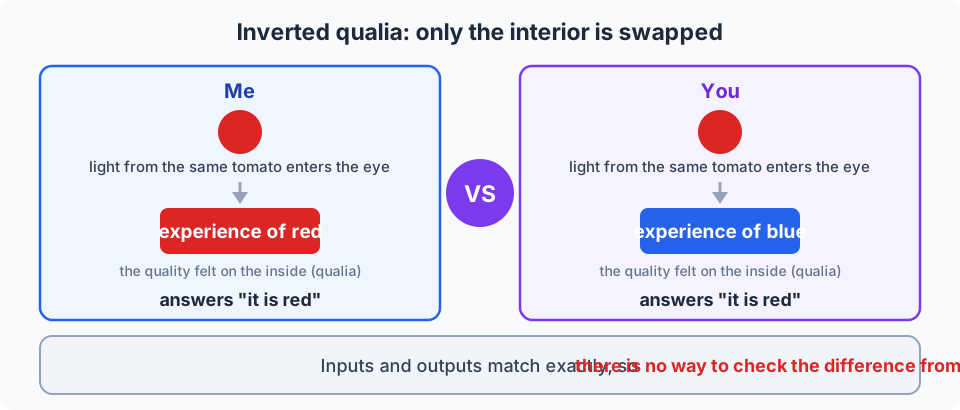
Many people have wondered as children whether “the red I see looks like the same red to everybody else.” If somebody’s experience were swapped from birth, they would still look at a tomato and say “red,” look at the sky and say “blue.” Their vocabulary and behaviour would match ours exactly.
Which is to say: any difference would be impossible to verify from outside. This plain question is in fact a distinguished problem argued over in philosophy for more than three hundred years, known as “inverted qualia” or the “inverted spectrum.” It shakes the framework of how mind is explained.
The same question, written down in 1690
The first person to set the question down clearly is generally taken to be the English philosopher John Locke. (Everybody thinks of it as a child; he was the first to write it.) An Essay Concerning Human Understanding, published in 1690, contains a passage to this effect.
If the idea that a violet produced in one man’s mind by his eyes were the same that a marigold produced in another man’s, and vice versa, this could never be known.
Locke goes on to say that both would nonetheless call one “a violet” and the other “a marigold,” and would never confuse them. Since the usage of the words agrees, the difference in the interior never surfaces.
Philosophy calls this “how it seems,” the felt quality, “qualia.” The redness of red, the painfulness of pain, the aroma of coffee. Each is tasted only by the person having it, and none can be handed outward in words. Inverted qualia is the thought experiment supposing that only the qualia are swapped between people.
Why it is a counterexample to a theory
The apparently plain question became suddenly important in the second half of the twentieth century. Its target was “functionalism,” an influential account of mind.
Functionalism claims roughly this. A mental state is fixed not by what material the brain is made of but by what role it plays between inputs, outputs and other mental states. Pain is defined by its role: the state caused by bodily damage that produces avoidance behaviour and discomfort.
The view is convenient and opens the way to granting a mind to an AI made of silicon. And inverted qualia turns a blade straight at it.
- The inverted person and I receive the same input (light from a tomato)
- The inverted person and I return the same output (answering “red”)
- All relations of role to other mental states are the same as well
- And still, only how it seems differs
If that is genuinely possible, then specifying every functional role leaves something still undetermined. The claim that mind can be exhausted by roles collapses at that point.
Where the philosophical zombie considers “the case of qualia being wholly absent,” inverted qualia considers “the case of qualia having their contents swapped.” Same target, and some consider this version tougher because it is easier to imagine.
Colour space is not actually symmetric
There is a very powerful objection to this thought experiment: colour space is not shaped so that it can be cleanly turned inside out.
The colours we experience have structure beyond their names. For example:
| Asymmetry in colour space | Example |
|---|---|
| Bias in brightness | Yellow feels bright; blue feels dark |
| Warm versus cool | Red and orange feel warm; blue and cyan feel cold |
| Position of the “pure” colours | Red, yellow, green and blue feel unmixed |
| Proximity between colours | Orange feels close to red; yellow-green and purple feel far apart |
Suppose you swap red and green exactly. The swap does not stop at those two colours. Their relations to orange, yellow and brown break too, and the perceived brightnesses stop adding up.
As a result, the inverted person would give different answers from ours to questions like “which two colours are closer?” and “which feels warmer?” Those differences show up in behaviour, so they are detectable from outside. If detectable, the person differs functionally too, and it is no longer a counterexample to functionalism.
Defenders reply that one should look for a cleverer swap that preserves the structure of colour space, or move to another modality — taste or sound — where it might work. The exchange continues.
Is a difference nobody can detect a difference?
The other line of objection is more fundamental, asking “can something in principle unverifiable by anybody be called a difference at all?”
On that view inverted qualia is not a meaningful hypothesis but something that merely has the surface form of a sentence. If no investigation produces any difference, the “difference” exists only in the words.
There is criticism that this objection is too strong. Push the same reasoning and the question of “whether other people really have consciousness” becomes meaningless too. I think this is where the real value of inverted qualia lies. Less as a way to reach an answer, it works as a tool for confronting yourself with how far you are prepared to count something as a meaningful question.
What if your own colours swapped overnight?
To push the argument, philosophers introduce a variant: an inversion occurring within one and the same person rather than between people.
Imagine waking one morning to find the sky yellow and lemons blue. In that case you would unmistakably notice that something had changed, because you can compare against yesterday’s memory.
That is the crux. If intra-personal inversion is clearly meaningful, then the concept of “qualia being swapped” is coherent. All that remains is that we have no means of checking whether the same thing holds between two people.
There is a counter here too. What you notice is a mismatch with memory, not a direct comparison of qualia themselves. Since you cannot rule out that the memory was rewritten instead, this route does not settle it either.
Where people get stuck on inverted qualia
Is colour blindness an actual instance of inverted qualia?
No. People with atypical colour vision differ from the majority in which colour combinations they can distinguish, so it shows up clearly in testing. Pairs of colours become indistinguishable; the correspondence is not simply turned over.
What makes inverted qualia troublesome is precisely that “no difference appears in behaviour or in any test.” The moment an actual instance is found, it stops being inverted qualia. That is the structure.
Could we not tell by examining the brain?
That is where the argument divides. Those positing inversion stipulate two people functionally identical down to their brain states. Any difference in the wiring is a physical difference, which fails the setup of the thought experiment.
On the other hand, holding that “same brain state means same qualia, necessarily” is to have adopted physicalism in advance. Inverted qualia exists to question exactly that premise, so the argument goes in circles here.
So, is inversion actually happening?
Nobody knows. And the claim of the thought experiment is arguably that no method currently exists for getting past “nobody knows.”
As an everyday matter, though, the very fact that so many people share colour names without difficulty is indirect evidence that the interiors are broadly aligned. Not decisive evidence, and that is roughly the temperature at which I hold it.
Related thought experiments
The major thought experiments in philosophy of mind about qualia and consciousness. They strike the same nerve from different angles, so reading them together gives the topic depth.
Summary
This article covered “Inverted Qualia.”
That a childhood question — “is my red the same as your red?” — has been seriously argued from Locke’s day to contemporary philosophy of mind is itself striking. And the argument has reached the point where a philosophical hypothesis is attacked with real data from perceptual psychology, as with the asymmetry of colour space.
On the single point that there is no way to check, this question will probably never be settled. It remains worth thinking about because it makes you re-examine “on what grounds could I claim that what seems obvious to me seems the same to anybody else?”
To return to the full list of thought experiments, follow the link below.
Thank you for reading. We hope to see you in the next article.
Also popular with readers
📚 Series: Famous Thought Experiments (6/60)