Thank you for visiting this site. This article covers “Barn Facades.”
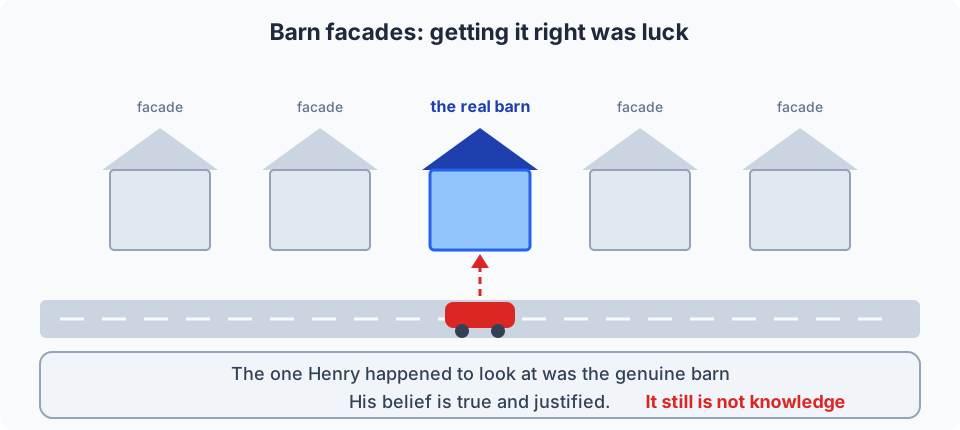
Henry is driving along a country road. A barn comes into view through the window, and he thinks “there’s a barn over there” (the case is also known as fake barn county).
His eyesight is normal, the weather is clear, the distance is short. And it really is a genuine barn.
There is one thing he does not know. In this district, a great many barn facades have been erected — fronts only, like film sets. From the road they cannot be told from the real thing (why anyone built them is not asked). What Henry saw was the one real barn dotted among them.
So: did Henry know that there was a barn over there?
All three conditions are met
Check the case against the traditional definition: knowledge is justified true belief.
| Condition | Henry’s case |
|---|---|
| Belief | He believes there is a barn there |
| Truth | It really is a genuine barn |
| Justification | Good light, normal vision, a clear view |
All three are satisfied without complaint. And yet hardly anybody will say Henry knew.
The reason is plain: had he looked at the barn a little further down the road, he would have been wrong with exactly the same confidence. Being right was an accident.
As a sequel to the Gettier problem
The case became famous not for its own charm but because it broke, head on, the leading repair to the Gettier problem.
In Gettier’s counterexamples, the protagonist reasons via a false proposition such as “Jones will get the job.” So philosophers proposed a fourth condition.
The reasoning must not pass through a false proposition (the no-false-lemmas condition).
The condition excludes Gettier’s two cases cleanly, and for a while it looked like a promising repair.
But it does nothing against barn facades, because Henry does no reasoning at all. He simply looks and believes. There is no false stepping stone anywhere.
And still it is not knowledge. However tidy you make the reasoning, epistemic luck was not eliminated.
What is missing
So what did Henry lack? Several answers have been proposed.
His belief is not sensitive. Ask: “if it had not been a barn, would he have failed to believe it was?” No. Faced with a facade he would have believed the same. If the belief does not change when the world does, it is not tracking the world.
His belief is not safe. Another phrasing: “could he easily have been wrong?” A slight turn of the head, or a few hundred metres further on, and he would have been. Correctness resting on a thin accident is too unstable to call knowledge.
Relevant alternatives are not ruled out. This is the analysis given by the philosopher who published the case (the invention is usually credited to another). For perceptual knowledge, the genuinely available alternatives in that setting must be discriminated and excluded. Henry had no means of telling a barn from a facade.
Every account points at the same structure: he happened to get it right. Arguably they are only different ways of saying it.
How wide is the neighbourhood?
The case has an awkward sequel: how many facades does it take?
If the whole district is full of them, it is not knowledge. What if there is only one? What if the mass of them is over the horizon in the next county? What if they were demolished a century ago and only the sites remain?
Nobody has managed to write a principle fixing which possibilities count as available. Draw the circle wide and we know almost nothing. Draw it narrow and cases that are obviously down to luck come out as knowledge.
Out of this difficulty grew the position that the use of the word “know” varies with context: loose standards in everyday conversation, higher standards in strict argument.
Applied to the modern environment
I find the case quite useful for thinking about the current information environment.
Suppose you happen to land on a correct item in a place awash with plausible but false ones. The content is right, and something resembling evidence is attached. If you had no means of telling them apart, your situation is exactly Henry’s.
At that point you are not knowing but hitting. And you cannot tell the difference from the inside, because from the winning side the two look identical.
So the practical lesson is this: ask not whether you were right, but whether you would have noticed had you been wrong. You can put that question to yourself, and if you cannot answer it, you have located where your judgement stands.
Questions about barn facades
What if Henry knew about the facades?
Everything changes. Knowing facades were around, he would be wary and go closer to check. Having checked and judged it a barn, that would be knowledge.
What is decisive in the case is the mismatch between the environment he is in and the information he has. The structure is: unaware of how treacherous the setting is, he came through unharmed by chance.
Why does it feel like it is not knowledge?
The intuition, which most people share, is taken to reflect the fact that knowledge is expected to be stable.
A judgement that came out right once differs from one that comes out right on repetition. We build into the word “knowledge” the implication that it will hold next time too. Which is why we do not want to use it where the hit was accidental.
So where did the Gettier problem end up?
Unresolved. What this case showed is that tidying up the form of the reasoning is not enough. Conditions like sensitivity and safety were proposed afterwards, and counterexamples have been built against each.
Today a strong current of the debate holds that writing down necessary and sufficient conditions for knowledge may simply be impossible. Barn facades is treated as one of the turning points that made the impasse decisive.
Related thought experiments
Articles on the difference between knowing and happening to be right. Placed next to barn facades, you can see where epistemic luck creeps in.



Summary
This article covered “Barn Facades.”
He looked at the real thing, judged correctly, and was right. And it is still not knowledge. A circumstance he played no part in — what happened to be standing nearby — changes the verdict. That is the strangest thing about the case.
And the discomfort is not somebody else’s problem. Among the information we take in daily, how do we establish that we are not driving down a road lined with facades? Not whether you were right, but whether you would have caught it had you been wrong. That habit is the best tool this thought experiment hands over.
To return to the full list of thought experiments, follow the link below.
Thank you for reading. We hope to see you in the next article.

Also popular with readers
📚 Series: Famous Thought Experiments (17/60)