Thank you for visiting this site. This article covers “Quaddition.”
What is 68 + 57? It is 125. Anybody will say so.
Then an odd sceptic turns up and says: what you have always meant by the sign ”+” is not addition but a different function, quus. So the right answer is 5.
It sounds absurd. But try to see the sceptic off and you have a surprisingly hard time, because the fact that “I meant addition in the past” turns out to be nowhere to be found.
Saul Kripke put the argument forward in 1982 (in the form of an interpretation of Wittgenstein), and it is treated as one of the nastiest problems in the philosophy of language.
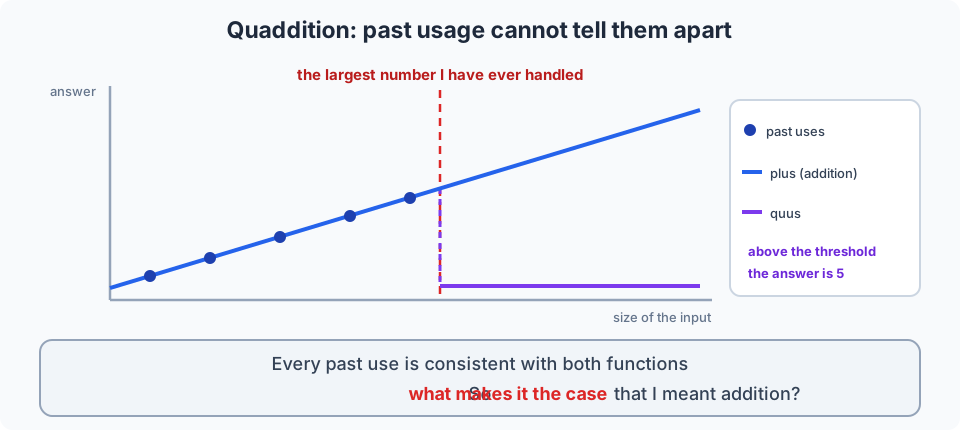
The function called quus
First, the sceptic’s function, quus.
x quus y = x + y (when x and y are both smaller than 57) x quus y = 5 (otherwise)
The number 57 means nothing in particular. It merely stands in for “the range of numbers you have actually computed with”.
That is the crux. The calculations I have performed in my life are finitely many. However many there are, the numbers involved have an upper bound.
And below that bound, addition and quus give exactly the same answers. Every result I have ever produced is consistent with both functions, without exception.
What settles it?
So the sceptic asks: what is it that makes it the case that by ”+” you meant addition?
Past usage does not settle it. Finitely many examples are compatible with infinitely many functions. I have never once done a computation involving 57 or more, so there is no evidence distinguishing the two.
Note carefully that the argument is not saying addition is wrong. What is at issue is one point only: whether there was, in my mind in the past, a fact that fixed the meaning.
The replies fall one after another
The natural replies all get blocked. In order.
I had the rule in mind. One wants to say that each time I calculated I held the rule for addition in my head. But how that rule is to be applied requires interpretation in its turn. Fixing which function the words or images in my head pointed to needs a further rule, and there is no end to it.
I had the relevant disposition. Another reply: had I been asked about numbers of 57 or more, I was disposed to return the addition answer. This has two problems.
First, a disposition only states what I would in fact do, not what I ought to do. If I were disposed to make mistakes, the mistakes would come out as the correct meaning. Meaning has a normative character — it supplies a standard of correctness. Dispositions cannot account for that.
Second, my capacities are finite. For numbers with absurdly many digits I produce no answer at all. Where the disposition does not exist, the meaning would be undetermined too.
The simpler one is the right one. One might say addition is simpler, so that is what I meant. But what counts as simple depends on which rules you are looking through. From a system that takes quus as basic, addition might look like the exceptional case.
Kripke’s “sceptical solution”
So no fact fixing the meaning is to be found inside the individual. Kripke accepts that conclusion and moves in a different direction.
His proposal is what he calls a sceptical solution: there is no fact that fixes meaning, and yet our talk about meaning still has a legitimate role.
The key is the community. We can say “he means addition” because the way he answers agrees with the way other people in the community answer. Agree and you are treated as one of us; deviate and you are corrected.
So the standard of correctness lies not inside an individual head but in the agreement of a practice. The conclusion connects directly to Wittgenstein’s argument that a private language is impossible.
Whether this reading matches what Wittgenstein intended has been strongly disputed. Many hold it should be treated as Kripke’s own argument — there is even a coinage separating the two figures.
Can infinite rules follow from finite examples?
The most widely applicable part of the argument, I think, is the observation that a finite set of examples cannot uniquely determine an infinite rule.
The same structure appears elsewhere.
- The grue paradox. Every emerald observed so far has been green. But the observations are equally consistent with a property “green until a certain time, blue thereafter.”
- Machine learning. Innumerable functions fit a finite dataset. Which one gets picked is not determined by the data; a built-in bias picks it.
In every case, the evidence alone does not narrow the rule down, and something outside the evidence does the choosing. What quaddition showed is that this something is not to be found inside the individual.
Questions about quaddition
Is this an argument for doubting addition?
No. Kripke never doubts that 68 + 57 is 125. What he questions is the grounds for saying that I meant that in the past.
Miss the distinction and the whole argument looks like hair-splitting. Hold on to the fact that the subject is the location of the meaning-fixing fact, not the correctness of the arithmetic, and you will not misread it.
Surely a mathematical proof settles it?
A proof is also an arrangement of symbols, so the same question repeats. Fixing what I meant by the symbols in that proof requires yet another fact.
That is what makes this scepticism awkward. Whatever you bring in to explain meaning is exposed to the same doubt in its turn. Somewhere the chain of explanation has to be stopped. Kripke stops it at the practice of a community.
Is there a usable everyday lesson?
That “it has worked so far” is not evidence that a rule has been identified.
Two things with the same track record can behave differently in territory not yet tried. What happens beyond the range of the record cannot be read off the record. That fitting past data does not guarantee fitting future data is a basic caution in statistics and machine learning, and this argument is at the root of it.
Related thought experiments and paradoxes
Articles on whether a rule can be determined from finite evidence.
Summary
This article covered “Quaddition.”
Since every number I have ever handled is finite, my usage fits addition and quus alike. And no fact deciding which one I meant is to be found anywhere inside me. The route to that conclusion is built with remarkable care, closing off the replies one by one.
Kripke’s answer takes meaning out of the individual and relocates it in the agreement of a practice. Whether that satisfies you will vary, but the observation that an infinite rule does not follow from a finite record bites well outside philosophy.
To return to the full list of thought experiments, follow the link below.
Thank you for reading. We hope to see you in the next article.
Also popular with readers
📚 Series: Famous Thought Experiments (18/60)