Thank you for visiting this site. This article covers “Twin Earth.”
Where does the meaning of a word live? The obvious answer is in the head of whoever uses it. When I say “water” there is an image of a clear liquid in my mind, and that is the meaning.
In 1975 the American philosopher Hilary Putnam denied the obvious head-on, using a thought experiment about a planet identical to Earth. His conclusion was blunt: “meanings just ain’t in the head.” The argument redrew the maps of both the philosophy of language and the philosophy of mind.
A near-identical planet, differing at one point
Somewhere in the universe is a planet almost exactly like Earth. Putnam called it Twin Earth.
There the same history unfolds, the same languages are spoken, and every person on Earth has a counterpart. My counterpart lives there too, in the same job, thinking the same things.
One thing differs. The liquid called “water” on that planet is not H₂O. It is an entirely different substance with a complicated formula, abbreviated here as XYZ.
And at ordinary temperatures and pressures XYZ is indistinguishable from water. Colourless, tasting the same, quenching thirst, boiling at 100 degrees. The rivers, seas and rain of Twin Earth are all XYZ, and nobody finds anything odd.
Two men in 1750
Now set the date to 1750 (the formula of water was established about half a century later). Chemistry is undeveloped and nobody knows the molecular composition of water.
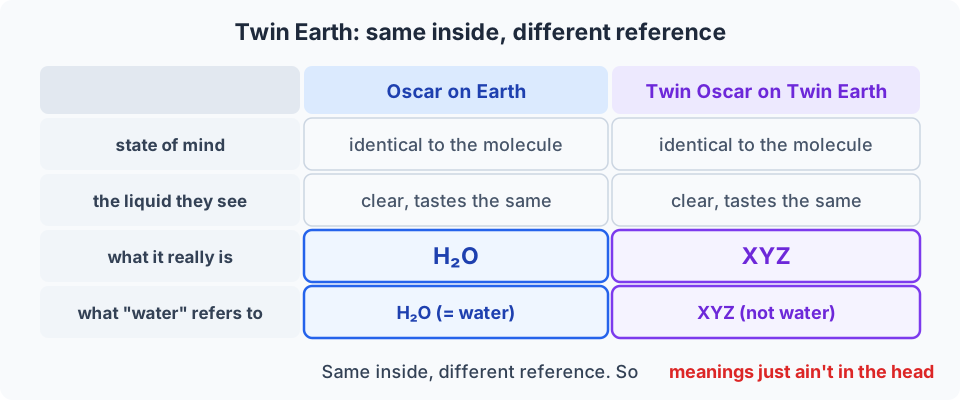
On Earth there is a man called Oscar; on Twin Earth his counterpart, Twin Oscar. The two match to the molecule — brain states, memories, beliefs, all identical.
Both use the word “water” and utter it in the same circumstances. Neither knows its formula. What goes on in their minds is exactly the same.
And still, Putnam says, Oscar’s “water” refers to H₂O and Twin Oscar’s refers to XYZ. Their words are about different things.
If Oscar visited Twin Earth and said “there’s a lot of water here,” he would simply be wrong. What is there is XYZ, not water.
The setup has a well-known crack: a large fraction of the human body is water, so Oscar and Twin Oscar cannot be strictly molecularly identical. Putnam acknowledged the point and set it aside as not affecting the skeleton of the argument.
Meanings ain’t in the head
The conclusion follows. Laid out:
- The two are in exactly the same mental state
- Their words “water” nevertheless refer to different things
- So what a word refers to is not settled by mental state alone
- Therefore meanings are not in the head
Putnam wrote it as “meanings just ain’t in the head.” The view is called externalism: what fixes the meaning of a word is not the speaker’s inner life but the outside world the word is actually hooked up to.
More carefully: a term for a natural kind such as “water” has its meaning fixed from the start in the form “whatever is the same kind of stuff as this liquid here.” What counts as the same kind is something chemistry establishes later, and users need not know it. A person in 1750 who did not know what water was had a word that referred to H₂O all along.
Meaning deposited with the experts
Putnam offers a second, more everyday example, which he called the division of linguistic labour.
Take elms and beeches. Most people cannot tell them apart, and the images in their heads are much the same — roughly “a large tree.”
And yet when we say “elm” we refer to elms, because the task of telling them apart is deposited with experts in the society. The same for gold and its imitations: a jeweller settles which is which.
So the meaning of a word is not held whole in one head but distributed across the community. We use words correctly without possessing all of their meaning.
I find this observation easier to feel than the exotic planet. We use words daily that we barely understand, and conversation still works. That fact shows well that meaning is not complete inside an individual.
Even the contents of the mind depend on the outside
The reach of the argument did not stop at language.
Oscar and Twin Oscar both think “I want a drink of water.” But what Oscar thinks is a desire for H₂O and what Twin Oscar thinks is a desire for XYZ. That is, the very content of their thoughts differs.
Identical brain states, different thought contents. This is content externalism, and it brought an awkward problem to the philosophy of mind. You are supposed to know what you are thinking. Grant externalism and part of that content is fixed by the environment outside you.
Another philosopher later exhibited the same structure with social elements, arguing that for somebody who slightly misuses a medical term, the content of their thought is fixed not by their understanding but by how the surrounding linguistic community uses the word.
Objections to Twin Earth
The argument did not escape unscathed. The main replies:
The setup is incoherent. Could a substance indistinguishable from water while differing in molecular structure physically exist? If boiling point, taste and solubility all match, it should share water’s chemical properties too.
Meaning is being fixed with hindsight. We can say a person’s “water” referred to H₂O in 1750 only because we know the answer now. Putnam replies that people then were already referring in the form “the same kind of stuff as this liquid,” so reference was fixed without knowledge of the composition.
Perhaps an inner meaning remains. Oscar and Twin Oscar do share something — both picture “a clear, drinkable liquid.” Hence the proposal to distinguish two layers, a meaning depending on the world and one complete in the head. Work in this direction continues.
Does it generalise to every word? Terms for natural kinds such as “water” and “gold” may differ from words like “bachelor” or “desk.” How far Putnam’s argument generalises is still contested.
Common questions about Twin Earth
Is there a point to arguing about a planet that does not exist?
There is. The role of the thought experiment is to prise apart, by force, two things that ordinarily coincide. On the actual Earth, inner states and the outside world line up exactly, so there is no occasion to see which one fixes meaning.
Twin Earth manufactures a case where they diverge. Whether it exists is irrelevant; the point is to extract our judgement about which one we follow when they come apart.
Did Putnam hold this position throughout?
No. Putnam is famous for changing his positions repeatedly across his career, moving on realism from a strong realism to an internal realism and then elsewhere.
The point Twin Earth established — that reference is fixed by connections to the world — has been widely accepted as a common starting point regardless. The thought experiment struck out on its own, independent of its author’s later moves.
What does it mean for everyday life?
It becomes the question “do I really understand the words I use?” We use terms from economics, medicine and law without knowing their precise content, and conversation works because the management of meaning is deposited with the society.
Turn that around and the words you feel surest about are the likeliest to be borrowed. Keep that in view and, when an argument fails to connect, you can suspect that the two of you have deposited a word with different experts.
Related thought experiments and paradoxes
Articles on what fixes the content of words and thoughts. Read alongside Twin Earth, the issues come into focus.
Summary
This article covered “Twin Earth.”
Two people identical inside, talking about different things. Putnam built an entire twin planet to press that single point. Meanings are not in the head is a provocative conclusion, and by the time you reach the elms and beeches you notice that this is how we already use words.
The content of your thoughts settled by something outside you is unsettling. It is also the news that you need not carry the meaning of a word by yourself. Use it without full understanding, and check with somebody who knows when it matters. Realising that this was always how language worked is, in its way, a relief.
To return to the full list of thought experiments, follow the link below.
Thank you for reading. We hope to see you in the next article.

Also popular with readers
📚 Series: Famous Thought Experiments (48/60)