Thank you for visiting this site. This article covers “Cryonics and the Self.”
Immediately after death the body is cooled and stored in liquid nitrogen. A hundred years later, in an era of better technology, it is repaired and wakes up.
Is the person who wakes you?
The person who slept last night and got up this morning is unquestionably you. So is the person who lost consciousness for hours under general anaesthesia and woke after surgery. So what is different about a hundred-year interruption?
Is it the length of the break that matters, or what happens to the body during it? Dig into that and you arrive at both personal identity and the definition of death.
Breaks in consciousness happen all the time
First, note that the problem is not exotic.
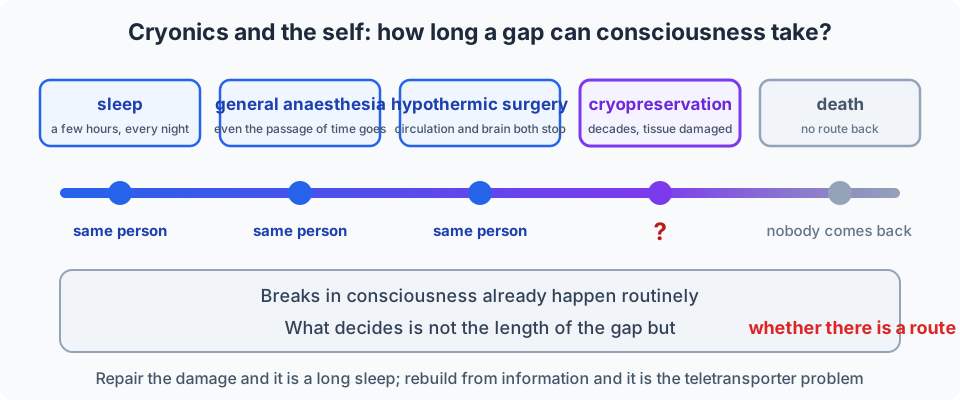
We lose consciousness every night. During dreamless deep sleep, experience is interrupted. Nobody thinks the person who gets up in the morning is somebody else.
Under general anaesthesia the break is more thorough. Not even the passage of time is felt; induction and waking are experienced as directly joined. Still, the person who wakes after surgery is treated as the same person.
There are more extreme cases. In surgery on the great vessels, a technique is sometimes used in which the body is cooled far down and circulation is stopped altogether (deep hypothermic circulatory arrest). Brain activity and heartbeat are both absent for a period. The patient who recovers is still the same person.
So a break in the continuity of consciousness is not by itself a condition that destroys identity. We already treat it that way.
So what is different?
What is special about cryopreservation is not the length of the break. It is what happens to the body during it.
In hypothermic surgery, tissue is preserved essentially intact. Stop the blood flow and the cellular structures are undamaged, so restarting works.
With cryopreservation as currently practised, considerable damage occurs. Cryoprotectants are substituted to avoid ice crystals, but those agents are themselves toxic, and at very low temperatures microscopic fractures form.
From here a decisive fork opens.
| Assumption | What revival amounts to | How identity comes out |
|---|---|---|
| Repair | Fix the damaged tissue and restart the original body | Close to recovery from a long coma |
| Reconstruction | Read off the structural information and rebuild | The same problem as teleportation or uploading |
On the first, the story stays an extension of general anaesthesia — no different from waking from a long coma. On the second, the discussion moves elsewhere entirely, because the structure is: destroy the original, make a copy.
Given the current state of the art, the prospects for mere repair are not good. Not being able to choose in advance which one it will be is what makes the decision hard.
The definition of death moves
The other thing this topic drags out is the definition of death.
Legal death is generally defined with irreversibility as a condition. But what is irreversible depends on the level of technology.
Once, a stopped heart was death. Today there are many situations where resuscitation after cardiac arrest succeeds. The same state counts as death in one era and not in another.
Supporters of cryonics take from this the notion of information-theoretic death: real death is the point at which the information needed to restore the person is lost, and before that, future technology might bring them back.
Whether that view is right is unknown. But the observation that a verdict of death depends not only on the state of the subject but on the technology we happen to have is hard to deny.
Where the science stands
On the distance between hope and reality, precision is worth having.
Preservation. Solidifying tissue without ice crystals is genuinely researched, and some animal organs have been reported to recover function after being brought back from very low temperatures. But this has not been achieved for a whole body including the brain.
Retention of memory. In organisms with very few neurons, studies report that a trained response present before preservation was still present afterwards. That suggests information may survive where structure survives — but the difference in scale is many orders of magnitude.
Revival. No human body has ever been revived from preservation. Nor does a method exist for repairing the damage current preservation causes. Nor is there any guarantee such a method will exist.
So as things stand, this is not a technical option but a bet on the future.
The structure of the bet
The choice is in fact often framed as a wager.
Without preservation, nothing certainly remains. With it, the probability is not zero. What you lose is finite — money and trouble — and what you might gain is incommensurable with that.
The form closely resembles the argument for deciding whether to believe in God by expected value: however small the chance of success, so long as it is not zero the expectation is positive.
And it inherits the same weakness. A possibility existing is not the same as a possibility you may count on. Whether the organisation storing you still exists in a hundred years, whether society keeps paying the cost — factors that drive the probability down stack up.
Things people wonder about cryonics
Waking into a completely different society
A separate issue from identity, but a real one. You would wake in a world with none of your acquaintances, where the language and the institutions have changed.
Being philosophically the same person and it being good for that person are two different things. Declining on exactly this ground is a perfectly coherent judgement.
So where does the difference from sleep really lie?
The decisive difference, I think, is whether the route back is established.
For sleep and anaesthesia, the mechanism for returning is either built into the body or established as medicine. For cryopreservation, there is not yet a way back. It is not the break itself but the unknown return from it that makes this a wager.
What is this thought experiment useful for?
For noticing that a verdict of “dead” is less absolute than it seems.
Resuscitation after cardiac arrest and hypothermic surgery were both once impossible. Both are routine now. The line we call death has been moving along with the technology. Whatever you conclude about cryonics, that fact is worth holding on to.
Related thought experiments
Articles on the conditions for remaining yourself. Set beside cryonics, you can see whether the issue is the break or the rebuilding.


Summary
This article covered “Cryonics and the Self.”
Consciousness being interrupted happens every night, so the length of the break settles nothing. The question was what happens to the body during the break, and how the return is made.
And whether you come back by repair or get rebuilt from information makes it two entirely different stories. The first is waking from a long sleep; the second brings the teletransporter’s question with it. At the moment of choosing, you cannot know which it will be. That is the most awkward thing about the decision.
To return to the full list of thought experiments, follow the link below.
Thank you for reading. We hope to see you in the next article.

Also popular with readers
📚 Series: Famous Thought Experiments (28/60)