Thank you for visiting this site. This article covers “A Drug That Erases Memory.”
Suppose there were a drug that could delete particular memories to order. The scene of the accident, the day you were betrayed, the event that tightens your chest every time it comes back. You can name them and have them removed.
Should you take it?
If it reduces suffering, there seems to be no reason not to. But the question remains: is the person left afterwards still you? And if what you erased was harm you did to somebody, what happens to the responsibility?
It is not pure fantasy either. Research aimed at weakening the emotional force of a memory really is under way.
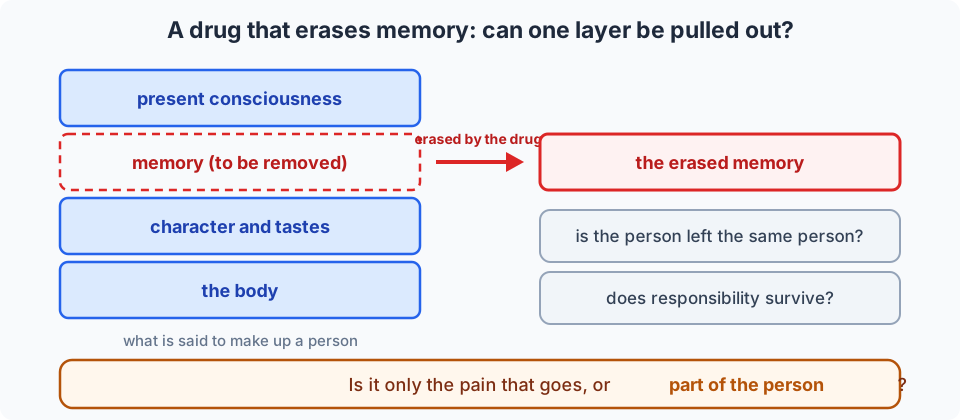
If memory is what makes the person
Start with the connection to debates about personal identity.
John Locke held that personal identity is fixed by how far consciousness reaches. A past action is mine just so far as I can recall it from the inside.
Take that straight and erasing a memory means ceasing to be yourself for that stretch. A particular day in your past comes to have the same standing as a day in somebody else’s.
Contemporary accounts do not hold the memory theory in its original form; it was amended into psychological continuity, taking in connections of character and intention as well as memory. On that view, deleting some memories leaves identity intact so long as other connections remain.
But a question of degree survives. Increase the amount erased and somewhere there must be a point where “they became a different person” is the right thing to say. Nobody can write down where that point is.
Where does responsibility go?
Trickier is the question of responsibility.
Locke had already touched on it (over three hundred years ago). Person, he said, is a forensic term, and reward and punishment attach to the subject that consciousness connects to.
If so, punishing someone who has erased the memory of a crime risks punishing a different person.
Locke himself did not carry the conclusion into practice. Human courts, he wrote, punish because they cannot tell whether the claim of lost memory is true. He acknowledged the clash between what the theory implies and what practice requires, and left it standing.
A drug that erases memory reliably brings the clash into the open. If the erasure can be objectively confirmed, “I don’t remember” stops being an excuse and becomes a fact. Punish anyway and you have to relocate the grounds of responsibility somewhere other than memory.
What it means to have been through it
The third issue is more personal: is there value in the fact of having passed through a hard experience?
We know that people change after suffering. They become careful, or attentive to other people’s pain, or reorder what matters to them.
Erase the memory and the ground that produced the change is gone. You end up in the odd state of keeping the resulting traits while losing any idea where they came from.
The issue has the same structure as the thought experiment about choosing to live wired to a machine that supplies only pleasant experiences. Is what we want only to feel good, or actually to experience something? The memory drug puts that question from the direction of the past.
A caution, though. Saying that suffering has meaning can become an injury the moment it is said to somebody else. Someone looking back on what they came through and someone telling a person who is in it now are doing entirely different things.
Is memory only the individual’s?
The fourth issue comes from the side of society.
Memory is not only inside a person. As testimony, as record, as part of a relationship, it means something to other people too.
If a witness erases their memory, facts cannot be established. If a perpetrator erases theirs, the person harmed loses the counterpart who could apologise. Erasing memory of a historical event can amount to abandoning the duty to pass it on.
So there are cases where a right to erase memory does not end at the individual’s own decision. That distinguishes it from most other choices about one’s own body.
How far this has actually got
A word on the state of the technology. There is no method for deleting a specific memory the way films depict.
There is related research going in a certain direction, though. A memory is thought to become temporarily unstable when it is recalled, and then to be fixed again (recall itself being the opening for rewriting). The process is called reconsolidation.
Administering a drug affecting emotional response during that unstable window — a class of drug long used for blood pressure — has been reported to weaken the emotional intensity attached to that memory. It has been studied as part of treatment for severe trauma.
Crucially, this does not erase the content of the memory. The event can still be recalled; what softens is the bodily reaction on recalling it. The difference matters ethically: if the facts can be kept while only the pain is reduced, most of the problems above get lighter.
Things people wonder about the memory drug
Is there a problem with using it as treatment?
How heavy the problem is depends greatly on the purpose and the case. Where the aim is relieving suffering severe enough to make daily life impossible, the prevailing view is that it should be considered within the same framework as other treatments.
The disputes are at the boundary. Where does treatment end and the deletion of inconvenient history begin? Is erasing a breakup or a failure treatment? Drawing that line is the difficulty shared with other enhancement technologies.
Do you remember having erased it?
That varies with the setup, and it makes a decisive difference. If you remember the fact of the erasure, you know there is a blank in your life. If you do not, the blank goes unnoticed as a blank.
The latter causes less distress, but by exactly that much your self-understanding departs from the facts. I regard the choice itself as a weighty one, because the question remains: can you consent in advance to living without knowing what was removed?
Is forgetting different from erasing?
Everyday forgetting happens gradually and is not chosen. It is not complete either — with a prompt, things come back.
Erasure by drug is targeted, reliable and chosen. That difference is not small. Forgetting is something that happens to you; erasing is a decision. And decisions have reasons and carry responsibility.
Related thought experiments
Articles on the conditions for remaining yourself and on the value of experience. Set beside the memory drug, the issues fall into place.


Summary
This article covered “A Drug That Erases Memory.”
Wanting to erase a painful memory if you could is a natural wish. Beyond it, though, wait a series of questions in turn: is the person left the same person, where does responsibility for the past go, and does memory belong only to the person who has it?
And the technology is moving not toward erasing memories but toward softening how much it hurts to recall them. If the facts can be kept while only the pain is reduced, most of the hard problems this thought experiment raises change shape. What to keep and what to soften — a question worth working through before the lines have to be drawn.
To return to the full list of thought experiments, follow the link below.
Thank you for reading. We hope to see you in the next article.

Also popular with readers
📚 Series: Famous Thought Experiments (27/60)