Thank you for visiting this site. This article covers “The Prince and the Cobbler.”
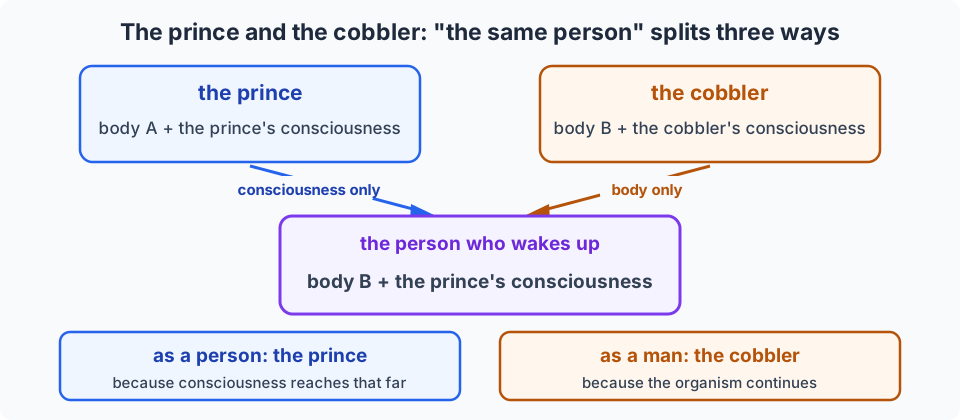
One morning the prince’s consciousness, carrying all his memories, enters the cobbler’s body. The cobbler’s soul left the body just beforehand, and what wakes up is a person with the cobbler’s face and hands and the memories of a life lived as the prince.
Who is this person? The prince, or the cobbler?
The setup is worn thin by films and novels, but the first person to bring it into philosophy was John Locke in the seventeenth century. He uses the swap to show that what we call “the same person” is in fact three separate things.
Everybody gives the same answer
Having set out the case, Locke writes that everyone would see that person as the same person as the prince, accountable only for the prince’s actions.
It does feel that way. The person who wakes has the prince’s memories, behaves as the prince, and recognises himself as the prince. Treating him as the cobbler and making him pay the cobbler’s debts makes no sense.
But Locke goes straight on: nobody would say he was the same man.
The body is the cobbler’s. The biological continuity runs to the cobbler. The same person, but not the same man. That apparently contradictory formulation is exactly what Locke was after.
Three identities pulled apart
Locke separated the three levels we run together when we say “the same.”
| Identity of what | What settles it | Answer after the swap |
|---|---|---|
| Substance | Same matter, same soul | Arguable |
| Man | Same living organism | the cobbler |
| Person | Same consciousness reaching it | the prince |
In everyday life the three always move together. Yesterday’s me and today’s me have the same body, are the same organism, and hold the same memories, so there is no need to distinguish them.
Only by manufacturing a case where the three come apart do we see which one we actually weight. The prince and the cobbler is a device assembled for that purpose.
And Locke’s answer was clear. What we really care about is the person, and what fixes the person is how far consciousness reaches.
”I” extends as far as memory does
On Locke’s view (in a chapter added to the second edition of the Essay), a past action is mine just so far as I can be conscious of it from the inside.
For the time, this was a bold move. Not sameness of soul, not sameness of body: the connection of consciousness alone makes the person.
Locke drives the point home with another example. If a little finger were cut off and consciousness went with the finger, then the person is on the side of the finger. The body left behind is not that person (a drastic example, which Locke offers with a straight face).
He also writes that if two different consciousnesses used one body alternately by day and by night, that would be two persons. One body, but no thoroughfare between the consciousnesses, so two people.
”Person” is a term of the courtroom
Why did Locke care so much about the person? He gives his reason: person is a forensic term.
When we assign responsibility and hand out reward and punishment, what we are asking is who can be conscious of the action as their own. Whatever happens to bodies, responsibility follows the thread of consciousness.
The passage on crimes committed while drunk is interesting. May a person be punished for an act they have no memory of? Locke’s answer: human courts punish, because they cannot tell whether the claim of lost memory is true. Though on the day when all is laid open, the treatment may differ.
In theory, no memory means no responsibility; in practice, punish, because the claim cannot be proved. Locke records the awkwardness honestly.
The holes in the memory theory
Clear as it was, the memory theory took two serious hits from later philosophers.
The brave officer
A counterexample from Thomas Reid in the eighteenth century. Consider three stages.
- A boy flogged for stealing fruit from an orchard
- A young officer who, taking a standard in his first battle, remembered being flogged
- An old general who remembers taking the standard but has forgotten the flogging
Apply Locke’s criterion. The officer remembers the boy, so officer = boy. The general remembers the officer, so general = officer. But the general does not remember the boy, so general ≠ boy.
If A is the same as B and B the same as C, A must be the same as C. That obvious property of identity has just broken.
Memory presupposes identity
The second is Joseph Butler’s criticism, also eighteenth century.
When we say “I remember my own past experience,” we have already granted that the experience was ours. So the concept of memory contains personal identity in advance.
If so, defining personal identity by memory is circular. What is being defined has been used inside the definition.
Amended, and still standing
Under these criticisms the memory theory could not be held in its original form. It was not discarded either.
The transitivity problem was repaired by overlapping chains of memory. The general need not remember the boy directly, so long as he is connected via the officer. Making continuity rather than direct memory the criterion preserves identity as long as the chain holds.
The circularity problem opened a route through the causal connection that produced the memory. The criterion becomes not whether the person is recalling but whether the present state was caused by the past experience.
Psychological continuity so amended is now the mainstream account of personal identity. That is why a prince and a cobbler from over three hundred years ago are still the starting point of the discussion.
Things people wonder about the prince and the cobbler
Does someone who loses their memory become a different person?
Applying Locke’s theory strictly, yes — and that has always been cited as its weakness.
On the amended psychological-continuity view, the connections considered include character, intentions and beliefs, not only memory. Forgetting particular events leaves identity intact so long as other connections remain.
This is not merely theoretical. How far should the wishes recorded by an earlier self be honoured after dementia has changed the person profoundly? Real decisions of exactly this kind have to be made.
What about false memories?
A serious question for the memory theory. People do vividly recall things they never experienced. If the feeling of remembering settles the person, somebody who mistakenly recalls another’s life becomes that other person.
Contemporary accounts address this by requiring that the memory actually arose causally from the past experience. It may feel the same, but with no causal link it grounds no identity.
Is it the same as the body-swap plot in films?
The setup is identical; the treatment is not. Stories start from the shared assumption that “whoever is inside is the person,” and the comedy follows from there.
Locke was interrogating that assumption. Why do we feel that the one inside is the person? And granting that intuition, how does it change our thinking about responsibility and punishment? What stories use as a premise, he tried to deliver as a conclusion.
Related thought experiments and paradoxes
Articles on what it takes to go on being the same person. Starting from the prince and the cobbler, you can see how far the argument has travelled.

Summary
This article covered “The Prince and the Cobbler.”
Everybody has the intuition that if the inside is the same, the person is the same even in another body. What was impressive about Locke is that he did not stop at confirming the intuition; he showed that “the same person” had been naming three separate things.
His memory theory then failed to stand in its original form, felled by the brave officer and by the charge of circularity. And it has gone on being used, amended over and over, for more than three centuries. Broken, repaired, still in service. For a theory, there is hardly a better fate.
To return to the full list of thought experiments, follow the link below.
Thank you for reading. We hope to see you in the next article.
Also popular with readers
📚 Series: Famous Thought Experiments (26/60)