Thank you for visiting this site. This article covers “Parfit’s Fission.”
My brain is divided into left and right halves and each is transplanted into a different body. The surgery is a complete success, and the two people who wake up both have my memories and my character.
So which one am I?
There are only three possible answers: “neither,” “one of them,” “both.” Derek Parfit showed that none of the three works, and then took the argument somewhere else entirely. Where it ended up changes how you look at death.
Not pure fantasy
It is worth noting first that the setup is not wholly invented.
The human brain is divided into two hemispheres, joined by the corpus callosum (a bundle of roughly 200 million nerve fibres). Research on patients whose connection was cut to treat severe epilepsy showed the two hemispheres processing information independently. Shown an object in one visual field only, a patient may be unable to name it aloud while picking it correctly with the left hand.
It is also known that removing one hemisphere early in life can leave the remaining hemisphere to take over its functions, with the person growing up and keeping their character (the operation is sometimes performed for severe epilepsy).
Parfit made use of those two facts. A person can live on one hemisphere, and the two sides can work independently. So what if both were placed in separate bodies? Technically impossible, but coherent in principle.
All three answers fail
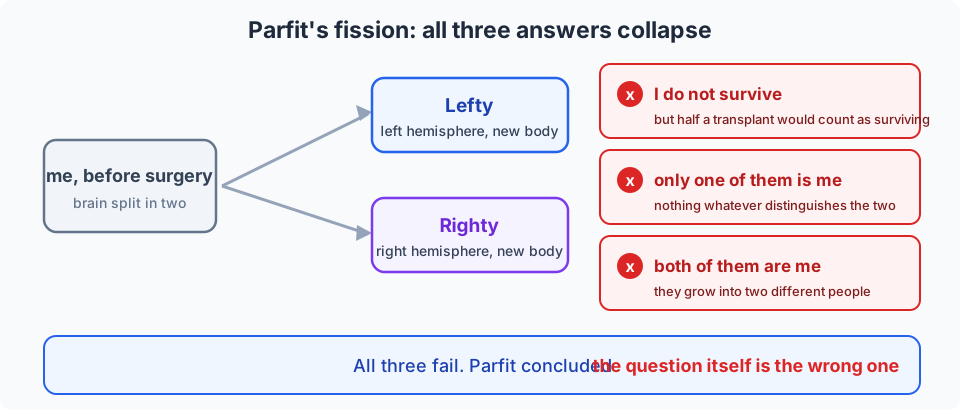
After the transplant two people wake up. Call the one who received the left hemisphere Lefty and the one who received the right Righty. Both think “I am the person from before the surgery.”
I did not survive
Suppose the fission killed me. This is odd.
Had only one hemisphere been transplanted and the other discarded, we would certainly say “I survived” — the same as somebody living on after losing a hemisphere in an accident.
But the moment the half that was going to be thrown away is also saved, I count as dead. Doubling the success turns it into a death — a conclusion nobody can accept.
I am one of them
Try saying that Lefty or Righty is really me.
But there is nothing whatever to tell the two apart. The surgery was symmetrical and both inherit the memories equally. With no grounds for choosing, the answer just discards one of them arbitrarily.
I am both
That leaves saying both are me. But this violates how the concept of identity works.
From the day after the surgery, Lefty and Righty have different experiences. They are in different places, eat different food, and come to think different thoughts. They are plainly two different people and are not identical with each other. If both are nonetheless identical with me, then by way of me the two of them are identical — which they are not.
Parfit’s answer
If all three fail, the question has no answer. The usual next move would be to go looking for a better fourth answer.
Parfit went the other way. The reason no answer comes out, he decided, is that the question is misconceived.
His claim: even if “which one am I?” has no answer, nothing goes wrong. What happened in the surgery is fully described as a matter of fact. The brain was divided, each half woke up in a different body, both have my memories. Outside that description there is no undecided “real truth” left over.
The feeling that something remains unasked comes only from assuming that personal identity is some deep further thing over and above the facts. Parfit called this an empty question.
Identity is not what matters
So what does matter? Parfit’s answer is what he calls relation R.
Relation R is psychological continuity and connectedness, holding with the right kind of cause: memories carried forward, character continuing, intentions inherited. I care about the wellbeing of tomorrow’s self, on this view, not because that person is “the identical me” but because we are joined by relation R.
Seen that way, fission comes out like this. I stand in relation R to both Lefty and Righty. Strictly they are not the same person as me, but everything I cared about has been passed on, twice over. So fission is as good as ordinary survival, and nothing has been lost.
Identity is not what matters. Parfit’s most famous claim comes down to that line.
Death starts to look different
Accepting the conclusion produces a large side effect. Parfit himself recorded the experience: his fear of death receded.
He wrote that he had felt his life to be like a glass tunnel, moving faster each year with darkness at the end. When his view of personal identity changed, he says, the walls of the tunnel disappeared.
The reasoning goes like this. If what I am is not a single deep entity running through time but merely a bundle of connections of memory and character, then the boundary between me and others, and between me today and me tomorrow, is less absolute than it seemed. And so what death takes away is less special than one imagined.
The view has ethical consequences too. Since my far-future self is close to being another person, the grounds for treating my own future as uniquely special weaken. Parfit took the argument from here toward giving greater weight to concern for others.
Objections from the unconvinced
There are objections, of course. The main ones:
| Position | Claim |
|---|---|
| Animalism | I am a human organism, not the psychological connections in a brain |
| Closest continuer theory | I am identical with my closest continuer; fission is a tie, so neither |
| Further fact view | A subject of consciousness cannot be divided. One of them is me as a matter of fact; we simply cannot tell which |
Animalism doubts the focus on the brain in the first place. I began to exist before I had memories, and I continue to exist when unconscious. So what I am is a biological human, of which psychological continuity is only a part.
The closest continuer theory has an entertaining weakness. On it, I survive if one hemisphere transplant fails and vanish if both succeed. Whether I am alive would be settled by the fate of somebody else entirely.
Of this whole sequence, the move I most admire is Parfit’s switch to “if a question has no answer, the fault is in the question.” Rather than keep hunting for an answer, ask why you wanted one. That manoeuvre transfers to other subjects.
Things people wonder about fission
What do the two think of each other?
Both will feel “I am the original and the other one is a copy.” Each has the pre-surgery memories and has experienced continuous consciousness up to the moment of waking.
That is the cruel part of the thought experiment. From the inside, neither can determine whether they are the genuine one. And if it cannot be checked from inside, Parfit reckons, there is no checking it from outside either.
How is it different from the teletransporter?
The structures are close, but fission blocks the exits. With a transporter you can answer “the original survives if the body is not destroyed, so the arrival is a copy.”
In fission there is no destroyed original and no source to copy from. My material is distributed evenly between the two, and both have the same claim. The original/copy distinction is unavailable, so the route of answering in terms of identity is closed off entirely.
Does this connect to anything real?
Wherever uploading or backing up minds is discussed, it becomes the live issue directly, because if copies can be made, which one is the person? always follows.
Closer to home, it touches how we think about wills and advance directives. What is the relation between the earlier person’s wishes and the person after dementia has changed them profoundly? How binding are earlier wishes once the psychological connections have thinned? That hard question is continuous with Parfit’s argument.
Related thought experiments and paradoxes
Articles on what it takes to remain the same thing. Set beside fission, the weak points of the concept of identity come into view.
Summary
This article covered “Parfit’s Fission.”
When all three of the only three answers collapse, the usual response is to look for a fourth. Parfit did not; he diagnosed the question as spinning its wheels. That switch is what put this thought experiment at the centre of work on personal identity.
The conclusion — “whether I survive is not, in fact, what matters” — is hard to accept on first hearing. It is striking, though, that the person who reached it wrote that it freed him from the fear of death. A rare case of a philosophical argument changing how its author lived.
To return to the full list of thought experiments, follow the link below.
Thank you for reading. We hope to see you in the next article.
Also popular with readers
📚 Series: Famous Thought Experiments (25/60)