Thank you for visiting this site. This article covers “Pascal’s Wager.”
Whether God exists cannot be settled by reasoning. In that case, decide by whether believing or not believing pays better. That blunt argument sits in the papers left by the seventeenth-century mathematician Blaise Pascal.
Bringing a gambler’s arithmetic to the subject of God was provocative even then, and the argument is also one of the earliest treatments of decision under uncertainty by expected value. A curious piece of work: a religious argument that still turns up in decision-theory textbooks. Here is its content, and the objections that have lodged in it.
Papers left by a founder of probability
Blaise Pascal, born in 1623, was a French mathematician and physicist who died at 39. His name survives in the unit of pressure, and through his correspondence with Fermat he was one of the founders of probability theory (the occasion, by tradition, was a question about dividing the stakes in a game).
In his last years he accumulated fragmentary notes for a defence of Christianity. After his death they were collected and published as the Pensées (he died before deciding the arrangement, so the order of the fragments is the editors’). The famous line “man is a thinking reed” comes from this book.
The wager is one of those fragments. As a premise Pascal held that the existence of God can be neither proved nor disproved by reason. Whether God exists cannot be settled by argument — a starting point he could share even with the atheists of his day.
From there he moves in an unexpected direction. If it cannot be decided, may we leave it undecided? No, he says.
”You cannot decline the bet”
On Pascal’s view we are already embarked (there is no getting off the wager). Being alive, we must either live believing in God or live not believing. Suspending judgement amounts in practice to betting on the “not” side.
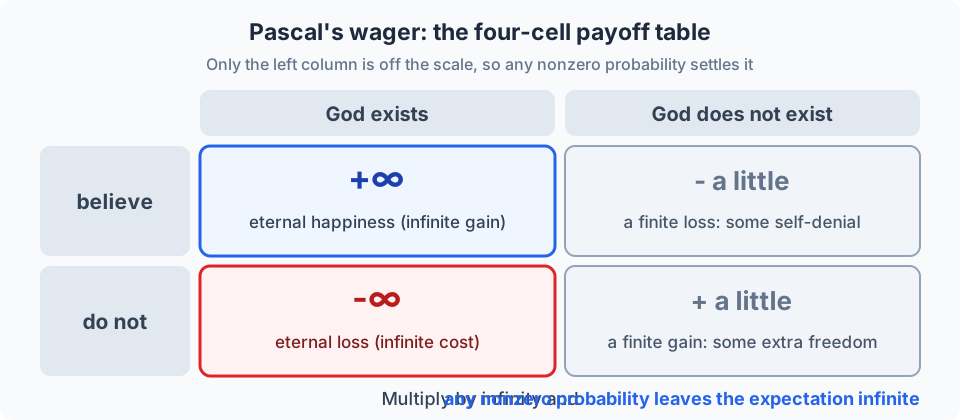
So the question becomes which bet pays. Pascal’s layout, as a table:
| God exists | God does not exist | |
|---|---|---|
| Believe | eternal happiness (infinite gain) | a small loss (some self-denial) |
| Do not believe | eternal loss (infinite cost) | a small gain (some extra freedom) |
Look at the table and one column is off the scale. If God does not exist, the difference is between a slightly constrained life and a slightly freer one. If God does exist, the difference is between infinite happiness and infinite loss — magnitudes with no comparison.
That is, a finite loss if the bet is wrong, an infinite gain if it is right. Attend to the asymmetry and the direction of the bet is settled.
With infinity in play, the probability stops mattering
Work the expected value and the argument’s edge is plain.
Let p be the probability that God exists. Pascal’s aim was to avoid having to fight about p at all. The expectation of believing is an infinite gain times p. However small p is, so long as it is not zero, infinity times it is still infinity.
Not believing yields at most a finite comfort. Infinity exceeds any finite quantity. So however unlikely you find God’s existence, betting on belief is rational.
The crux is that the argument never claims God’s existence is likely. Concede only “unlikely, but not impossible” and the arithmetic delivers the conclusion by itself. Pascal demanded not faith from his interlocutor but only room for a possibility.
The objections that stuck
The argument has been under fire ever since. The main lines:
Which god?
The best-known objection is the many-gods problem. The world holds countless religions, each with a different god and different conditions for salvation.
Pascal’s argument assumes a binary of believe or not, whereas the actual choice is a multiple-choice question about which god. And believing in one god may count as betrayal to another. With several candidates promising infinite gain, the expectations tie everywhere and nothing is settled.
You can act as if, but you cannot believe on command
The other strong objection is that belief cannot be chosen by will. Knowing it would pay, somebody who can see the cup in front of them is empty cannot genuinely believe “there is water in it.” Faith is the same: genuine faith is unlikely to be produced by a calculation of gains.
Interestingly, Pascal anticipated this. His answer was “begin by behaving as those who believe do.” Attend the rites, pray, follow the shape of the life, and belief will come naturally. Reshaping by habit rather than by argument — a suggestion that looks oddly sharp from the standpoint of modern psychology.
Would God be pleased by a calculating believer?
The third objection doubts the payoff table itself. If God does exist, how that God treats a believer who says “I worked out that believing pays” is unknown.
It is equally possible, logically, to posit a God who prefers the honest atheist. On that view what goes into the cells of the table is simply whatever the author chose to write there. I take this to bite as hard as the many-gods problem.
May infinity be used in a multiplication?
There are mathematical objections too. Bringing infinity into an expected-value calculation is known to break it.
Allow infinite payoffs and every story with the faintest possibility — “buying a lottery ticket might bring infinite happiness” — carries the same infinite expectation, and nothing can be ranked. The trouble caused by infinite expectations is also known as the St Petersburg paradox.
Why a religious argument stayed in decision theory
For all the criticism, the wager does not disappear from the history of philosophy, because it is one of the earliest clear presentations of the framework of multiplying probability by payoff to choose an action under uncertainty.
Modern decision-making has that shape more or less everywhere. Whether to buy insurance, how much to spend on earthquake preparation, how far to prepare for low-probability accidents. All have the structure “unlikely to happen, catastrophic if it does” — the very asymmetry Pascal handled.
So quite apart from whether you accept the conclusion, the form of the argument is still alive. That is why a fragment of religious apologetics stays in decision-theory textbooks.
Sticking points for the unconvinced
Did Pascal actually believe this argument?
The Pensées is not a finished work but a collection of fragments assembled for a systematic apologetic. So it is inappropriate to treat the wager as the centre of his faith.
Pascal’s own faith rested on an experience of conversion, not a calculation. The prevailing reading is that the wager was written as an entrance for bringing somebody far from faith to the table — a device for a first step, not a destination.
Is it right to decide grave matters by expected value at all?
Still debated. Judging by expected value is powerful where the same bet is repeated many times, and different where the choice is once only and irreversible. Life and faith fall on the once-only side.
How far “it pays on average” can guide a single decisive throw is exactly the discomfort recorded in the well-known paradoxes about expected value.
Is the argument worthless to an atheist?
Not quite. The wager presses the question “when the evidence runs out, on what basis do people settle their attitude?” You may take yourself to be suspending judgement while your actual behaviour bets one way. That observation holds regardless of faith.
Related thought experiments and paradoxes
Articles on the trouble caused by infinite expectations and on choosing actions from probabilities and payoffs. The frame of Pascal’s wager runs straight into modern theory.
Summary
This article covered “Pascal’s Wager.”
Deciding whether to believe in God by profit and loss sounds almost improper on first hearing. Follow the argument and you find that the real protagonist is the structure by which an infinite outcome lets the arithmetic settle matters however small the probability, with religion merely the material.
The objections all land — the many gods, the impossibility of believing at will. The argument survives anyway because it was the first to formalise a problem we still cannot answer: how to prepare for what is unlikely but irreversible.
To return to the full list of thought experiments, follow the link below.
Thank you for reading. We hope to see you in the next article.
Also popular with readers
📚 Series: Famous Thought Experiments (42/60)