
Thank you for visiting this site. This article covers “Frankfurt Cases.”
When we blame somebody we tacitly assume one thing: that they could have acted otherwise.
If circumstances left them no alternative, blaming them is beside the point. The assumption is deeply embedded in law and in everyday judgement alike.
Then in 1969 Harry Frankfurt constructed a case where somebody could not have done otherwise and is responsible anyway (in a very short paper). Short as it is, it changed the framework of the free will debate.
The principle targeted
Frankfurt aimed at what is called the principle of alternate possibilities. The name is forbidding; the content is simple.
A person is morally responsible for an act only if they could have done otherwise.
The principle had been accepted as near self-evident and installed as the foundation of the free will debate.
If the world is deterministic and every event follows uniquely from the preceding state, nobody could have done otherwise. Accept the principle and, if determinism is true, nobody is responsible for anything. The dispute between free will and determinism was fought on that layout for a long time.
A man with a device installed
Frankfurt’s setup runs as follows.
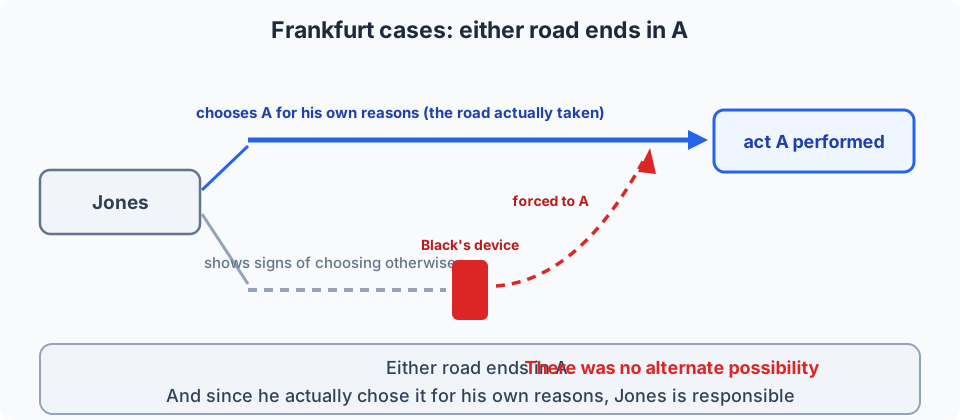
A man called Black wants Jones to perform a certain act A (the names are from the paper). So Black has installed an intervention device in Jones’s brain. It works like this.
- If Jones chooses A on his own, the device does nothing
- If Jones shows any sign of choosing otherwise, the device fires and forces A
Black intends to have A performed, using the device if necessary. So it is settled from the outset that Jones will perform A.
What actually happens? Jones chooses A for his own reasons. The device never fires. Black merely watched.
Two facts holding at once
Sort the case out and two things hold simultaneously.
Jones had no alternate possibility. Whatever he thought, the arrangement guaranteed A.
And Jones is responsible for A. He chose it on his own reasoning and the device played no role. What he actually did is exactly what he would have done with no device present.
If that judgement is right, the principle of alternate possibilities is false, because what grounds responsibility is not whether one could have done otherwise.
So what does ground responsibility?
Frankfurt’s answer: whether the act came from the agent.
If the act arose through the person’s own thinking, desires and judgement, they are responsible. If it was pushed in from outside, they are not. What matters is not the number of options but where the act actually came from.
If that view is right, determinism and responsibility are compatible. Even in a deterministic world, if my act arises via my thinking, it is my act. Which is why the paper is credited with giving compatibilism a strong push.
Frankfurt later developed his own theory of free will, emphasising whether you actually have the desires you want to have. The difference between wanting to stop and being unable to, and doing it because you want to, is the substance of freedom on his view.
Objections
Influential as the paper was, it did not settle anything. Two of the strongest replies:
Flicker of freedom. Did Jones really have no room at all? Look closely and a difference remains: whether he shows the sign that triggers the device.
The device fires only after a sign appears. So a minute fork existed, between producing a sign and not producing one. If any alternative remains, however small, the principle is not broken.
The counter-reply is that such a minuscule difference is implausible as a ground of responsibility. Can producing a sign or not be called a morally significant choice?
The dilemma defence. The sharper criticism. It presses on what kind of relation holds between sign and act.
If the connection from sign to act is deterministic, the setup already presupposes determinism. You have assumed what was to be proved, and it fails as a counterexample.
If the relation is indeterministic, Black cannot predict reliably. A sign may appear without the other act following, so the decision to intervene cannot be well-founded.
Either way the setup breaks. Numerous improved versions with modified devices have been proposed in response. The argument continues.
What the argument changed
The paper’s greatest achievement, I think, was moving the focus of the dispute.
Until then the free will debate revolved around the single question “could we have done otherwise?” Whether you accepted determinism translated directly into whether anyone was responsible.
Frankfurt’s cases severed that link. If responsibility is possible without alternate possibilities, then the truth of determinism and the existence of responsibility can be argued separately.
Subsequent work moved toward what it takes for an act to issue from a person in a way that makes it theirs. Not counting possibilities but looking at the provenance of the act. The shift connects naturally to legal discussions of capacity and responsibility.
Things people wonder about Frankfurt cases
There is no such device in reality
Of course not. But the structure does show up in real situations.
Take an employee already certain to be dismissed who commits a fraud beforehand on their own initiative. The outcome would not have changed, and responsibility for what they did remains. The outcome being settled and the act issuing from the person are separate matters — a distinction practice already makes routinely.
What if they were forced?
Then they are not responsible. Had the device actually fired, the act would be Black’s.
That difference is the point of Frankfurt’s claim. The same outcome, and responsibility attaches differently depending on where it came from. Look at the actual route rather than the number of possibilities.
Has the free will problem been solved?
No. The dilemma defence and other criticisms remain strong, and improved versions and counter-replies keep trading blows.
But the map of the debate certainly changed. Few philosophers now place alternate possibilities unconditionally among the conditions of responsibility. Nothing settled, and the premises different. As philosophy papers go, that is about as much work as one can do.
Related thought experiments
Articles on the relation between action and responsibility. Beside Frankfurt cases, the question of where responsibility comes from comes into focus.



Summary
This article covered “Frankfurt Cases.”
Unable to do otherwise, and responsible. That apparently contradictory combination can be built by installing a single device — a device that never fires. For sheer ingenuity of construction it ranks among the best thought experiments there are.
What it left behind is the view that what supports responsibility is not the number of possibilities but the provenance of the act. Objections continue, but in shifting the focus of the debate it has already done its work.
To return to the full list of thought experiments, follow the link below.
Thank you for reading. We hope to see you in the next article.

Also popular with readers
📚 Series: Famous Thought Experiments (41/60)