Thank you for visiting this site. This article covers “Duties to Future Generations.”
How much should we care about people alive three hundred years from now?
“Obviously we should” is easy to say. Try to explain where the obligation comes from and the ground disappears under you.
They do not yet exist, can give us nothing back, and can neither protest nor negotiate. Much of the machinery we use to ground morality spins its wheels under those conditions.
Meanwhile, in the real world, converting future damage into present value is done routinely. Put harm through that conversion and distant future damage all but vanishes.
They cannot give anything back
One leading way of grounding morality is reciprocity. I do not harm you because you do not harm me. We keep the rules because everyone gains when everyone keeps them.
The social contract runs along the same line. Agreement means something because the relationship is mutually beneficial.
With future generations no such relationship exists.
- They can return nothing at all
- They cannot harm us
- They cannot come to the table or object
- Influence flows in one direction only
The asymmetry of power could not be more complete. Ground morality in reciprocity and no obligation emerges from this relation.
Philosophers who built theories of justice were aware of the difficulty. The parts of their theories dealing with problems that span generations are often the least comfortable.
Discount rates, the machinery in use
Independently of the theory, practice already has an answer: discounting.
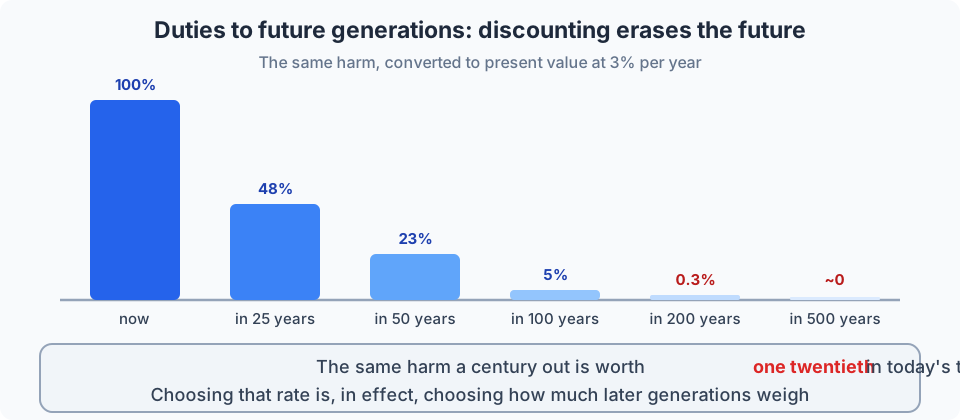
Future costs and benefits are converted to present value at a given rate. Discount at 3% a year and you get the following (rates near this really are used in evaluating public works).
| Time | In present value |
|---|---|
| Now | 100% |
| 25 years | about 48% |
| 50 years | about 23% |
| 100 years | about 5% |
| 200 years | about 0.3% |
| 500 years | effectively zero |
Harm occurring a century from now is worth one twentieth today. At two centuries it barely affects the calculation.
There are reasons for the operation. Society should be richer in the future, so the same sum weighs less. Capital invested grows, so there is an opportunity cost. The future is uncertain. Each has some force.
Things change when pure time preference is mixed in: weighting something less simply because it is far off. One economist dismissed this as a product of weakness of imagination.
A major dispute about climate change came down to what this rate should be. A small rate makes future harm look heavy; a large one makes it look light. The same data yields opposite conclusions from the rate alone — a textbook case of an ethical judgement buried inside a technical number.
Writing a letter to 100,000 years from now
One problem puts the abstract argument in the most concrete possible form: the management of high-level radioactive waste.
Bringing such waste down to safe levels is estimated to take on the order of 100,000 years (nearly twenty times as long as humans have had writing). Bury it deep in rock, and the question becomes how to tell people 100,000 years from now where it is.
A hundred thousand years ago humans had no writing. No language in use today is guaranteed to survive that long. How do you convey “this place is dangerous, do not dig” without language?
The problem has been studied seriously and various proposals made: fields of structures shaped to evoke dread, warnings composed purely of symbols, stories deliberately embedded in a culture to carry the danger forward. Every proposal has a fatal weakness. A structure meant as a warning may be read as marking where treasure is buried.
I take this to be the most concrete form the obligation to future generations has taken. Trying to hand something over to people whose faces, languages and cultures are unknown shows up here as an engineering problem.
Attempts to ground the duty
Several attempts have been made to explain the obligation without leaning on reciprocity.
As stewards of what we inherited. One political thinker (Burke, taken as the father of conservatism) described society as a partnership between the dead, the living and those yet to be born. We received culture, institutions and the natural environment from earlier generations; having received them, we owe their passing on.
Responsibility toward the vulnerable. One philosopher argued that as the reach of technology expands, the reach of ethics must expand with it. His principle: act so that the consequences of your action are compatible with the permanence of genuine human life on earth. Not reciprocity but the one-sided responsibility of the party with the power.
Choosing without knowing your position. If you had to choose the principles of a society without knowing which generation you would be born into, you would choose principles under which no generation fares terribly. Whether people not yet born can be counted as parties to the choice remains a problem.
The question of whose sake
There is another awkward layer: our choices change who gets born.
Change the policy and people’s lives change, along with whom they meet and when they have children. After a few generations the cast is entirely different. So the people alive under a degraded environment are people who would not have existed otherwise.
We cannot say we harmed them. This is treated in detail as the non-identity problem, and it knocks the footing out from under “for the sake of future generations.”
So the obligation to future generations is doubly hard: hard because the other party does not exist, and hard because we decide who that party will be.
Things people wonder about future generations
How far ahead should we look?
There is no answer from first principles. But a practical rule can be stated: match the timescale of the problem you are handling.
For waste management, 100,000 years; for climate, centuries; for public finance, decades. Framed as checking whether you are deciding on a horizon shorter than the effects you are causing, the line becomes much less arbitrary.
Won’t future people be richer than us?
That is one of the main justifications for discounting. If growth continues, people later have more slack, so the same burden weighs less on them.
Handle the premise with care. Growth is not guaranteed, and irreversible losses cannot be made up with wealth. An extinct species and a lost ecosystem do not come back for money. Losses to which discounting applies must be separated from those to which it does not.
Is there anything we can do?
The most workable policy, I think, is choosing reversible forms.
We do not know what future people will want. So what we can decide is limited. At the least, leave them room to choose again. That policy can be carried out without predicting future values — the most tractable answer I know of to this hard problem.
Related thought experiments
Articles on responsibility toward people who do not yet exist. Read together, the location of the difficulty becomes clear.
Summary
This article covered “Duties to Future Generations.”
They do not exist, can return nothing, and cannot object. Explanations of morality grounded in reciprocity stop dead under those conditions. And we feel the obligation anyway — enough to design warnings aimed a hundred millennia out.
Meanwhile, in real decisions, a discount rate quietly supplies the answer. Move the rate by one percentage point and the treatment of harm two centuries away changes several times over. An ethical argument hiding inside a technical number. Noticing that alone makes the question worth working through.
To return to the full list of thought experiments, follow the link below.
Thank you for reading. We hope to see you in the next article.

Also popular with readers
📚 Series: Famous Thought Experiments (40/60)