Thank you for visiting this site. This article covers “The Non-Identity Problem.”
Some choices feel plainly wrong while it cannot be said that any particular person was made worse off by them.
Ordinarily, when we condemn an action we explain it in the form “because of what they did, somebody ended up worse than they would otherwise have been.” Where people not yet born are involved, that explanation stops working, because changing the choice changes who gets born at all.
The difficulty Derek Parfit extracted still unsettles the foundations of arguments about obligations to future generations and about climate change.
Whether to wait three months
One of Parfit’s examples.
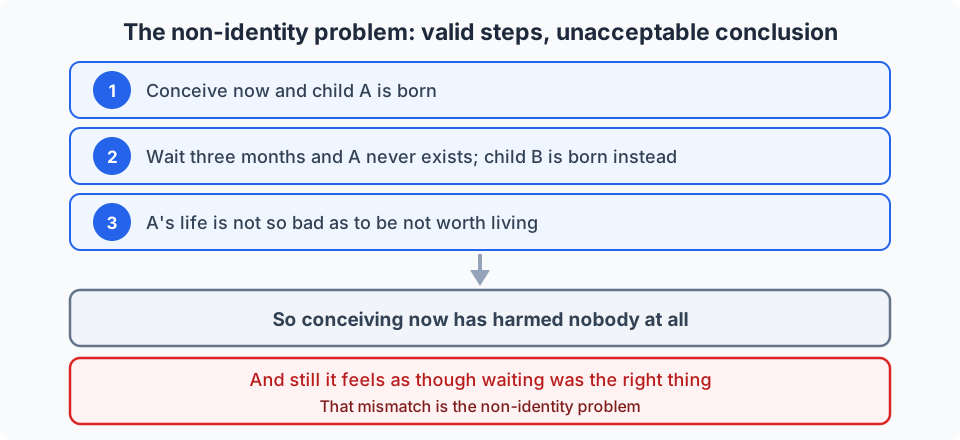
A woman is told by a doctor: conceive now and the child will have a particular health difficulty; wait three months and there will be no such concern.
Most people think she should wait. It seems to be for the child’s sake.
There is a trap in that judgement. The child born after waiting three months is a different person from the child born by conceiving now. Different sperm, different egg, different date of birth. It is not that the same person is born in better health.
So the options are these.
| Choice | Who is born |
|---|---|
| Conceive now | child A (with the health difficulty) |
| Wait three months | child B (without it) |
And now the decisive question: whom did the choice to conceive now harm?
”Better never to have been born” does not apply
Was A harmed? But had the waiting option been taken, A would not have existed at all.
Harm is normally defined by a comparison: “without that act, this person would have been better off.” For A the alternative is not a better life but nonexistence.
This is the crux. Unless A’s life is so bad as not to be worth living, existing is not worse for A. A life with difficulties but also joy, affection and achievement is a life worth living.
If so, A is not harmed. Nor is B, since a person who does not exist cannot be harmed.
Nobody has been harmed. And it still feels as though she should have waited. That mismatch is the non-identity problem.
Note that the setup has drawn strong criticism from the people it describes: may living with a health difficulty simply be treated as “a worse state”? That objection questions the premise of the non-identity problem itself.
The depletion policy
Parfit showed the same structure at a much larger scale.
Suppose a society must choose between two policies.
- Depletion: the present generation uses resources heavily and raises its standard of living
- Conservation: the present generation accepts some restraint and leaves resources for the future
Centuries later, the standard of living is clearly lower under the first. So depletion is wrong, we think.
But the same problem arises. Different policies change how people live, whom they meet, when they have children. After a few generations the cast of people born is entirely different.
So the people living centuries later under depletion would not have existed at all had conservation been chosen. Their lower standard of living is not “worse than it would have been” for them.
Count harm person by person and the policy harms nobody.
What has broken
The root of the problem is in the moral framework we use.
An act is bad because it leaves somebody worse off. That is a way of counting harm with persons as the unit. It is intuitive, tractable, and works well in most cases.
Where future generations are concerned, the framework spins its wheels, because who exists is settled by the very choice at issue. The person to compare against is swapped out with each option.
Without a fixed comparison, better and worse cannot be assessed. The measuring stick moves along with what is being measured.
Candidate exits
Philosophers have proposed several ways out. Each has a cost.
Stop using persons as the unit. The simplest direction: move to evaluating “it is better if better lives are realised” without asking whose lives. That lets you say depletion is bad.
It has a well-known trap. Assess the goodness of lives by summing them and the total keeps rising as population grows. Enough lives barely worth living outweigh a few excellent ones. Parfit called this the repugnant conclusion and never stopped being troubled by its unavoidability.
Redefine harm. Rather than by comparison, count falling below a certain threshold as harm: not “worse than they would have been” but “at an unacceptable level to begin with.” No comparison class required — at the cost of justifying where the threshold goes.
Look elsewhere for the wrong. One can locate the wrongness of the act somewhere other than harm: in the failure of regard for future generations, or in the character of the agent. This suits the intuitions but loses theoretical bite.
Where it bites in real debates
The problem is not a game. It touches the foundations of actual policy arguments.
In debates about climate change, people speak of responsibility to future generations. But grant the non-identity problem and the people alive if we fail to act are people who would not have existed had we acted. We cannot say we harmed them. To say we should act anyway, some ground other than harm has to be brought in.
The same applies in debates about reproductive choices. Which embryo to select, when to have a child — these decisions change who is born. Here too, “for the sake of this particular person” stops being available.
The chief benefit of the problem, I think, is that it has made “for the sake of future generations” unusable as it stands. Press on who the beneficiary is and the beneficiary refuses to be fixed. Arguments have to be rebuilt with that in view.
Questions about the non-identity problem
Could the intuition be the thing that is wrong?
Some philosophers take that line, accepting the conclusion that if nobody is harmed then it really is not wrong.
Take that road and you swallow a great deal. Deplete the resources, wreck the environment, and you have not harmed the people several generations hence. For most people that is too much to pay for keeping the theory. Which is why the research has gone into repairing the framework instead.
Is it really true that a different choice means a different person?
Biologically it is a fairly secure claim. Conception is one realisation out of an enormous set of combinations, so shift the timing by months and a different person is born.
For society-wide policy it is more thorough still. Any change in behaviour changes meetings, marriages and the timing of births. After a few generations essentially no overlap in the cast remains. This premise is barely disputed.
Has the problem been solved?
No. Every proposed exit brings a different difficulty with it. Abandon persons as the unit and the repugnant conclusion is waiting; introduce a threshold and you must justify where it falls.
Parfit treated this area as a place where nobody has yet written a satisfactory theory and worked on it for the rest of his life. It remains open, and research continues.
Related thought experiments
Articles collecting the hard places where ethics deals with numbers and persons. Beside the non-identity problem, the limits of counting by persons come into view.
Summary
This article covered “The Non-Identity Problem.”
Change the choice and a different person is born. That entirely ordinary biological fact invalidates the most basic way morality has of talking: “somebody was harmed.” What Parfit found is a loophole of a very nasty kind.
No exit has been found. Even so, having been through the problem, you cannot use the phrase “for the sake of future generations” without thinking. For whose sake — and is that somebody perhaps only determined after our choice? The question is worth carrying even without an answer.
To return to the full list of thought experiments, follow the link below.
Thank you for reading. We hope to see you in the next article.
Also popular with readers
📚 Series: Famous Thought Experiments (36/60)