Thank you for visiting this site. This article covers “The Utility Monster.”
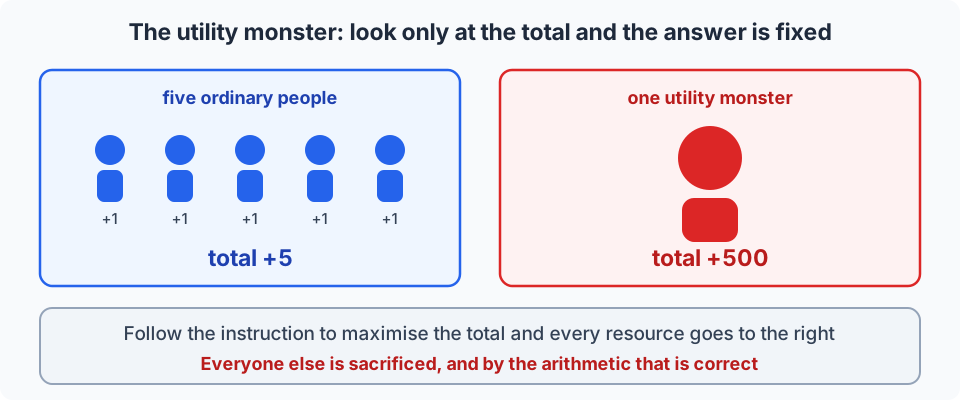
Here is an unusual creature. It gets hundreds of times more satisfaction than an ordinary person from the same food, the same time, the same resources. If eating one cake gives you a pleasure of 1, the same cake gives this creature 500.
Now, following the principle “maximise the total happiness in the world,” how should resources be allocated?
The answer is clear: give everything to the creature. Even if everyone else starves, the total comes out higher. Robert Nozick introduced the odd monster in order to press that conclusion.
A monster born in a short passage
The creature appears in Anarchy, State, and Utopia, published in 1974 (it won that year’s National Book Award). Robert Nozick wrote the book as a response, from the other side, to the influential liberal theory of justice of the day.
The utility monster is presented very briefly: what if there were a being who gains far more utility from other people’s sacrifices than those sacrifices cost them?
Nozick’s conclusion was compact. Utilitarian theory appears to require that all of us be fed into the monster’s mouth.
A few lines of text — and half a century of discussion followed.
The arithmetic gives the order
Follow the calculation.
The basic utilitarian idea is “add up the utility of everyone involved and choose the option with the largest total.” Counting everybody’s happiness as one vote makes it look scrupulously fair.
But the principle asks nothing about who gets it. Only the total matters.
| Allocation | Utility of five ordinary people | Utility of the monster | Total |
|---|---|---|---|
| Share equally among the five | 5 (1 each) | 0 | 5 |
| Give everything to the monster | 0 | 500 | 500 |
Laid out like that the answer is obvious. Follow the instruction to maximise the total faithfully and the lower row is the only choice.
Nor does the monster need to be a noble being. Simply having a vastly larger capacity to feel gives it priority over every resource.
What Nozick was aiming at
The point is not merely that utilitarianism produces a strange result. It is to dig out why it does.
Utilitarianism collects the utilities of several people into one total. That operation amounts to treating the whole world as though it were one giant person.
Within one life the addition and subtraction is natural. Suffer today and gain a great deal next year, and calling it a net gain is fine, because the one who loses and the one who gains are the same person.
Across people living separate lives, that premise does not hold. There is no compensating relation between my going hungry and the monster being full. My loss is not made good by somebody else’s gain.
This point, the separateness of persons, is the weightiest part of the case against utilitarianism. The utility monster is that abstract observation translated into a creature anybody can picture.
”No such being exists” is not an escape
The first objection is “there is no such monster in reality.” True, and not a rebuttal.
What a thought experiment tests is what the principle commands, not whether the situation occurs. If you accept that everyone should be sacrificed were the monster to exist, the principle is defective. Being saved by the monster’s nonexistence is not a defence of the principle.
More serious escape routes have been proposed. In turn:
Diminishing marginal utility. Real creatures gain less and less satisfaction the more they eat, so a monster is biologically impossible. But this is an empirical fact, not a principle. Posit a being without diminishing returns and the problem is back.
Use the average, not the total. Switch to maximising average utility per person. This can make matters worse: a world containing only the monster has an overwhelmingly higher average. The conclusion becomes that removing everyone else raises the average.
Utilities cannot be compared. One may reply that comparing utilities numerically across people is impossible in the first place. Powerful, and expensive: if they cannot be compared, utilitarianism cannot compute at all. You evict the monster by removing the theory’s foundation.
Give priority weights. The common modern amendment is to weight the utility of the worse off. The same increase of 1 counts for more when it goes to someone suffering. Then the monster has no unlimited priority — at the cost of a new problem, namely justifying the weights.
Modern utility monsters
The thought experiment now gets discussed in forms with some reality to them.
One is artificially enlarged capacity to feel. If a mind running on a computer could experience pleasure tens of thousands of times faster than a human, should resources go there? The more faithful you are to totals, the harder that conclusion is to dodge.
The other is comparison across species. When animal welfare is added into the same sum as human welfare, the point that a numerous species’ utility could dominate the total is genuinely debated.
The place to use this thought experiment, I think, is as a warning that a metric looking only at totals will eventually justify some extreme allocation. Push to an extreme case shaped like a monster and properties usually overlooked come into view.
Questions about the utility monster
Is there anything like this in real society?
No monster in the strict sense, but the structure whereby a total-only metric drives an extreme allocation is everywhere.
Look only at a country’s total output and the figure rises even if the gains concentrate in a few hands (which is why per-capita figures look different). Look only at a company’s total revenue and it seems healthy even when dependent on a handful of customers. A total discards the information about distribution. The utility monster is that property blown up to its limit.
Does this refute utilitarianism?
No. The utility monster is a counterexample to naive total-sum views, not an argument that destroys utilitarianism as a whole.
In fact the criticism drove amendments: introducing weights, or shifting the object of evaluation to rules. It has functioned less as an argument that kills a theory than as pressure testing how far the theory can be repaired.
What was Nozick’s own position?
He took individual rights as his starting point. Putting the principle that each person is not a resource available for other people’s purposes at the top, he argued for restricting the role of the state to a minimum.
From that position the monster problem is inevitable. A theory that treats individuals as material for a total will eventually use individuals up as material. For him the monster was a device for showing that consequence in advance.
Related thought experiments
Articles where arithmetic collides with how individuals are treated. Beside the utility monster, the danger in the operation of summing becomes visible.
Summary
This article covered “The Utility Monster.”
Count everybody’s happiness as one equal vote. A principle designed on that basis ends up ordering everything handed to whoever feels most intensely. That reversal is the sharpest thing about the monster.
The cause was collecting several lives into one ledger. Totals discard distributions, and what is discarded surfaces only in extreme situations. So you build an extreme case on purpose and check. As a demonstration of that method, this one is a model.
To return to the full list of thought experiments, follow the link below.
Thank you for reading. We hope to see you in the next article.
Also popular with readers
📚 Series: Famous Thought Experiments (35/60)