Thank you for visiting this site. This article covers “The Drowning Child.”
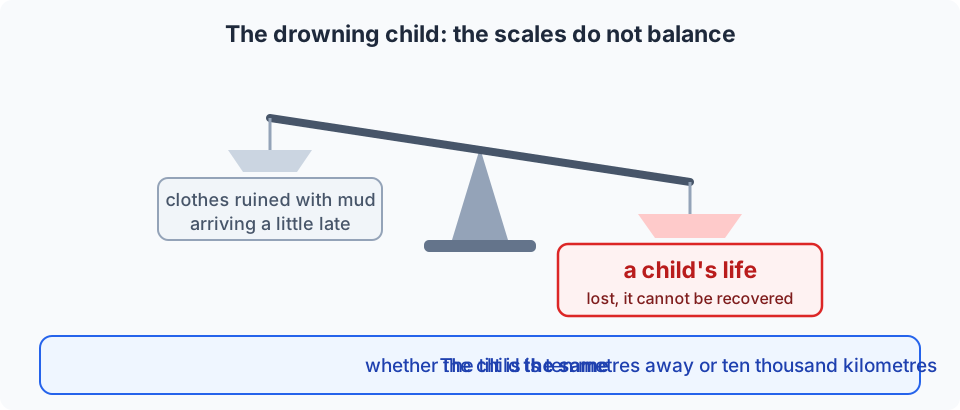
On your way to work you pass a shallow pond where a small child is drowning. The water is knee-deep, so wading in would certainly save them. What you lose is a set of muddy clothes and being a bit late.
Nobody would walk on. In fact, if somebody did walk past, we would condemn them severely. Nothing controversial so far.
The problem starts here. The philosopher Peter Singer asked what happens if you apply the same logic to children dying in distant countries. And he showed that our ordinary lives barely survive the question.
Written during a refugee crisis
The thought experiment appears in a paper published in 1972, “Famine, Affluence, and Morality.” Its author, the Australian philosopher Peter Singer, was then in his twenties.
The background was the large-scale refugee crisis in Bengal in 1971. Millions had been driven from their homes and aid was drastically short. Rich countries could have saved them had they chosen to, and were not giving enough. Singer wanted to know whether that situation could be named not as negligence but as a moral wrong.
Hence the shallow pond. Rather than opening with an abstract argument, he puts down a concrete case everybody answers the same way and extracts the principle from it.
The principle extracted
Singer writes out the judgement we follow in the pond case as a principle.
If it is in our power to prevent something bad from happening, without thereby sacrificing anything of comparable moral importance, we ought, morally, to do it.
Put plainly: if you can prevent great harm at no great cost, you are obliged to. In the pond, muddy clothes do not weigh against a child’s life, so a duty arises.
Almost everybody agrees with the principle itself. It looks modest enough to accept without being a utilitarian. But Singer draws attention to what the principle does not contain.
It contains no condition about distance, and none about who happens to be nearby.
Does distance lighten the duty?
So the first question: does the weight of the duty change depending on whether the person you could save is ten metres away or ten thousand kilometres?
Intuitively it feels as though it does. The child in front of you is not somebody else’s business; the child in a distant country feels less connected to you. Singer points out that no justification for the feeling can be found.
To say distance lightens the duty, you have to claim that the suffering of a nearby person weighs more than that of a distant one. But suffering is the same suffering wherever it happens. And in an age of instant communication and transfers, the practical excuse “they are too far away to help” does not hold either.
So what distance has, on Singer’s reading, is not the power to lighten a duty but only the power to dull our feelings.
”Other people aren’t helping either” does not save you
The second point is the number of bystanders.
Suppose ten other people are standing around the pond and none of them moves. Does that give me a reason not to help? It does not. “Everyone was watching and nobody helped” only multiplies the fault across everyone present; it does not divide the duty among them.
This anticipates the familiar responses about international aid: “other countries aren’t giving enough either,” “it’s the government’s job.” What other people are failing to do is not a reason for you not to do it.
The line between charity and duty dissolves
Third, and most cutting: giving stops being a fine thing to do and becomes a duty to be discharged.
We ordinarily think in these terms.
| Category | Examples | If you don’t |
|---|---|---|
| Duty | Not harming people, keeping promises, paying tax | You are blamed |
| Charity | Donating, volunteering | You are not blamed (praised if you do) |
Accept Singer’s principle and the line cannot be drawn. Passing up a donation that would save a life is structurally the same as walking past the child in the pond. Not giving becomes grounds for blame rather than a mere absence of praise.
Worse, the principle has no brake. The duty continues until the sacrifice reaches “comparable importance,” so in theory you should keep giving until your own standard of living is at the margin.
Can anyone live with this?
Objections came, naturally. The main ones:
It is too demanding. The most common reply. If morality swallows your entire private life, leaving no room for hobbies or time with family, it is an unusable theory. Singer later conceded the point and proposed a realistic level — giving a continuing share of one’s income — that many people can sustain.
It ignores special relationships. We owe more to our own children and parents than to strangers. A theory that cannot account for these special obligations is missing an important part of morality.
Nobody knows whether aid works. Some aid produces corruption or dependency; it is not as certain as pulling a child from a pond. This criticism became the engine that pushed the discussion toward choosing recipients whose effects can be measured.
Not doing is different from doing. Pushing the child in and failing to save them differ in gravity — an objection based on the distinction between acts and omissions. Singer takes the distinction to make no difference in outcomes; most people’s intuitions keep it.
Effective altruism, its descendant
Out of this argument grew the movement called effective altruism.
At its core is the idea of not merely giving out of goodwill but choosing, on the evidence, where the same sum saves more lives. Organisations that compare aid charities numerically were founded, along with pledges to give a set share of income for life. Singer himself pushed the direction in books for general readers.
A case of a thought experiment redirecting actual money. That is the strongest thing about the drowning child, I think. For all the objections, nobody seriously denies the starting point: if you can save someone at no great cost, you should.
Hard questions about the drowning child
Am I morally bad for not giving away everything?
Read Singer’s principle strictly, yes, but few writers — including Singer — push the conclusion through as it stands. The usual view is that duty is continuous, not all-or-nothing.
I think the realistic use of this thought experiment is not as a device for generating guilt but as a yardstick for becoming aware of where you are drawing your line. A line has to be drawn somewhere, but there is a large difference between drawing it unawares and drawing it for reasons.
Why does the hand reach out naturally for the child in front of me?
That is psychology rather than ethics. Human empathy is biased: it works strongly for one identified individual and weakly for a statistical many. People give to a story about one child with a name and a face; rephrase the same content as “millions per year” and the response drops, as has been confirmed repeatedly.
What Singer’s argument presses is that the bias is a separate thing from moral correctness. The person your hand reaches for is not necessarily the right person.
Is the pond really the same structure as real aid?
This is where objectors put most of their weight. In the pond you are the only helper, the action leads directly to the result, and it is over in one go. Real aid is uncertain on all three counts.
That said, it does not follow that you need not help. If uncertain effectiveness is the problem, the answer is to look for recipients whose effect is certain. Effective altruism was born by following exactly that route.
Related thought experiments
Ethical thought experiments about how far moral obligations extend, each staging a collision between intuition and principle from a different angle.


Summary
This article covered “The Drowning Child.”
Nobody walks past a child they could save at the cost of a muddy suit. From that one point of universal agreement, Singer runs straight through to the conclusion that distance, the number of bystanders, and the boundary between charity and duty all lack moral grounding. Objections can be mounted, but bringing down the starting point is not easy.
As a thought experiment that leaves you unsettled afterwards, it is thoroughly ill-mannered. But that unsettledness is exactly the material for checking how much you take to be your own responsibility. It is a question worth carrying around without answering.
To return to the full list of thought experiments, follow the link below.
Thank you for reading. We hope to see you in the next article.

Also popular with readers
📚 Series: Famous Thought Experiments (33/60)