Thank you for visiting this site. This article covers “The Survival Lottery.”
Pick one healthy person, kill them, and save two people with their organs. Institute that scheme and the number of deaths certainly falls. And virtually nobody agrees to it.
The problem is that every attempt to put the objection into words gets counterattacked. When the philosopher John Harris proposed the scheme in 1975, it was not in order to win support (the paper is called, straightforwardly, “The Survival Lottery”). It was a challenge, demanding that the other side explain why it is better for two people to die.
A world where transplantation works perfectly
The staging first. Harris assumes a society in which transplant technology is complete. Rejection and infection are solved; a transplant saves the patient with certainty.
In it are two patients, call them Y and Z. Y needs a heart, Z needs a lung. Without transplants both will certainly die.
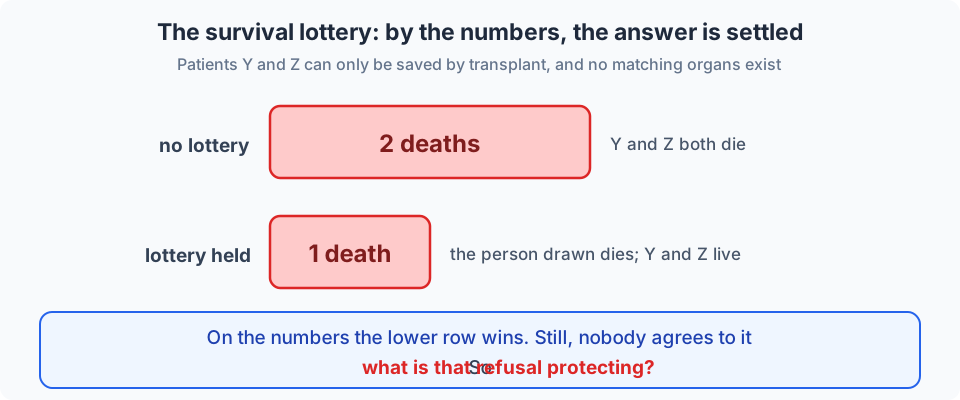
But no matching organs appear. Waiting for accidents and illnesses to supply them comes nowhere near the numbers needed. Two people who could be saved die purely because organs are scarce.
Even with today’s medicine this is no fantasy; people do die waiting. What is distinctive about Harris’s setup is that it strips out every technical uncertainty and leaves only the question of where the organs come from.
The lottery proposed
Harris proposes the following scheme.
- Every healthy citizen is assigned a number in advance
- Whenever two or more patients appear who can be saved only by transplant, a computer draws a lot (designed so that nobody’s will enters into it)
- The person drawn is summoned to hospital and killed for their organs
- Two or more patients are saved with them
Look coolly at the numbers and the scheme is coherent. Without the lottery, two die; with it, one. One life saved on the balance.
It even has a claim to fairness. Nobody selects any particular person, and everyone faces the same probability. You can even argue that the lottery smooths out the existing unfairness whereby the naturally healthy gain and the sick lose.
Still nobody agrees. Nor do I. The question is whether the refusal can be given reasons.
Is killing different from letting die?
The first thing refusers reach for is the distinction: “killing the person drawn is murder, whereas Y and Z dying is the course of nature.” Acting is different from standing by.
Harris aims squarely at that distinction. His reply:
From Y and Z’s side, a doctor who had the means to save them and did not use it has killed them. Whether a hand was laid on anyone is a fact about the killer’s situation; to the person dying it makes no difference.
He also blocks the objection that “we would be playing God.” Run the lottery and you have chosen one person; refuse it and you have chosen to let Y and Z die. Both are choices; there is no neutral place called doing nothing.
That two-stage move is what gives the survival lottery its edge. You know intuitively that it is wrong, and every reason you offer gets pushed back at you.
The objections Harris lists himself
Harris enumerates objections too. The weightiest of them:
Living in fear. In a society running the scheme, everyone lives without knowing when their number will come up. A loss that cannot be measured in lives saved. Harris himself treats this as the strongest objection (he was posing a question, not selling a policy).
Trust in medicine collapses. If hospitals become places where people are killed, people stop going. More lives may be lost than the scheme was meant to save.
Drawing the line becomes a swamp. Should people who damaged their own organs through their habits be excluded from the draw? Exclude them and you must decide how far self-responsibility extends. Include them and the careful lose out. The scheme advertised as a fair lottery trips over the definition of fairness.
Doctors become killers. A profession that exists to heal takes on the practical work of killing. The framework of professional ethics itself breaks.
Each objection is persuasive, but note something. Every one of them has the form “the consequences would be worse on balance.” That is, they fight on the terrain of the utilitarian calculation. Run the scheme in a way that produced neither fear nor mistrust, and this whole line of objection stops working.
Answers that do not enter the calculation
So positions arise that answer from another terrain: some things must not be entered into the calculation at all.
| Line of reply | What it claims |
|---|---|
| Do not treat people merely as means | The person drawn is used as material for saving others; doing so without consent denies their personhood |
| Rights are trumps against majorities | The right to life cannot be overridden however great the gains from violating it |
| Agent-relative constraints | Morality demands “I must not kill,” not “minimise the total number of killings” |
| The separateness of persons | Offsetting one person’s loss with another’s gain wrongly merges several lives into one ledger |
I find the last, the separateness of persons, especially important. Within a single life, trading present discomfort against future benefit is natural. But there is no reason to perform the same addition and subtraction across people living separate lives. To the person drawn, two others surviving is no compensation for their own death.
Its distance from the trolley problem
The survival lottery is often placed next to the trolley problem, both having the shape “sacrifice one to save five?”
There is a difference. In the lever version of the trolley problem, most people say you should pull. In the version where you push a large man off a bridge, the answer flips. Same one-against-five, and the judgement changes according to whether a person is used directly as a tool.
The survival lottery has the shape of the second. The person drawn is not incidentally caught up; they are selected for the purpose of extracting organs. Being institutionalised makes it look colder still.
So the survival lottery takes the kink in our intuitions found in the trolley problem and blows it up to the scale of a social institution.
Questions about the survival lottery
Did Harris seriously advocate this?
No. His paper was written to test whether opponents of utilitarianism can state their own position properly. The aim was not to sell a scheme but to make people put their refusal into words.
In that sense the survival lottery is not a thought experiment that produces an answer but one that demands an objection. The strong refusal readers feel is the raw material, and the real work is excavating the principle that supports it.
How does it differ from real organ donation systems?
Decisively, in whether killing is involved. Real systems handle donation from people who have died, or living donation with consent. The survival lottery kills living people as a matter of policy, which makes it a fundamentally different thing.
Schemes treating people who have not registered a preference as donors do get debated, but those concern the dead and do not take organs from the living. Conflating the two distorts the debate about real policy.
If intuition refuses strongly, can that be the reason?
Ethicists disagree. Some dismiss intuition as mere feeling; others hold that intuitions formed over long stretches of time carry unarticulated wisdom.
My own view is to use intuition not as the final answer but as an entrance for digging into why you feel that way. Dig into the refusal of the survival lottery and clear principles come out — the handling of rights and of persons. Do not stop at the feeling; get that far and you have an argument.
Related thought experiments
Ethical thought experiments weighing one sacrifice against many rescues. Beside the survival lottery, the line where judgements flip becomes visible.
Summary
This article covered “The Survival Lottery.”
Count the dead and the lottery comes out ahead. Nobody accepts it anyway. The value of the thought experiment lies in refusing to leave that gap alone and making you articulate the refusal to the end.
Where the articulation lands is usually one point: people are not entities to be added and subtracted as numbers. It sounds obvious. Holding on to the obvious while designing institutions is much harder than it sounds.
To return to the full list of thought experiments, follow the link below.
Thank you for reading. We hope to see you in the next article.
Also popular with readers
📚 Series: Famous Thought Experiments (34/60)