Thank you for visiting this site. This article covers “The Happy Slave.”
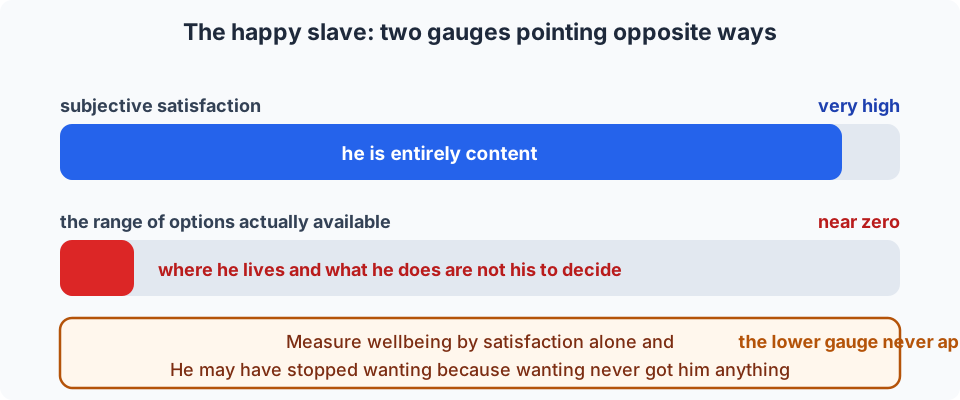
A person lives as somebody else’s property. Where he goes, what work he does, whom he lives with — none of it is his to decide. And he is entirely content with his situation. He knows no other way of living, has never imagined one, and passes his days calmly.
Measure his subjective wellbeing and his score would come out fairly high.
So is his a good life?
Most people feel it is not. But if happiness just is being satisfied, that intuition cannot be explained. Excavating what lies behind the sense that something is missing despite the satisfaction is the job of this thought experiment.
This is not an account of what historical slavery was actually like. It is an artificial setup with extreme conditions, built to think about how happiness is measured.
How happiness gets defined
First, the positions this thought experiment targets.
There are broadly three accounts of what happiness is.
| Position | Happiness is |
|---|---|
| Hedonism | Having many pleasant experiences and few painful ones |
| Desire satisfaction | Getting what you want |
| Objective list | Having certain goods: knowledge, friendship, autonomy, health |
The first two have the merit of letting happiness be judged from inside the person. There is no arrogance of scoring somebody else’s life from outside; the person’s own sense of things is respected.
The happy slave collides head-on with both. He passes his days pleasantly and gets what he wants. By the first two criteria, he is happy.
Why did he stop wanting?
The thing to notice is that he wants nothing. Not wanting freedom, he feels no dissatisfaction at lacking it.
So why did he stop wanting? One possibility: going on wanting what you cannot have is painful, so he stopped wanting.
The phenomenon is called adaptive preference. The fable of the fox looking up at grapes he cannot reach and walking off declaring them sour gives it another name (Aesop’s sour grapes).
Adaptation itself is one of our better traits. Where a situation cannot be changed, accepting it and staying calm is easier to live with than nursing permanent frustration.
The problem is that the adaptation raises the person’s satisfaction score. Which can produce a reversal in which the harsher the situation, the more adaptation occurs and the better the satisfaction figures look.
What satisfaction hides
Amartya Sen pressed this point from the side of economics.
He argued strongly against measuring how people live by utility or satisfaction. The reason is plain: people kept in deprivation for a long time lower the level of their expectations in order to survive.
Somebody who has learned to find joy in small mercies registers as satisfied on the questionnaire. A satisfaction metric systematically understates the situation of the worst off.
So Sen proposed a different measure (the capability approach). Not what the person feels but what they are actually able to do and to be — the range of options open to them.
Look at the happy slave that way and the verdict flips. His satisfaction may be high, but the range of what he can do is close to zero. Movement, occupation, company — none of it is chosen. What was missing was not satisfaction but options.
The dissatisfied Socrates
The same intuition was voiced much earlier. John Stuart Mill, who systematised utilitarianism, wrote:
It is better to be a human being dissatisfied than a pig satisfied; better to be Socrates dissatisfied than a fool satisfied.
Mill argued for recognising differences in the quality of pleasures, not only their quantity. His test: whichever is preferred by those who have experienced both is the higher pleasure.
The position has costs. It gives up the simplicity of measuring by quantity alone. Bring in quality and you need an external standard for judging it, which takes you outside hedonism.
But that is exactly the problem the happy slave presses. Concede that quantity of satisfaction is not enough and you have to say what to add.
”Mind your own business”
There is a strong objection: is it not arrogant for outsiders to declare somebody unhappy when they are satisfied?
The criticism cannot be brushed aside. History supplies no shortage of cases where “it’s for your own good” served as a tool for justifying intervention, with an objective standard of happiness produced as grounds for overriding people’s wishes.
Defenders reply: what is at issue is not denying the person’s choice but the removal of their options. Put them in a position to choose, and if they choose their present life, that deserves respect. Being satisfied while unable to choose is a different matter.
The reply matches Sen’s approach. What is being pressed on people is not a particular way of living but the range within which they can choose.
How to read satisfaction surveys
Abstract as it looks, the thought experiment bears directly on how real numbers should be read.
Workplace satisfaction surveys, regional wellbeing indices, user questionnaires — all quantify subjective states. A high number does not necessarily mean the situation is good.
Lower the level of expectation and the same situation scores higher. Without knowledge of alternatives there is nothing to compare against. In a group that has learned that voicing complaints changes nothing, complaints stop being voiced.
When I look at such figures I try to check “do these people have other options?” alongside them. Put satisfaction and range of options side by side and things appear that neither shows alone.
Questions about the happy slave
If he is satisfied, isn’t that enough?
That position is coherent, and hedonists accept the conclusion: happiness is the quality of a person’s experience, not their external circumstances.
Hold the line, though, and you take on other consequences. For instance, administering a drug that produces satisfaction would raise happiness without improving anything. Whether you can nod at that conclusion is where the positions part.
Does it apply to us?
Differently in degree, identically in structure. Growing used to not being able to choose, and so ceasing to want, happens all over ordinary life.
Believing you cannot change jobs and so ceasing to feel dissatisfied; learning that your views go nowhere and so ceasing to have views. Subjectively these are calm states. Being calm and being in a good state are different things — a perspective you can apply to yourself.
Does having more options make you happy?
Not necessarily. Too many options makes deciding harder and can lower satisfaction. It is not a matter of the wider the better.
Sen’s argument does not say maximise the number of options either. What it asks is whether the level of options needed for a recognisably human life is secured. Treat it as being about a floor rather than a ceiling and the argument becomes much easier to use.
Related thought experiments
Articles on what happiness is and how to measure it. Beside the happy slave, you can see why subjective satisfaction is not enough.



Summary
This article covered “The Happy Slave.”
Satisfied, and yet not living a good life. Dig into the discomfort and it emerges that by “happiness” we had been pointing at more than satisfaction: being able to choose, knowing what is possible, deciding for yourself. None of that shows up in a satisfaction score.
And the awkward part is the reversal: the worse the situation, the lower the expectations, and the higher the satisfaction can go. When you see a number, stop once to consider what the number is throwing away. That is where this thought experiment earns its keep.
To return to the full list of thought experiments, follow the link below.
Thank you for reading. We hope to see you in the next article.

Also popular with readers
📚 Series: Famous Thought Experiments (37/60)